Two traffic officers thought they had pulled over just another young woman on a quiet country road. They were wrong. What they pulled out of her pocket didn’t just silence them — it ended their careers.
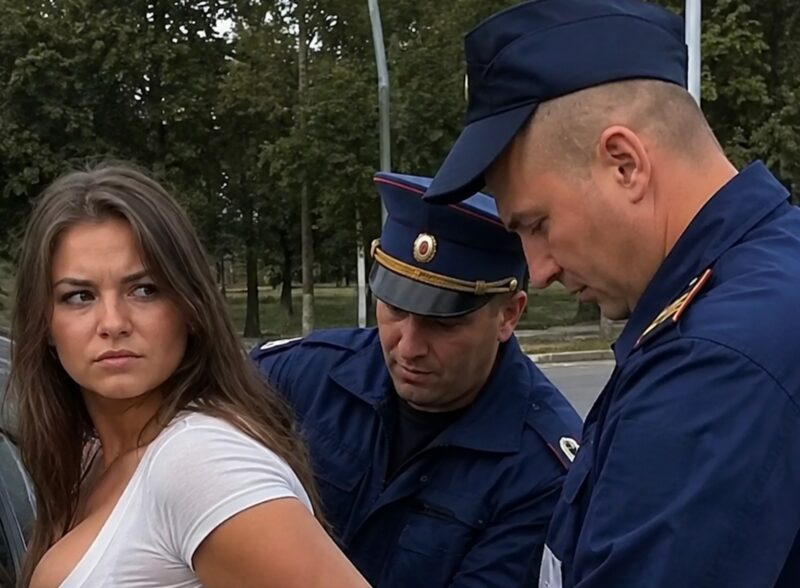
Victoria was driving home on a calm, peaceful afternoon. The highway was nearly empty, the weather was pleasant, and she had absolutely no reason to expect anything unusual. She was obeying every traffic law, staying within the speed limit, and paying careful attention to the road ahead. It was, by every measure, an ordinary drive.
Then a patrol car appeared in her rearview mirror. The officers switched on their flashing lights and motioned for her to pull over. Victoria immediately complied. She turned off the engine, rolled down her window, and waited. She had done nothing wrong and had nothing to hide.
A tall, broad-shouldered officer with a cold expression approached the driver’s side door. His partner hung back slightly, watching her through the window with an air of quiet intimidation. Neither man introduced himself. Neither explained why she had been stopped.
“License and registration,” the first officer said flatly.
Victoria handed over her documents without argument. The officer examined them for what felt like a very long time. He inspected the vehicle. He looked her over. And then — despite finding absolutely nothing wrong — he made no move to return her paperwork.
“Why did you stop me?” Victoria asked calmly.
“Routine check,” he replied.
“What kind of routine check? I haven’t broken any laws, and you haven’t even identified yourselves.”
The officer’s expression darkened. It was clear he wasn’t used to a young woman standing her ground and asking the right questions. His partner stepped forward, smirking.
“Think you’re pretty smart, huh? Sit still while we’re still being nice to you.”
Victoria looked steadily from one man to the other. She didn’t raise her voice. She didn’t panic. She simply continued to speak calmly and directly.
“I am speaking calmly. You are the ones behaving rudely and stopping me without explaining why. Please identify yourselves and provide a legal reason for this stop.”
The first officer, visibly angry now, threw her documents onto the roof of her car.
“Get out of the vehicle.”
“On what grounds?”
“I said, get out.”
Victoria recognized what was happening. These men were deliberately trying to intimidate her. She reached for her phone to begin recording. That’s when the second officer yanked open her door and grabbed her by the arm.
“Put that phone away — now.”
“Don’t touch me,” she said firmly. “You are abusing your authority.”
Those words pushed them completely over the edge. The first officer pulled her from the car, forced her against the vehicle door, and the second officer wrenched her hands behind her back and snapped a pair of handcuffs around her wrists.
“You’ll spend some time at the station,” the second officer said coldly. “Maybe then you’ll learn some manners.”
Victoria didn’t scream. She didn’t struggle. She simply looked back over her shoulder at both men with a calm, measured expression.
“Are you sure you want to continue?”
“You trying to scare us?” the first officer laughed.
“No. I’m warning you. You have detained me without cause, used physical force without justification, and failed to complete a single piece of required paperwork.”
“We’ll deal with that later,” he said dismissively. “Right now, you’re coming with us.”
Victoria paused for just a moment before speaking again, her voice quiet and steady.
“Fine. But first — reach into the right pocket of my shorts. My hands are behind my back. I can’t do it myself.”
The officers exchanged a look. One of them smirked, convinced she was playing some kind of trick.
“What’s in there?”
“Take it out and see for yourselves.”
The first officer slipped his hand into her pocket and pulled out a small leather case. He opened it casually, expecting nothing of significance. A split second later, the smirk on his face was completely gone.
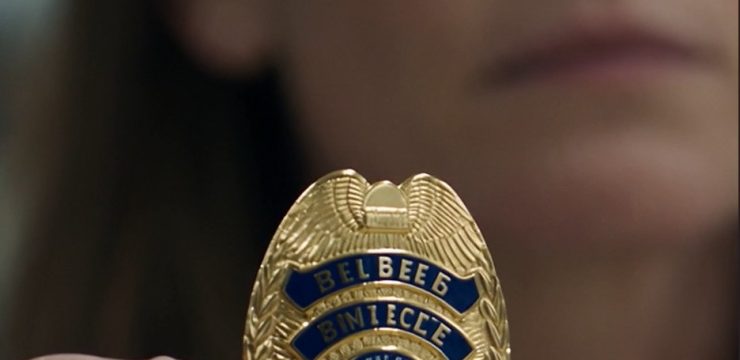
Inside the case was an official badge and an identification card bearing Victoria’s photograph, her name, her rank, and the name of her agency. She was an officer with the Internal Affairs Division — the very department responsible for investigating misconduct and complaints filed against police officers.
She had been returning from a professional meeting and driving her personal car, which was why the officers had assumed she was simply a civilian with no connections and no recourse. They had badly miscalculated.
The second officer grabbed the identification from his partner and read it himself. His hands were visibly shaking.
“Why didn’t you say something sooner?” he asked, his voice barely above a whisper.
“Because I wanted to see exactly how you treat ordinary people,” Victoria replied. “Now I have my answer.”
The handcuffs came off immediately. Both men began scrambling to explain themselves, insisting it had all been a misunderstanding, that she had refused to follow lawful orders, that she had provoked the entire situation. Their excuses came fast and desperate.
What they didn’t know was that Victoria’s dashboard camera had been recording both video and audio from the very beginning of the stop. And when the second officer had grabbed her phone from her hand, it had automatically uploaded the footage directly to cloud storage before he even realized what had happened.
The commanding officer of the district arrived shortly after and reviewed the full recording. It was unmistakably clear — no traffic violation, no resistance, no provocation. Just a young woman asking legitimate questions and being met with aggression.
Both officers were ordered to surrender their badges and service weapons on the spot.
The investigation that followed was swift. One officer was dismissed from the force entirely for unlawful detention and excessive use of force. The second was demoted for his role in the incident and for failing to intervene when his partner crossed the line.
Sometimes, the person you least expect to challenge you is exactly the one who has the power to hold you accountable. Victoria didn’t raise her voice. She didn’t beg. She simply knew her rights — and she documented every moment. That was more than enough.