He had been sitting on that sidewalk for longer than he could explain to anyone — not even to himself.
There was no dramatic reason for it. No scene, no breakdown in the usual sense. Just a man in an expensive coat sitting on cold concrete, staring at nothing, feeling the particular kind of emptiness that money builds around you so quietly you don’t notice until one day you’re hollow all the way through and the city keeps moving and you don’t.
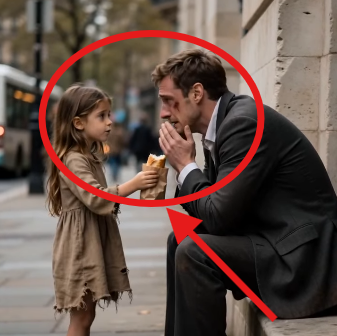
He wasn’t crying. Not yet.
He was just sitting.
And then the little girl appeared.
She couldn’t have been more than six or seven years old. Barefoot on the pavement. A thin cotton dress, worn soft from too many washings. Her hair pulled back simply, the way mothers do when there isn’t much time in the morning. She was carrying a small piece of bread — the kind you tear off and share without thinking, the kind that comes from a table where there’s never quite enough but somehow always something to give.
She stopped in front of him.
She didn’t hesitate the way children usually do around strangers. She just looked at him with those wide, steady eyes and held out half of what she had.
He stared at her small hand.
He couldn’t remember the last time someone had offered him something without wanting anything back.
He took it.
And then, because the bread was warm and her eyes were kind and something about the moment broke straight through every wall he’d built over the years, he started to cry. Not loudly. Not dramatically. Just the quiet kind of crying that happens when you’ve held something too long and your arms finally give out.
The little girl watched him without fear. Without judgment. Like she had been told exactly what this moment would look like.
He wiped his face and looked at her properly for the first time.
And that was when he made himself ask her name.
For one long second, the whole sidewalk disappeared. Not the traffic, not the footsteps, not the city. Only the child. And the answer he was suddenly afraid to hear.
She told him her name.
And the world tilted.
Because it was the same name. The exact same name he and the woman he had loved had whispered together in a tiny apartment over cheap soup and impossible hope — the name they had chosen for the baby they never got to raise together.
He looked at the shape of her mouth. The line of her brow. The quiet way she held herself, like her mother had taught her that dignity didn’t require anything expensive.
And the impossible began to feel real.
He had wanted to give up everything for that woman once. She was stubborn and warm and too honest for the world he came from. When she became pregnant, he had promised to protect them both. But then his father arrived with lawyers and threats and the kind of money that makes people disappear from your life with no explanation. He was told she had accepted a settlement and left. Told she wanted nothing more to do with him. Told the baby was gone.
He had believed it because they made disbelief too costly.
Now a barefoot little girl stood before him carrying the same quiet mercy her mother had always carried in her hands.
His voice came out rough.
“Where is your mother?”
The little girl looked down at the other half of the bread in her hand. Then back up at him.
“She’s sick.”
A pause. The kind that holds everything.
“She told me to stay near this building because one day a sad man would sit here. And if he cried when I shared my bread — ” she looked at him with those steady eyes — “he was my father.”
That finished him.
Completely and quietly, right there on the sidewalk.
Because he understood now what her mother had done. She hadn’t sent the child with a letter. No photograph. No test. She had sent her with kindness — because kindness was the one thing his family had never been able to counterfeit convincingly enough to fool her.
He looked at the little girl’s bare feet. The faint dust on her legs. The dress worn almost thin at the shoulders. And grief shifted inside him, changed shape into something heavier and more specific.
Not just grief for a love that had been taken apart by other people’s decisions.
Grief for the years. The ordinary, irreplaceable, vanished years.
She had been alive all this time. His daughter had been alive all this time. Growing up, learning to walk, learning to share what little she had with strangers on the street. And he had spent those same years becoming the man his father had wanted him to be, while the two people he should have been protecting learned how to survive without him.
The little girl touched his sleeve gently.
“Mom said not to be scared if you looked surprised.”
Then, almost softly:
“She said you weren’t bad. Just late.”
That line was almost worse than any accusation could have been.
Because an accusation would have given him something to push back against. Anger would have let him defend himself. Explain himself. Point to his own wounds.
But mercy — the plain, unhurried mercy of she said you weren’t bad — left him with nowhere to hide. Nowhere to go except forward.
He stood, then dropped to one knee in front of her so they were eye to eye.
“Take me to her,” he said.
And the little girl, still holding half a piece of bread she had never finished, nodded slowly — like she had always known that would be his answer, if he turned out to be the man her mother had remembered him as.
She reached up and took his hand.
And for the first time in longer than he could name, a man who had everything walked forward into the one thing he had been missing — not knowing whether he would be forgiven, only knowing he had finally, finally shown up.