The words landed harder than any command ever had.
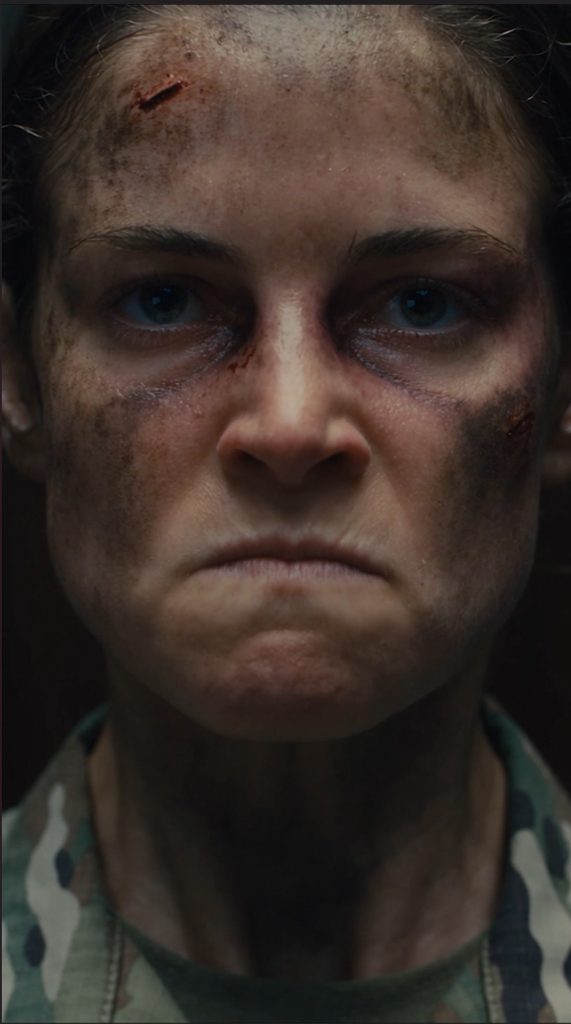
“Don’t make your brother look bad today.”
For half a second, the enormous military hall seemed to disappear around Emily. The rows of uniforms. The polished medals. The flags hanging motionless beneath the lights. All she could hear was her mother’s voice behind her—quiet enough to avoid attention, sharp enough to reopen a wound that had never really healed.
Major Emily Carter didn’t turn around.
She stood perfectly straight in the center aisle, white gloves resting against the seams of her uniform, her expression unreadable.
Ahead of her, another ribbon was being placed in her brother’s hands.
Applause spread politely through the hall.
Their mother stepped forward before anyone could stop her, smiling with a warmth Emily had spent most of her life trying to earn. She took the ribbon herself and pinned it carefully to her son’s chest.
Her fingers lingered there.
Proud. Tender. Certain.
“Now that’s what an officer is supposed to look like,” she said.
A few people nearby smiled.
Emily’s jaw tightened almost imperceptibly.
She had learned years ago how to stand still when something hurt.
Her brother turned after the ceremony official stepped away. For a moment, he basked in the approving glances around him. Then his eyes found Emily.
He crossed toward her.
There was pride in his face, but something else too—a trace of curiosity.
“Mom says you’re getting transferred,” he murmured, making sure no one else could hear.
Emily finally looked at him.
Her expression gave him nothing.
“She has no idea why I’m here.”
His smile faltered.
Before he could ask what she meant, a sharp click echoed from the front of the room.
The microphone had been switched on.
Conversations vanished instantly.
Hundreds of officers turned toward the podium.
The voice that followed was calm, formal, practiced—the kind of voice trained to make every word sound deliberate.
“There is one officer whose identity has remained confidential until this morning.”
Something shifted in the hall.
Emily’s brother slowly looked back toward the podium.
Their mother stopped adjusting his ribbon.
The official paused.
Then came the name.
“Major Emily Carter.”
Silence.
Not polite silence.
Not ceremonial silence.
The kind that seemed to pull the air out of the room.
Emily’s mother went completely still.
The proud smile she had worn only seconds earlier disappeared from her face. Color drained slowly from her cheeks as she stared toward her daughter, as though she were seeing the uniform for the first time.
Her brother’s eyes widened.
He looked from the podium to Emily, then back again.
The certainty in his face began to crack.
Emily, meanwhile, remained seated.
Her gloved hands rested neatly in her lap. Her breathing stayed measured. She lifted her gaze slightly toward the ceiling, almost as if this moment had been approaching for far longer than anyone else in the hall could possibly understand.
The microphone came alive again.
This time the official’s voice was quieter.
Somehow, that made the words heavier.
“Please stand.”
Chairs scraped against the floor.
One after another, hundreds of officers rose.
Then all at once.
The sound rolled through the hall like distant thunder.
Emily remained seated for one more heartbeat.
Her mother stared at her.
Her brother whispered, “Emily?”
She stood.
And suddenly the entire room seemed to understand something her family had not.
Emily Carter was not there because she was being transferred.
She was not there to watch her brother receive another ribbon.
And she was certainly not the officer everyone had been expected to overlook.
Her mother took one uncertain step toward her.
Her brother said her name again, softer now, like a question he was afraid to finish.
Emily looked at neither of them.
She faced forward toward the flag, toward the podium, toward the hall that had never expected her to be at the center of anything.
Then the official lowered his eyes to the sealed document waiting in front of him.
His hand moved toward the microphone.
And Emily’s mother seemed to realize, one second too late, that whatever he was about to say would change everything she thought she knew about her daughter.
Nobody in that hall was prepared for what came next. 👇
The official unfolded the document.
The paper made a small, dry sound that seemed impossibly loud in the silence.
“By order of the Department of Defense,” he began, “Major Emily Carter is recognized for extraordinary command under classified operational conditions, during which her decisions directly resulted in the safe recovery of twenty-three service members and civilian personnel.”
Emily’s mother covered her mouth.
Her brother did not move.
The citation continued. It spoke of a broken extraction route, communications failure, incoming fire, and an officer who had refused evacuation until the last vehicle crossed the perimeter. It described decisions made in seconds that had kept people alive for years afterward.
Then came the words no one in Emily’s family had expected.
“Effective immediately, Major Carter is promoted to lieutenant colonel and assigned command of the newly formed Joint Recovery Group.”
A breath moved through the hall.
Emily closed her eyes once.
Not from surprise. From the weight of finally hearing aloud what had existed for months behind sealed doors and signatures she had not been permitted to explain.
Her mother stepped into the aisle.
“Emily…”
The name came out differently now. Almost like a plea.
Emily turned her head.
“Why didn’t you tell me?” her mother whispered.
Something passed across Emily’s face—small, but unmistakable.
“You never asked what I was doing,” she said. “You only told me what I wasn’t.”
Her mother flinched.
Before she could answer, the official lifted one hand.
“There is an additional matter.”
Emily’s brother looked toward the podium.
“The ribbon presented earlier this morning was approved on a recommendation submitted from the classified command authority attached to the same operation.”
His fingers rose instinctively to the ribbon on his chest.
“That recommendation was written and signed by Lieutenant Colonel-select Carter.”
He slowly looked at Emily.
“You recommended me?”
Emily nodded once.
“You did your job when people needed you. You deserved to have that recognized.”
His mouth opened, but nothing came.
Their mother looked between them, searching for somewhere to stand inside a moment that no longer belonged to her.
“I only wanted both of you to succeed,” she said.
Her son looked at her.
“Then why did it always have to be one of us?”
She stiffened.
“That’s not fair.”
“No,” he said quietly. “It wasn’t.”
He glanced at Emily, shame pulling his eyes downward.
“You made every good thing that happened to me feel like proof that something was wrong with her.”
“I was trying to motivate—”
“You were keeping score,” Emily said.
Silence.
Her mother had no quick answer this time.
Emily stepped closer.
“I spent years thinking if I worked harder, stayed quieter, achieved more, eventually you would look at me the way you looked at him five minutes ago.”
Her voice stayed steady.
“That was the mistake.”
Her mother’s face crumpled.
Emily’s brother reached toward her, then stopped before touching her arm.
Emily noticed the hesitation.
It mattered.
The official waited at the podium.
Finally, Emily faced forward.
“I’m ready, sir.”
When the new rank insignia was brought forward, Emily’s mother instinctively stepped toward it.
Emily raised one hand.
Her mother stopped.
Emily looked at her brother.
“Will you do it?”
He stared at her.
“Me?”
“You.”
His hands shook as he removed the old insignia from her shoulder. He fumbled with the fastening, and Emily almost smiled.
“Still terrible with these,” she murmured.
A broken laugh escaped him.
He secured the new insignia and stepped back.
When the hall applauded, he looked only at his sister.
Outside, afternoon light turned the stone steps pale gold.
Emily stood near the edge of the courtyard with her cap beneath one arm when her brother approached alone.
For several seconds, neither spoke.
Then he said, “I believed her.”
Emily looked toward the flag above the building.
“I know.”
“I liked being the one she was proud of.”
That admission cost him something.
“And I knew you were paying for it,” he continued. “Maybe not all of it. But enough.”
Emily met his eyes.
He did not ask her to make him feel better.
“I can’t fix that today,” she said.
“I know.”
“I’m not sure what fixing it looks like.”
“Then don’t fix it. Just let me stop making it worse.”
Emily studied him, then held out her hand.
He took it.
It was not forgiveness.
But it was a beginning.
Their mother found Emily before sunset, sitting alone on a bench beneath the long shadow of the administration building.
When Emily stopped several feet away, her mother did not ask her to come closer.
“I embarrassed you,” her mother said.
Emily shook her head.
“You hurt me.”
Her mother looked down.
“Yes.”
No defense followed.
The silence lasted.
“I don’t know how to undo years,” her mother said finally.
“You don’t.”
Her eyes lifted.
“You stop asking me to pretend they didn’t happen.”
Her mother nodded.
“And then?”
“Then you change what happens next.”
That became the boundary.
There was no instant reconciliation. Her mother called without comparing. She listened without correcting. She apologized without adding excuses.
Her brother did something harder.
He stopped accepting praise that required Emily to be diminished.
The old machinery of their family began to fail because neither child would turn its gears anymore.
Months later, Emily stood in another military hall.
Smaller this time. Warmer.
Sunlight came through high windows as members of her new command filled the seats. Her brother arrived early, and their mother sat quietly in the second row.
Before the ceremony began, the official who had presided over Emily’s promotion approached her brother with a thin envelope.
“There’s something you were never told,” he said.
Emily saw her brother read the paper inside.
Then he looked at her.
His face went completely still.
He crossed the room and handed her the original schedule from that first ceremony.
Beside his ribbon presentation was a handwritten instruction.
Present this recognition before my identity is announced. He earned his moment. Let it belong to him.
Emily’s signature sat beneath the note.
Her brother stared at her.
“You planned it that way.”
Emily folded the paper carefully.
“I didn’t want my announcement to swallow yours.”
His eyes filled.
Their mother’s warning from that morning came back with brutal clarity.
Don’t make your brother look bad today.
And now he understood.
Emily had entered that hall knowing everyone would eventually rise for her, and her first concern had been making sure her brother was allowed to stand in his own light first.
He pulled her into his arms.
Emily went rigid for half a heartbeat.
Then her shoulders loosened.
Across the room, their mother covered her mouth.
She did not approach.
For once, she let the moment belong to them.
Later, the three of them walked outside together.
Not perfectly.
Not as if nothing had happened.
But without anyone walking ahead.
The evening was cool, and the sky above the base had turned the soft blue that comes just before night.
At the bottom of the steps, their mother stopped.
“I’m proud of you,” she told Emily.
Emily held her gaze.
Her mother swallowed.
“Not because of the rank.”
Emily’s expression shifted.
“Because you could have used your power to make other people feel small, and you didn’t.”
Emily looked away for a moment.
When she looked back, the hardness in her face had eased.
“Thank you.”
It was not absolution.
It was something more honest.
Her brother slipped his hands into his pockets.
“So,” he said carefully, “dinner?”
Emily raised an eyebrow.
“Only if nobody talks about medals.”
He smiled.
“Deal.”
They walked toward the parking lot as the building lights came on behind them one by one.
Emily’s new insignia caught the last of the sunset, but she did not notice.
Her mother was beside her.
Her brother was on the other side.
And for the first time in longer than she could remember, no one was asking her to shrink so someone else could shine.
They reached the car together, still talking softly beneath the evening sky, and Emily realized that home was no longer the place where she had learned to disappear.
It was the place they were finally learning how to see one another.