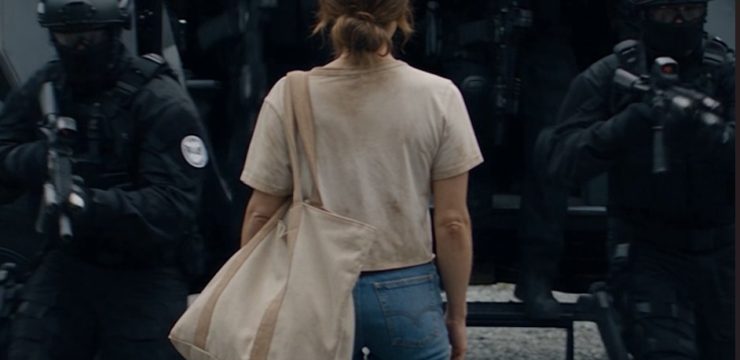
The room went silent before anyone understood why. A mother’s proud smile vanished in seconds, a brother’s confidence cracked beside her, and hundreds of decorated officers slowly turned toward the woman everyone had barely noticed.
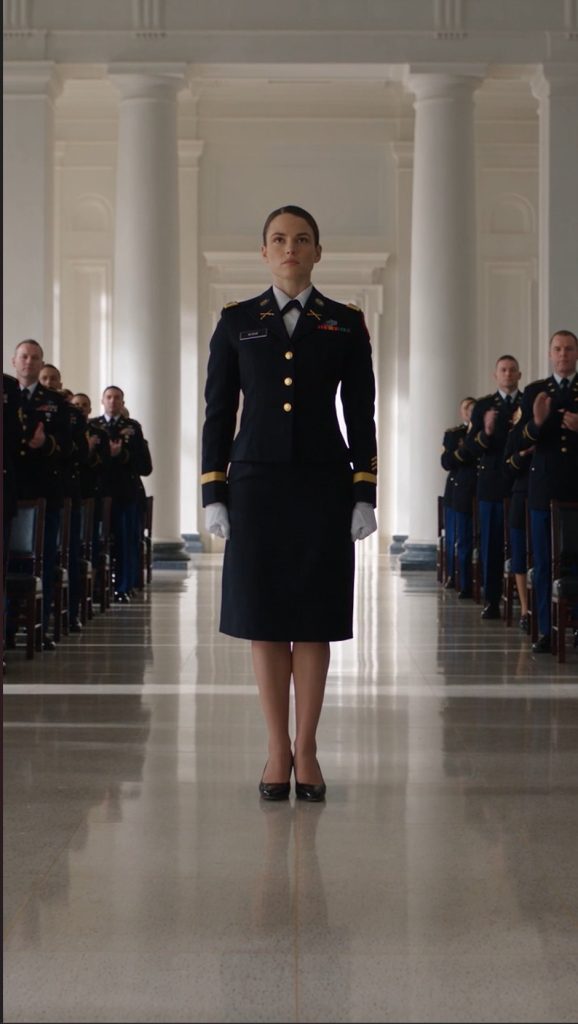
Something had just changed.
The grand hall seemed to hold its breath beneath the bright ceremonial lights. Rows of dress uniforms stretched toward the polished stage, gold buttons catching the glow, medals resting against rigid chests while conversations stayed low and careful.
Major Emily Carter sat near the center aisle, perfectly composed.
Her white gloves rested neatly in her lap. Her shoulders were straight, her expression unreadable, but the tension in her jaw betrayed what she refused to show anywhere else.
Behind her, her mother leaned forward.
“Don’t make your brother look bad today.”
The words were quiet enough that no one nearby seemed to notice.
Emily did.
For half a second, her fingers pressed together inside the gloves. Then they relaxed.
She didn’t turn around.
At the podium, her brother stood beneath the flags as another ribbon was announced. Applause moved through the hall, restrained but warm, and their mother was already rising from her seat before the presenter had finished speaking.
She walked toward him glowing with pride.
It was a look Emily knew well.
Not because she had received it.
Because she had spent years watching it belong to someone else.
Their mother pinned the ribbon carefully onto her son’s uniform, smoothing the fabric afterward as though the moment itself deserved to be perfect. Her fingertips lingered briefly against his chest.
Then she smiled.
“Now that’s what an officer is supposed to look like.”
A few people nearby murmured their approval.
Emily kept her eyes forward.
She had learned long ago that silence could protect more than pride. Sometimes it protected information. Sometimes it protected people.
And sometimes it was simply easier than explaining yourself to someone who had already decided who you were.
Her brother stepped away from the stage a short while later. The new ribbon seemed to add another inch to his posture.
When he noticed Emily, his expression shifted.
He approached casually, stopping beside her row before leaning close enough that their mother couldn’t hear.
“Mom says you’re getting transferred.”
Emily finally looked at him.
There was no anger in her face. No satisfaction either.
Only a strange calm that unsettled him more than either would have.
“She has no idea why I’m here.”
His eyebrows drew together.
Before he could answer, a sharp burst of static came from the speakers.
The room settled immediately.
A microphone had been switched on.
The voice that followed was formal, controlled, and carried the kind of authority that made hundreds of trained officers straighten without being told.
“There is one officer whose identity has remained confidential until this morning.”
Emily’s brother stopped breathing for a moment.
Across the hall, heads began to turn.
Her mother glanced toward the stage, still wearing the faint trace of her earlier smile, but something uncertain had entered her eyes.
The announcer paused.
It lasted only a second.
It felt much longer.
“Major Emily Carter.”
The silence afterward was absolute.
Her mother froze.
Not subtly. Not gracefully.
The smile disappeared from her face as if someone had physically wiped it away. The color began draining from her cheeks while her eyes searched the room and landed on her daughter.
Emily’s brother stared at her.
The pride he had been carrying moments earlier shifted into confusion, then disbelief.
Emily remained seated.
Her hands stayed folded.
Her gaze lifted slightly toward the ceiling, and for the first time there was something almost weary in her expression—as if she had imagined this moment too many times to feel surprised by it now.
The microphone came alive again.
This time the voice was quieter.
Somehow, that made it heavier.
“Please stand.”
Chairs scraped against the floor.
Hundreds of officers rose at once.
Emily stayed seated for one brief heartbeat longer.
Then she stood.
Her mother took a small step forward.
Her brother whispered her name.
“Emily…?”
She didn’t look at either of them.
Because by then, everyone in the hall understood one thing.
She was not the officer being transferred.
She was the reason the ceremony had been arranged.
Emily faced the flag, waiting in the unbearable silence for the next order.
And nobody in that room was prepared for what came next. 👇
A side door beside the stage opened.
An older general entered carrying a narrow black case beneath one arm. He moved without ceremony, but the officers nearest the aisle stiffened as soon as they recognized him. Even Emily’s brother instinctively straightened.
The general stopped at the microphone.
“For the last eighteen months, Major Carter has served under classified operational authority.”
Emily’s mother made a small sound behind her.
The general continued.
“Her assignment required that her location, responsibilities, and commendations remain restricted. That restriction ended at 0800 this morning.”
He opened the black case.
Inside lay a decoration.
Emily’s brother stared at it, then at his sister. His mouth parted, but nothing came out.
The general’s voice hardened.
“Major Carter repeatedly refused public recognition while members of her team remained unable to receive theirs. She requested that no ceremony be held until every surviving member and every family of the fallen had been formally notified.”
That changed the room.
The applause everyone had expected did not come.
Instead there was silence of a different kind.
Emily lowered her eyes.
The general looked directly at her.
“Major, front and center.”
She stepped into the aisle.
One foot. Then another.
Her mother reached for her sleeve as she passed.
“Emily.”
Emily stopped.
Every instinct told her to keep walking.
Then her mother whispered, “Why didn’t you tell me?”
Emily turned.
For years, she had imagined answering that question with anger. She had imagined listing every comparison, every dismissed achievement, every family dinner spent listening to her brother’s career while nobody asked about hers.
But standing there, she found she had no appetite for revenge.
“You never asked.”
Her mother’s hand fell.
Emily walked on.
She had almost reached the stage when another voice broke across the hall.
“General, this ceremony needs to stop.”
Emily froze.
Her brother did too.
A colonel near the front row had risen from his seat. Colonel Richard Vale was silver-haired, immaculate, and suddenly very pale.
The general regarded him without surprise.
“Sit down, Colonel.”
Vale didn’t.
“This commendation is based on an incomplete operational record.”
Emily slowly turned.
There it was.
The thing she had feared more than the ceremony itself.
Vale looked toward her, and beneath the authority in his expression she saw panic.
“Major Carter violated direct command during that operation.”
Whispers moved through the hall.
Emily’s mother stared between them.
The general closed the medal case.
“Major Carter,” he said, “you have a choice. We can clear the room and proceed privately.”
Emily understood what he was offering.
Protection.
For eighteen months she had protected the mission, the survivors, the dead, even the institution that had allowed Vale to remain decorated while an investigation unfolded behind sealed doors.
She looked at the rows of officers.
Then at her brother.
Finally at her mother.
“No, sir.”
Her voice carried farther than she expected.
“If the accusation is public, the answer should be public too.”
Vale’s face tightened.
The general nodded once.
A screen behind the podium illuminated.
A date appeared.
Then an operational log.
Vale went still.
Emily’s brother leaned forward as lines of communication records appeared one after another. Orders. Time stamps. Coordinates. Repeated warnings from Emily’s unit that civilians and wounded personnel remained inside the evacuation zone.
Then Vale’s command appeared on the screen.
Withdraw immediately.
The general spoke quietly.
“Major Carter did disobey that order.”
Emily’s mother covered her mouth.
Vale exhaled as if he had been handed a weapon.
But the general wasn’t finished.
“The investigation determined Colonel Vale had received verified intelligence twelve minutes earlier confirming that withdrawal would abandon seventeen personnel and nine civilians.”
No one moved.
“He withheld that intelligence.”
Vale’s confidence disappeared.
Emily watched his fingers curl against the back of the chair in front of him.
“That is not what happened.”
The general pressed a control.
A recording filled the hall.
Vale’s own voice.
Cold. Impatient. Unmistakable.
Then another voice—Emily’s.
“Sir, they’re still in there.”
“Withdraw, Major.”
“I have wounded personnel who cannot move without assistance.”
“You have your order.”
A pause crackled through the recording.
Then Emily’s voice came again.
“If I follow it, people die.”
Vale’s recorded answer landed in the hall like a stone.
“That is no longer your responsibility.”
The recording ended.
Nobody seemed to breathe.
Emily’s brother slowly removed his hand from the ribbon their mother had pinned to him minutes earlier.
The general looked toward Vale.
“Major Carter remained.”
Images replaced the communications log. Rescue manifests. Medical reports. Statements from surviving officers.
“She organized an unauthorized extraction and brought twenty-three people out alive.”
Vale shook his head.
“She compromised the entire operation.”
“No,” Emily said.
It was the first time she had addressed him.
Vale looked at her.
Emily’s hands were trembling now, but she did not hide them.
“You compromised them.”
Something in Vale’s face broke.
“You think this uniform survives because everyone gets to make moral decisions in the field?”
Emily stepped closer.
“No. I think it survives because someone has to remember why we wear it.”
Vale stared at her.
Then Emily’s brother moved.
He stepped into the aisle and positioned himself beside his sister.
Their mother looked at him in shock.
He swallowed hard.
“I submitted a statement too.”
Emily turned sharply.
She hadn’t known.
Her brother’s eyes were wet.
“Three months ago,” he said. “Investigators asked whether Colonel Vale had ever pressured officers to alter after-action reports.”
Vale’s face emptied.
Emily’s brother looked at him.
“I told them the truth.”
Two military police officers entered through the side doors.
Vale glanced around the hall, perhaps searching for an ally, perhaps finally understanding there were none left.
His insignia still caught the ceremonial lights.
For another few seconds, he looked exactly like the powerful man he had been when the morning began.
Then the officers stopped beside him.
“Colonel Vale, you are relieved of command pending final disposition of charges.”
Vale did not resist.
That somehow made the moment heavier.
He removed his cap.
As he was escorted down the aisle, nobody spoke.
Emily watched until the doors closed behind him.
The silence afterward felt enormous.
Not triumphant.
Just final.
Her brother stood beside her, staring at the floor.
“I knew something was wrong,” he said quietly. “Not everything. But enough to know you weren’t just being transferred.”
Emily looked at him.
“Why didn’t you tell Mom?”
A humorless breath escaped him.
“Maybe for the same reason you didn’t.”
Their mother flinched.
Neither child had meant the words for her.
That made them hurt more.
She approached slowly.
For once, there was no correction waiting in her expression. No comparison.
She stopped in front of Emily.
“I thought you were shutting me out.”
Emily’s jaw tightened.
“I stopped trying to get in.”
Her mother’s eyes lowered.
The hall, the uniforms, the watching officers—all of it seemed to disappear around the three of them.
“I made you compete for something a mother should have given freely,” she whispered.
Emily said nothing.
Her mother looked toward her son.
“And I made you believe being praised meant you had to keep proving you deserved it.”
His face changed.
He looked away quickly.
Their mother’s voice cracked.
“I hurt both of you differently.”
Emily’s throat tightened.
“I can’t make you forgive me.”
“No,” Emily said softly. “You can’t.”
Her mother nodded.
For the first time, she accepted an answer she could not control.
The general waited.
Emily finally turned back toward the stage.
When she reached him, he opened the black case again.
“This decoration,” he said, “recognizes extraordinary courage under circumstances most people in this room will never fully know.”
Emily looked at the medal.
Then she looked beyond it.
In the front row, several people had risen.
A man with a cane.
A woman with a scar crossing one side of her forehead.
Another officer whose left sleeve was pinned neatly above the elbow.
Emily stopped breathing.
Members of her team.
The survivors.
She had been told they would not attend.
The woman with the scar smiled through tears.
“You really thought we’d let you do this alone?”
Emily’s composure finally cracked.
Her mouth trembled.
She looked down, pressing her lips together, but the tears came anyway.
Then came the final surprise.
The general stepped aside.
Emily’s brother was holding the medal.
She stared at him.
He shook his head almost imperceptibly.
“I asked,” he whispered.
Her mother’s ribbon ceremony flashed through Emily’s mind—the careful hands, the proud smile, the sentence that had followed.
Now her brother stood before her with none of that certainty left.
Only love.
“May I?”
Emily closed her eyes for one second.
Then nodded.
His fingers shook as he fastened the decoration to her uniform.
When he finished, he didn’t step away immediately.
“I spent half my life thinking I was ahead of you,” he whispered.
Emily looked at him.
“You weren’t behind me either.”
He gave a broken little laugh.
That was when the applause began.
Not polite applause.
Not ceremonial applause.
The survivors started it.
Then the officers joined them.
Within seconds, the hall was on its feet again.
Emily looked toward her mother.
She wasn’t clapping at first.
She was crying.
Then slowly, almost awkwardly, she brought her hands together.
Emily held her gaze.
Nothing was repaired in that instant.
But something had finally stopped breaking.
Months later, Vale was convicted on charges arising from falsified operational reporting, obstruction, and the orders that had endangered the evacuation. His rank, his command, and the authority he had used to silence others were gone.
Emily never attended the sentencing.
She was home when the decision came.
Her brother was in the kitchen burning dinner.
Their mother was setting three plates on the table.
She had started coming over on Sundays, but only when invited.
Some weeks Emily invited her.
Some weeks she didn’t.
Her mother never complained.
That mattered.
The first few dinners were difficult. Their conversations kept catching on old wounds.
Then, slowly, they stopped performing.
Her brother admitted how terrified he had always been of disappointing their mother.
Their mother admitted she had mistaken pressure for preparation and favoritism for encouragement.
Emily did not forgive everything at once.
Nobody asked her to.
Healing arrived in smaller forms.
A cup of coffee left beside her without a question.
Her brother calling after a nightmare and saying nothing except, “You awake?”
Her mother learning to ask, “Do you want to talk about it?” instead of demanding an explanation.
Then, nearly a year after the ceremony, Emily received a package.
There was no official seal.
Inside was a photograph.
It had been taken during the evacuation.
Emily stood in the center, filthy and exhausted, supporting a wounded officer with one arm while pointing toward an approaching aircraft with the other.
On the back were twenty-three signatures.
Beneath them was one sentence.
You stayed.
Emily sat at her kitchen table for a long time.
Her mother arrived first.
Then her brother.
Neither asked why she was crying.
Emily simply handed them the photograph.
Her brother read the signatures and lowered himself into the chair beside her.
Their mother remained standing.
Her fingertips touched the edge of the photograph but did not take it.
“I spent years waiting for you to become someone I could be proud of,” she whispered.
Emily looked up.
Her mother’s eyes filled.
“And all that time, you were waiting for me to see who you already were.”
Emily’s face crumpled.
Her mother did not reach for her.
Not until Emily reached first.
Then the distance between them disappeared.
Her brother wrapped his arms around both of them, and for several minutes the three of them stayed there in the quiet kitchen while rain tapped softly against the windows and dinner cooled untouched on the stove.
Later, Emily framed the photograph.
She did not hang it beside the medal.
The medal went into a drawer.
The photograph went in the hallway.
Years afterward, when visitors asked why, Emily would smile.
Because the medal remembered what she had done.
The photograph remembered why.
And on Sunday evenings, when the house filled with the sound of her brother arguing about dinner and her mother laughing from the kitchen, Emily sometimes stopped beneath that photograph without anyone noticing.
She would touch two fingers lightly to the frame.
Then she would walk toward their voices.
Not toward applause.
Not toward a ceremony.
Not toward anyone’s approval.
Just home.