The judge ordered the courtroom doors closed, then asked for my eight-year-old daughter. Across the aisle, my husband’s confident smile vanished. Whatever Lily had captured in the photographs she had given the court, he was suddenly terrified of it being exposed.
Only moments earlier, Jason Carter had looked like a man celebrating a victory.
I stood seven months pregnant inside a Tennessee family courtroom, prepared to surrender almost everything we had spent ten years building.
Our house. Both cars. Every piece of furniture. Our savings. Nearly $480,000 in marital assets.
I wanted none of it anymore. I wanted my daughter, Lily, my unborn son to be safe, and a chance to leave without being afraid.
My attorney, Rachel Kim, had warned me that the settlement was financially devastating. She was right. But after living in a beautiful house where I constantly felt unsafe, even a mattress on an empty apartment floor sounded like freedom.
Jason sat across from me wearing the charcoal suit I’d bought him for our tenth anniversary.
Behind him sat Vanessa Reed, his mistress of nearly a year. Her manicured fingers covered her mouth, barely concealing a satisfied smile.
Judge Eleanor Whitman studied the divorce agreement.
“Mrs. Carter, do you understand you’re voluntarily surrendering approximately four hundred and eighty thousand dollars in marital assets without compensation?”
“Yes, Your Honor.”
My unborn son pressed against my ribs. I rested one hand over my stomach, trying to steady my breathing.
Jason leaned toward his attorney, Mark Talbot, and whispered something. Both men glanced at me.
Talbot immediately stood.
“My client is prepared to accept Mrs. Carter’s generous offer.”
Vanessa smiled openly now. I wondered whether she’d already imagined herself living in my house, sleeping in my bedroom, surrounded by everything I was leaving behind.
But Judge Whitman wasn’t finished.
“And what exactly are you requesting in return, Mrs. Carter?”
I swallowed.
“Primary custody of Lily. Supervised visitation until the court completes its review. Permission to relocate within the county. And an order preventing Jason or Ms. Reed from contacting me except through our attorneys.”
The courtroom grew quiet.
Those requests revealed what the financial agreement concealed. I wasn’t being generous.
I was trying to escape.
Jason shook his head.
“She’s being dramatic.”
That word made my stomach tighten.
Dramatic.
He’d used it whenever money disappeared. Whenever objects were moved and he insisted I’d misplaced them. Whenever Vanessa’s name appeared on restaurant receipts from evenings he claimed to be working.
Now he was using it in front of a judge.
Talbot stood again, explaining that Jason intended to seek joint custody of Lily and shared parental rights after our son was born.
“There is no evidence suggesting Mr. Carter poses any danger to either child.”
Judge Whitman stopped reading.
Slowly, she removed her glasses.
“Ms. Kim, has the guardian ad litem submitted the supplemental report I requested this morning?”
“Yes, Your Honor.”
Rachel handed a sealed envelope to the bailiff.
Jason frowned. Vanessa straightened in her seat. Neither looked particularly comfortable anymore.
The envelope reached the bench.
Judge Whitman opened it and began reading.
One paragraph.
Then another.
Before finishing the page, she lifted her eyes toward Jason.
She said nothing.
Something changed in his expression. His jaw tightened, and his fingers curled against his chair.
The judge turned toward the court officer.
“Close the courtroom doors. Please bring Lily Carter in with Ms. Monroe.”
Vanessa leaned toward Jason.
“What did she tell them?”
He didn’t answer.
I stared at the man who had spent years making me question my own judgment.
For the first time, I saw genuine fear in his eyes.
Not fear of me.
Not fear of Rachel.
Not even fear of the judge.
He was afraid of our eight-year-old daughter.
And somewhere beyond those closed courtroom doors, Lily was carrying something her father desperately wished she had never found.
The door was about to open. 👇
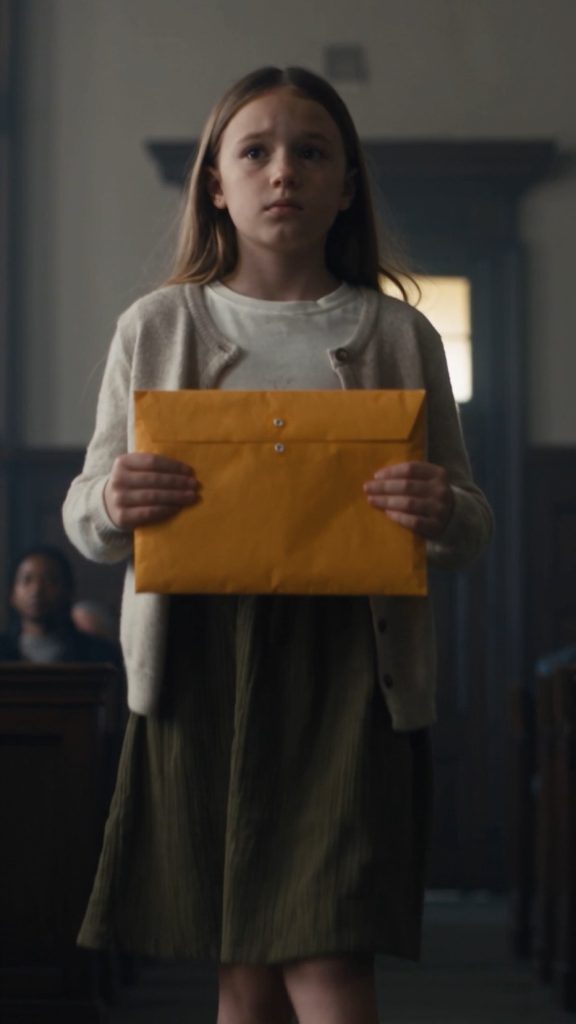
The metal latch clicked, and my daughter stepped into the courtroom clutching a faded blue folder against her chest.
Her hair was braided unevenly, the way it always looked when she insisted on doing it herself. Beside her walked Ms. Monroe, the guardian ad litem appointed to protect Lily’s interests.
Lily spotted me immediately.
“Mommy?”
Every instinct in my body told me to run toward her.
But Judge Whitman gently raised her hand.
“Mrs. Carter, please remain seated for a moment.”
Lily’s eyes moved toward Jason.
Her footsteps stopped.
It was such a small movement that someone who didn’t know my daughter might have missed it. But I knew the difference between Lily being shy and Lily being frightened.
She moved closer to Ms. Monroe.
Judge Whitman’s expression softened.
“Lily, sweetheart, you’re not in trouble. Do you understand that?”
Lily nodded without looking up.
“Can Mommy stay?”
“Of course.”
The judge explained that Lily had already spoken privately with Ms. Monroe and that the court would rely primarily on the photographs and supplemental report rather than making her repeat painful details.
Then she asked one question.
“Did someone tell you to take these pictures?”
Lily’s fingers tightened around the folder.
“Daddy did.”
Jason shifted sharply.
“That’s not what happened.”
“Mr. Carter,” the judge said, “you will remain silent.”
Lily swallowed.
“He gave me his old phone. He said Mommy was forgetting things and getting confused. He wanted me to take pictures when she made mistakes.”
I couldn’t move.
My daughter’s voice became smaller.
“But sometimes Daddy was the one moving things.”
She opened the folder.
The first photograph showed our kitchen counter. My car keys were beside a red coffee mug.
The next showed Jason holding those same keys beside the garage door.
A third photograph showed them tucked behind a toolbox.
I remembered that morning.
I’d searched for nearly an hour while Jason stood watching me, shaking his head.
He’d told me pregnancy was making me forgetful.
Eventually, I’d believed him.
Lily turned another photograph over.
This one showed Vanessa standing in our bedroom with my handbag open on the dresser.
I remembered the afternoon my wedding ring disappeared.
Jason had accused me of carelessness.
I’d found it two days later inside a winter boot I hadn’t worn in months.
Vanessa’s face drained of color.
“That’s completely out of context,” she whispered.
Judge Whitman looked toward her.
“Ms. Reed, you are not a party to this proceeding. Do not interrupt.”
But the photographs weren’t finished.
Ms. Monroe placed another image before the judge.
I recognized our kitchen immediately.
Jason stood near the refrigerator, gripping my wrist while I leaned away from him.
My other hand rested protectively over my pregnant stomach.
The picture had been taken from the hallway.
From Lily’s height.
The memory returned so sharply that I felt the cold refrigerator handle against my back.
That evening, I’d confronted Jason about another unexplained withdrawal from our savings.
He’d blocked the doorway when I tried to leave.
I had told him he was hurting me.
He’d laughed.
And somewhere behind us, our daughter had been watching.
“Why didn’t you tell me?” I whispered.
Lily’s eyes filled.
“Because Daddy said nobody would believe you.”
The room seemed to tilt.
For months, I’d wondered whether I was becoming the unstable woman Jason described.
Now I understood that my little girl had been collecting proof that I wasn’t.
Judge Whitman called a brief recess and instructed Ms. Monroe to take Lily into the adjoining room.
As Lily passed my chair, I reached for her hand.
She stopped long enough to whisper, “I didn’t want you to get in trouble.”
I pressed her fingers against my cheek.
“You didn’t do anything wrong, baby.”
After she left, Rachel opened another section of the supplemental report.
The photographs had led Ms. Monroe to request a closer examination of financial documents Jason had submitted.
One image showed papers spread across our dining table.
A loan application.
My name.
My signature.
Except I had never signed it.
Rachel placed a copy beside my actual signature from an earlier document.
The difference was unmistakable to me.
Jason suddenly leaned forward.
“Emma knew about that loan.”
“No,” I said.
My voice was barely audible.
Then I looked directly at him.
“I didn’t.”
Vanessa stared at the paperwork.
“Jason, you told me she agreed.”
He turned toward her.
“Don’t start.”
Those two words carried the same warning I’d heard hundreds of times.
Only this time, I wasn’t alone.
Judge Whitman ordered the disputed agreement set aside pending further proceedings. She granted temporary primary custody of Lily to me, restricted Jason’s contact to supervised visits, and issued temporary protective conditions while the allegations were investigated.
She also ordered the preservation and disclosure of financial records.
Jason’s attorney stopped whispering to him.
For the first time, Mark Talbot appeared to be reading documents his own client had never fully explained.
When the hearing ended, Jason stood.
“Emma, you’re destroying this family.”
I looked at him across the space that had separated us all morning.
“No, Jason.”
My hands were shaking, but my voice held.
“I’ve been trying to save what’s left of it.”
He opened his mouth.
Nothing came out.
Outside, rain tapped against the courthouse windows.
Rachel walked beside me while Ms. Monroe brought Lily from the adjoining room.
My daughter hurried straight into my arms.
I held her carefully against my stomach, feeling my unborn son move between us.
For several seconds, none of us spoke.
Then Lily whispered, “Do we have to go back to the house?”
I kissed her hair.
“Not today.”
She pulled back slightly.
“Can we go somewhere Daddy doesn’t know?”
Rachel crouched beside us.
“We’ve already arranged somewhere safe.”
I looked at her.
She gave me a small, tired smile.
“I told you we had options, Emma. You just needed the chance to see them.”
The months that followed were not easy.
There were interviews, financial examinations, additional hearings, and mornings when I woke convinced Jason would somehow make everyone doubt me again.
But each time fear returned, Rachel reminded me of what had changed.
There were records now.
Independent witnesses.
Evidence that couldn’t be dismissed simply because Jason spoke with confidence.
The financial investigation eventually uncovered unauthorized transactions and a loan taken out using my forged signature. Some of the missing money had been transferred into accounts connected to Jason’s plans with Vanessa.
Vanessa’s relationship with him collapsed as investigators examined the transfers and her involvement.
She never contacted me directly again.
Her attorney eventually provided financial records that helped establish where the money had gone.
Jason fought the custody findings until his own documents contradicted his sworn statements.
At the final divorce hearing, Judge Whitman awarded me primary custody of Lily and confirmed strict restrictions on Jason’s contact until he could satisfy the court’s safety requirements.
She also approved a financial judgment that rejected the settlement I’d once been desperate enough to sign.
Separate criminal proceedings followed over the forged documents.
Jason ultimately entered a guilty plea and was ordered to pay restitution as part of his sentence.
The consequences weren’t as dramatic as the moment his smile had disappeared in court.
They arrived quietly, through signed orders, financial records, and decisions he could no longer manipulate.
When Rachel called to tell me the last major legal matter had been resolved, I was standing beside the window of our apartment.
Lily was sitting on the carpet, coloring.
My son slept in a bassinet nearby.
I looked around at the secondhand sofa, the mismatched dishes, and the tiny kitchen where sunlight gathered every afternoon.
Then I began to cry.
Rachel waited on the telephone.
“Emma?”
I wiped my face.
“I’m okay.”
And for the first time in years, I meant it.
My son had been born six weeks earlier.
We named him Noah.
The night he arrived, Lily sat beside my hospital bed and watched his tiny fingers curl around hers.
“Is he going to be scared too?” she asked.
The question nearly broke me.
I brushed a loose strand of hair behind her ear.
“I hope not, sweetheart.”
She looked down at her brother.
“What if someone hurts him?”
“Then the grown-ups will protect him.”
Lily studied my face.
“You promise?”
I took her hand.
“I promise. And you don’t have to be the grown-up anymore.”
Her chin trembled.
Then she leaned against my shoulder and cried with the exhausted relief of a child who had carried something far too heavy.
Healing didn’t happen all at once.
Lily sometimes asked whether doors were locked.
She became anxious when someone raised their voice.
We found a counselor she liked, a woman who kept colored pencils beside her chair and never made Lily answer questions before she was ready.
Slowly, my daughter began laughing without checking the room first.
She invited friends over.
She complained about homework.
She left her shoes in the hallway and forgot where she’d put her favorite sweater.
Ordinary childhood things.
Things I had once been afraid she would never get to enjoy again.
One Saturday afternoon, several months after the divorce became final, Lily appeared in the living room holding that same blue folder.
I recognized it immediately.
My chest tightened.
“Sweetheart, you don’t need to look at those pictures anymore.”
“I know.”
She sat beside me.
“But these are different.”
Inside were photographs I’d never seen.
There was one of me asleep on the sofa while Lily rested against my shoulder.
Another showed us making pancakes, flour scattered across the kitchen counter.
A third captured me kneeling beside her bicycle, trying to straighten a crooked training wheel.
There were dozens.
Tiny moments I’d forgotten.
Moments that had survived inside the same phone Jason had given her to document my supposed failures.
I turned another page.
It showed our old living room on a rainy afternoon.
Lily was curled against me beneath a blanket, laughing at something outside the frame.
I couldn’t remember who had taken that picture.
“Lily,” I whispered, “why did you keep all these?”
She looked surprised.
“Because Daddy kept saying you were a bad mommy.”
My throat closed.
She touched one of the photographs.
“And I knew he was wrong.”
I pressed my hand over my mouth.
Lily turned to the final picture.
It showed our new apartment shortly after we’d moved in.
There was almost no furniture.
Just a mattress on the floor, two suitcases, and sunlight spilling across the carpet.
In the middle of the photograph, I was sitting with Lily in my lap, both of us laughing.
I’d forgotten that afternoon.
We’d been eating peanut butter sandwiches on paper plates because I couldn’t find the box containing our dishes.
I remembered thinking that I had failed her.
That I’d taken her away from the beautiful home she’d known and given her almost nothing.
But Lily had photographed that moment too.
Beneath the picture, in careful eight-year-old handwriting, she’d written three words.
Our First Home.
I stared at them.
“Lily, sweetheart, we had a home before.”
She shook her head gently.
“That was Daddy’s house.”
Then she pointed at the photograph.
“This one is ours.”
I pulled her against me.
For a long time, we sat together on that secondhand sofa while Noah slept nearby and the afternoon light moved slowly across the floor.
I had once stood in a courtroom willing to surrender nearly half a million dollars because I thought safety meant escaping with nothing.
But my daughter had understood something I hadn’t.
The things Jason could take were never the things that made us a family.
That evening, Rachel came over for dinner, and Ms. Monroe stopped by briefly with a small gift for Noah.
Lily proudly showed them the photograph album.
Rachel studied the final page and blinked several times before speaking.
“That’s a beautiful home, Lily.”
My daughter grinned.
“I know.”
Later, after our guests had gone, I tucked Lily into bed.
“Mommy?”
“Yes, baby?”
“Are you still scared sometimes?”
I considered pretending otherwise.
Instead, I sat on the edge of her mattress.
“Sometimes.”
She nodded thoughtfully.
“Me too.”
I took her hand.
“But we’re safe here. And when we feel scared, we can talk about it.”
She squeezed my fingers.
“Okay.”
Then she rolled onto her side, pulled her blanket beneath her chin, and closed her eyes.
No more questions.
No listening for footsteps.
No waiting for an argument to begin.
Just sleep.
I stood in the doorway for a moment, watching her breathe.
Then I crossed the hall to Noah’s room.
He stirred when I touched his tiny hand, his fingers wrapping instinctively around mine.
Through the window, the last light of the evening settled over the quiet street.
Our apartment wasn’t large.
The furniture didn’t match.
There were still bills to pay and ordinary difficulties ahead.
But my children were sleeping peacefully under the same roof, and for the first time in a very long while, I wasn’t waiting for something terrible to happen.
Before going to bed, I placed Lily’s photograph of our first afternoon in the apartment on the little shelf beside the front door.
In the picture, we had almost nothing.
Yet we were laughing.
I turned off the light, listened to the soft sounds of my children breathing in their rooms, and finally understood why Lily had called that empty apartment our first home.
It was the first place where none of us had to be afraid to be happy.