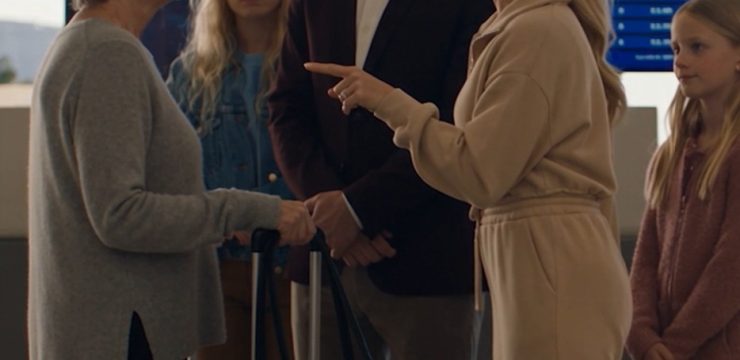
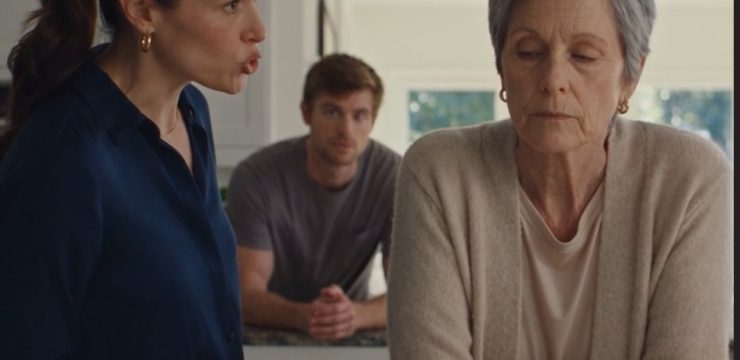
The dress wasn’t hers, and she knew I could see it the moment she stepped into the aisle. Beneath the church lights, every embroidered rose looked painfully familiar. Then, as she reached my pew, she leaned toward me and whispered, “Now everyone will remember me instead of you.”
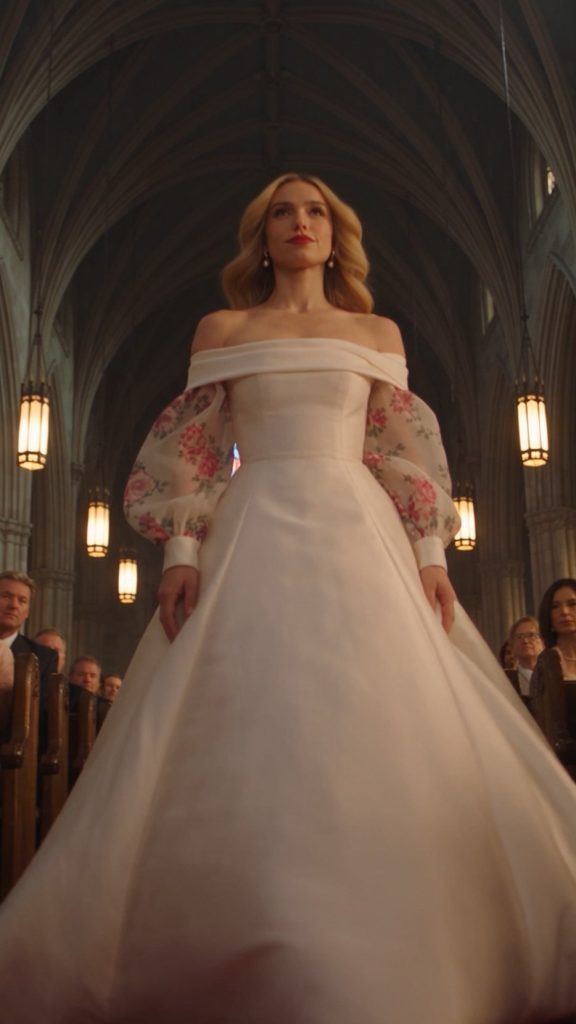
I didn’t move. My hands remained in my lap, fingers pressed together hard enough to ache. My sister straightened and kept walking, her smile unbroken, as though she’d only stopped to share a tender moment with me.
Around us, two hundred guests watched Chloe make her way toward the altar. They saw a beautiful bride in a beautiful gown. I saw the last thing my grandmother and I had ever created together.
Before Grandma died, we’d designed that dress side by side. Each rose had begun as a sketch, its petals altered and refined until it looked exactly the way we’d imagined. Her initials were stitched inside the hem in pale blue thread, a quiet piece of her that would have been close to me when I wore it.
Chloe knew all of that. She knew what the roses meant, why I’d kept every detail exactly as we’d planned it, and how much of Grandma I still carried in the thought of wearing that gown. She had taken it anyway.
Three days before the wedding, the designer had shown me the security footage. I remembered watching the screen, hoping I’d misunderstood what I was seeing, until the unmistakable image of my sister made hope feel ridiculous.
Chloe had collected the dress with a copy of my driver’s license. She’d given a false assistant’s name, then asked if the ownership paperwork could be changed because, as she’d put it, “the bride had changed.”
The designer’s explanation was calm and precise. That somehow made it worse. Every step had been deliberate, down to the last question about whose name belonged on a dress that had never been hers.
I took what I’d learned to my mother. I thought the proof might finally be enough to make her understand that this wasn’t a disagreement between sisters, or something I could simply let go.
Instead, she told me Chloe needed the dress for only one day. “You have time to find another dress,” she said. Then came the familiar words, delivered with the weary certainty she’d used whenever Chloe went too far: “You’ve always been the reasonable one.”
For a moment, I couldn’t speak. Another dress. As though I could walk into a shop and replace the hours Grandma and I had spent bent over sketches, or the pale blue initials hidden in the hem.
I gave Chloe one chance to return it. I asked plainly, without threats or an audience. She refused.
So I promised my mother I wouldn’t make a scene at the wedding. I meant it. But neither she nor Chloe asked whether staying quiet was the same thing as doing nothing.
Now my mother sat gripping her ceremony program so tightly the paper had begun to bend. My father wouldn’t meet my eyes. Neither looked toward me when Chloe passed, trailing my grandmother’s roses behind her.
At the altar, Chloe turned toward the officiant, still smiling. The room settled into that expectant hush that comes just before vows are spoken.
Then the officiant reached for a sealed envelope that had arrived before the ceremony. He opened it and read the note once, then twice. When he finally looked up, his eyes found Chloe.
Her smile faltered as the silence deepened. “Before we continue,” he said, “there’s something about this dress you need to explain.”
For the first time that day, everyone was looking at Chloe for a reason she hadn’t chosen. 👇
Chloe’s fingers tightened around her bouquet. For several seconds, she seemed unable to decide whether to laugh or look offended.
“Excuse me?” she said quietly.
The officiant lowered the paper. “I’ve received documentation concerning the gown you’re wearing. It appears to belong to someone else.”
A murmur moved through the church.
Chloe looked toward our mother.
That single glance told me everything. Even now, with her fiancé standing beside her and two hundred people waiting, she expected someone else to rescue her.
“This is ridiculous,” she said. “It’s a family matter. Can we please continue?”
Her fiancé turned toward her.
“Chloe, what is he talking about?”
She caught his wrist. “Nothing. It’s a misunderstanding.”
But he didn’t take his eyes off her.
The officiant unfolded another page.
“The designer has provided a signed statement regarding how this gown was collected. The documentation includes security images and a record of a request to transfer its ownership.”
Chloe’s face drained of color.
My mother stood abruptly.
“That’s enough,” she said, her voice trembling. “This is my daughter’s wedding.”
The officiant regarded her gently. “Ma’am, please take your seat.”
My mother turned toward me instead.
I recognized the expression immediately. It was the same warning she’d given me throughout childhood whenever Chloe broke something, took something, or hurt someone and expected me to understand.
Don’t make this worse.
For years, I’d obeyed without being asked.
This time, I stood.
The wooden pew creaked beneath me, a small sound that seemed unbearably loud.
“I sent the envelope,” I said.
Every face turned.
Chloe stared at me as though I’d struck her.
“You promised Mom you wouldn’t embarrass me.”
“I promised I wouldn’t make a scene.”
I looked at the gown, at the roses Grandma had drawn with her hands.
“I asked you to return my dress. You refused. So I sent the evidence to someone who could decide whether this ceremony should go ahead without addressing what happened.”
My voice shook on the final words.
I let it.
Chloe gave a short, disbelieving laugh.
“You’re seriously destroying my wedding over a dress?”
“No,” I answered. “I wanted my dress back. You decided that wasn’t going to happen.”
Her fiancé slowly withdrew his arm.
“Wait,” he said.
Something in his voice changed the room.
“You told me your grandmother left that dress to you.”
Chloe went still.
He looked at her, searching for a denial.
“You showed me pictures. You told me she’d wanted you to wear it when you got married.”
My stomach tightened.
I hadn’t known that part.
Chloe opened her mouth, but nothing came out.
The lie was bigger than I’d understood.
She hadn’t simply taken something precious from me. She’d rewritten Grandma’s memory to make herself the person everyone celebrated.
“Chloe,” her fiancé whispered, “did you lie to me?”
Tears appeared in her eyes.
“I just wanted something beautiful for once.”
The words hung between us.
For once.
As though our entire childhood hadn’t been arranged around making sure Chloe got whatever she wanted.
Our mother hurried toward the aisle.
“Everyone needs to calm down. We can fix this privately.”
“No.”
The voice came from my father.
He had finally stood.
My mother stared at him.
He was looking at Chloe, but when he spoke, his words seemed meant for both of them.
“We’ve been fixing things privately for years. That’s why we’re here.”
My mother shook her head.
“Please don’t start.”
Dad looked at me.
His eyes were wet.
“I knew she took the dress,” he said. “Your mother told me. I said it was wrong, but I let her convince me it would be easier if you just accepted it.”
He swallowed.
“I’ve spent your whole life choosing what was easier.”
Nobody spoke.
Then Chloe’s fiancé stepped away from the altar.
“I can’t marry you today.”
Chloe reached for him.
“Please. Don’t do this.”
He looked down at her hand.
“I’m not walking away because of a dress. I’m walking away because you looked me in the eye and made me believe a dead woman had given you something she made for your sister.”
Chloe released him.
The bouquet slipped from her fingers, scattering flowers across the polished floor.
The officiant quietly suggested that everyone move into separate rooms.
But Chloe didn’t move.
She stared at me.
“You got what you wanted.”
I looked at the embroidered roses.
Nothing about that moment felt like winning.
“I wanted you to give it back before anyone got hurt.”
For the first time, Chloe had no answer.
Her fiancé turned to the officiant and asked him to tell the guests the wedding would not proceed.
A few people began to leave. Others stayed frozen, uncertain where to look.
My mother lowered herself into the nearest pew.
Dad remained standing beside her.
And Chloe walked away from the altar, holding the stolen dress against her body as though she could somehow keep the entire day from falling apart.
I stayed until the church was almost empty.
The officiant approached me afterward and returned the envelope.
“I’m sorry it happened this way,” he said.
“So am I.”
He hesitated.
“You could have asked me to read everything aloud.”
“I know.”
I folded the envelope carefully.
“I didn’t want everyone to know every detail. I just needed someone to stop pretending nothing was wrong.”
He nodded, and for the first time that morning, the silence around me felt bearable.
The designer called the following afternoon.
Chloe had returned the gown.
There was no apology attached. Only a garment bag and a brief handwritten statement acknowledging that she’d collected it without permission.
The studio documented the incident and made a formal report about the misuse of my identification.
Chloe’s former fiancé ended their engagement.
He later sent me a short message.
He apologized for believing the story Chloe had told him about Grandma, though he couldn’t have known it was false.
I told him he had nothing to apologize for.
Our mother called repeatedly that week.
At first, she wanted to discuss the guests, the canceled reception, and the expense.
I listened until she said, “You must understand how devastated your sister is.”
Then I interrupted.
“Mom, have you thought about how devastated I was?”
Silence.
I waited.
When she couldn’t answer, I ended the call.
Dad came to my apartment the following Sunday.
He brought the old sketch folder Grandma and I had used while designing the dress.
It had been sitting in my parents’ house for years.
He placed it on my kitchen table and didn’t sit down until I asked him to.
“I should have protected you,” he said.
I touched the worn cardboard cover.
“Why didn’t you?”
He stared at his hands.
“Because whenever Chloe was unhappy, your mother was unhappy. And whenever they were both unhappy, I expected you to make things peaceful.”
I looked away.
He continued.
“I confused your patience with not needing anything.”
That was the first apology I’d ever heard from him that didn’t contain an excuse.
I cried then.
Not loudly. Not dramatically.
I just sat at the kitchen table while he moved his chair closer and waited until I was ready to speak again.
My mother visited two weeks later.
She brought nothing.
No gifts. No flowers. No attempt to turn the conversation into another discussion about Chloe.
“I kept calling you reasonable,” she said, “because it meant I didn’t have to ask your sister to change.”
Her voice broke.
“I don’t know how to undo that.”
“You can’t undo it.”
She nodded.
“I know.”
I told her forgiveness wouldn’t mean pretending those years hadn’t happened.
She accepted that without arguing.
It wasn’t a perfect reconciliation. But it was the first conversation we’d had in which my feelings weren’t treated as an inconvenience.
Chloe sent a letter several weeks later.
She admitted she’d copied my identification, lied to the designer, and told her fiancé the dress had been Grandma’s gift to her.
She also admitted she’d wanted everyone to remember her wearing it.
“I wanted what you had with Grandma,” she wrote. “And I hated that I couldn’t take that from you, even when I took the dress.”
She paid the studio’s documented costs and cooperated with the report.
I didn’t answer the letter immediately.
For once, I didn’t feel responsible for making my sister comfortable with what she’d done.
A month after the wedding, the designer invited me back to the studio.
The gown had been cleaned and carefully restored.
Under the soft fitting-room lights, the embroidered roses looked exactly as I remembered them.
Then the designer showed me something she’d discovered while checking the lining.
A tiny pocket had been sewn behind the section of hem containing Grandma’s pale blue initials.
Inside was a folded piece of paper.
My breath caught when I recognized the handwriting.
Grandma’s.
The note was addressed to me.
I opened it with trembling fingers.
“My sweet girl,
We made these roses together, but the most beautiful thing you’ve ever helped me create isn’t this dress.
It’s the life you’re still learning to claim as your own.
I stitched my initials inside the hem so that wherever you walk, a small part of me will be walking with you.
But promise me something.
Don’t wear this dress because anyone expects you to.
Don’t give it away because someone asks you to be kind.
And don’t mistake keeping the peace for being loved.
You are allowed to want things.
You are allowed to say no.
And whether you marry in this dress someday or never wear it at all, it was always yours.
Love, Grandma.”
I pressed the paper against my chest.
For years, I’d believed the gown was precious because it was the last thing Grandma and I had made together.
But she’d left me something more important than a wedding dress.
She’d left me permission to stop disappearing.
The designer quietly stepped outside while I cried.
When I finally lifted the gown from its hanger, I didn’t picture Chloe wearing it at the altar.
I remembered Grandma sitting beside me, adjusting a pencil sketch and laughing because we’d drawn the same rose three times without getting it right.
That memory belonged to me.
Nobody had taken it.
A few weeks later, Dad came over to help me set up Grandma’s old sewing machine beside my window.
Mom came too, carrying a box of thread she’d found among Grandma’s things.
We worked together without rushing.
At one point, Mom held up a spool of pale blue thread.
“Wasn’t this her favorite?”
I smiled through sudden tears.
“It was.”
Mom set it carefully beside the machine.
She didn’t ask about Chloe.
She didn’t ask me to forgive anyone faster.
Instead, she sat beside me and helped sort the threads by color.
The three of us stayed there until the afternoon light began to fade.
The gown rested safely in its garment bag, waiting for a day I would choose for myself.
And on the windowsill, beside Grandma’s sewing machine, lay her folded letter, held open by the little blue spool.
For the first time in my life, I didn’t have to give something away to feel that I belonged.