The laughter hurt more than she expected. Beneath the glittering chandeliers, surrounded by hundreds of elegantly dressed strangers, a wealthy man had just offered to marry her—not because he loved her, but because he was certain she would embarrass herself.
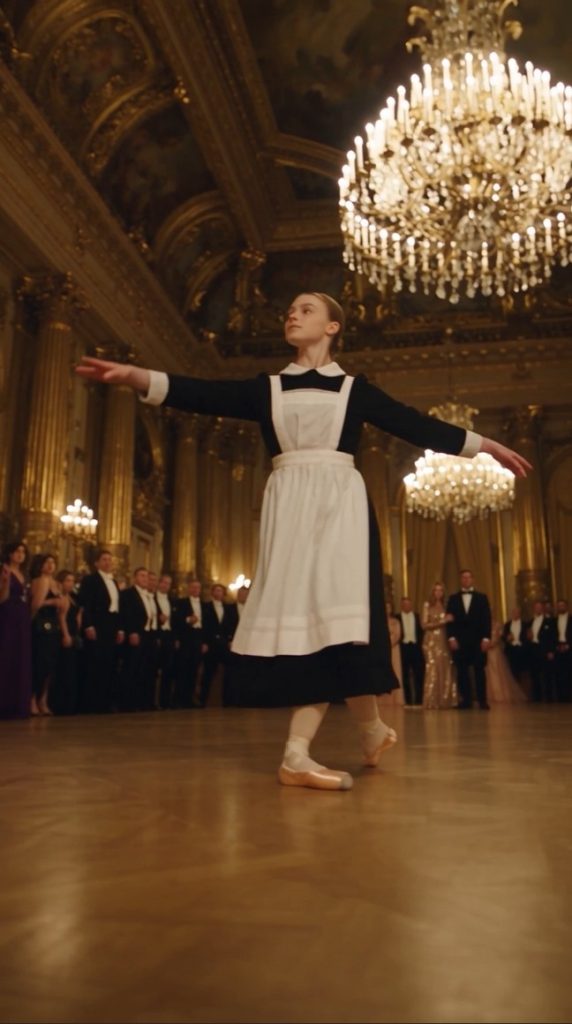
And the beautiful woman standing beside him seemed to enjoy every second of her humiliation.
The ballroom shimmered with gold, crystal, and expensive silk. Waiters moved silently between the tables, carrying champagne beneath towering floral arrangements, while an orchestra played softly near the marble staircase.
Among them was a young waitress who had spent the entire evening trying to remain invisible.
Her uniform was simple. Her shoes were worn. And behind her carefully composed expression was a life quietly falling apart.
She was already behind on her apartment payments. Unpaid bills waited at home, and every shift brought the same exhausting calculation: how much could she earn, and how much longer could she hold on?
Then the billionaire noticed her.
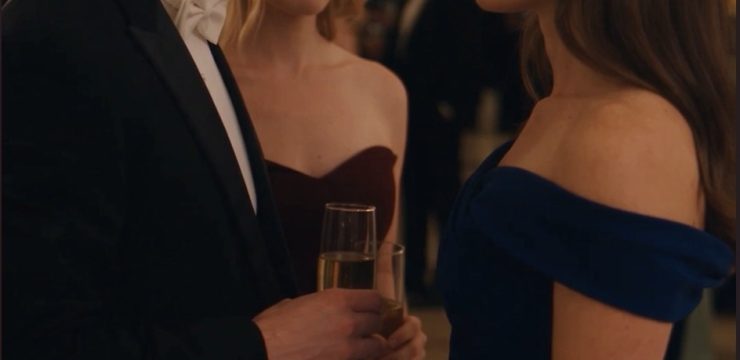
He was standing beside his glamorous date, a woman whose perfectly fitted gown and confident smile made her look as though she belonged in every photograph taken that evening.
As the waitress passed, he raised his champagne glass and pointed toward her.
“See that girl?” he announced, loudly enough for the surrounding guests to hear. “If she can actually dance, I’ll leave my date and marry her tonight.”
For a moment, the nearby conversations stopped.
Then laughter rippled across the room.
The woman beside him smiled, apparently certain the challenge meant nothing. Several guests turned toward the waitress, waiting for her reaction.
She kept her eyes lowered.
Her fingers tightened around the silver tray until its edge pressed painfully into her skin. She wanted to walk away, to disappear behind the service doors and pretend she had heard nothing.
But humiliation had a way of lingering long after the laughter ended.
She continued toward the hallway, her footsteps measured, her face carefully still.
A moment later, she heard someone following her.
“Wait.”
The billionaire had left the ballroom.
Away from the music and curious guests, his voice became quieter, though his expression carried the same unmistakable confidence.
“I’ll make it worth your time,” he said.
She turned slowly.
“Fifty thousand dollars. All you have to do is accept the challenge.”
For several seconds, she said nothing.
Fifty thousand dollars.
The number seemed almost impossible. It was enough to protect her apartment, clear the bills that had been suffocating her, and give her room to breathe again.
She searched his face, looking for some sign that he understood what he was offering.
But he appeared convinced that money could purchase her embarrassment as easily as it purchased everything else in his world.
Her heart was beating hard.
She could refuse and keep what little dignity she had left. Or she could walk into that ballroom, face every watching stranger, and risk becoming the evening’s entertainment.
Her eyes dropped briefly to her hands.
Then she looked directly at him.
“I accept.”
Minutes later, the orchestra stopped playing.
Conversations faded as the waitress stepped into the center of the ballroom, alone beneath the enormous chandelier.
The billionaire settled comfortably into his chair, smiling as though the outcome had already been decided.
Beside him, his glamorous date watched with effortless amusement.
The musicians raised their instruments.
A quiet melody began.
The waitress stood perfectly still for one breath, her arms resting gently at her sides.
Then she moved.
It was a small movement, controlled and precise, but something about it immediately changed the atmosphere.
The billionaire’s date leaned forward.
Her smile vanished.
She knew that movement.
And as the waitress prepared to take her next step, the woman’s fingers closed tightly around the arm of her chair.
Whatever she had recognized, she was suddenly terrified of seeing more.
The next movement was about to reveal why. 👇
The waitress extended her right arm, turned her wrist toward the chandelier, and slowly lowered her head.
A champagne glass slipped from the glamorous woman’s fingers.
It struck the marble floor with a sharp, terrible crack.
But the waitress didn’t stop.
Her name was Elena Brooks, and seven years earlier, she had been one of the most promising young dancers in the city.
Before the overdue rent notices. Before the double shifts and aching feet. Before a single accusation had taken everything she loved.
She had studied at a small dance academy founded by her mother, a place where children who couldn’t afford lessons were welcomed without question.
And the movement she had just performed belonged to a dance her mother had created.
A dance that had been stolen.
“Stop the music,” the glamorous woman whispered.
Nobody heard her.
“Adrian, make them stop.”
The billionaire, Adrian Blackwood, turned toward his date.
“Vivian? What’s wrong?”
Vivian’s face had lost its color.
“That woman shouldn’t be here.”
At the center of the ballroom, Elena moved through the second sequence, her worn shoes gliding across the polished floor.
Every turn carried the discipline of thousands of hours of practice. Every measured breath seemed to hold back something far heavier than exhaustion.
The guests who had laughed were now sitting completely still.
Then the orchestra’s elderly conductor lowered his baton slightly.
He recognized the choreography too.
“Good heavens,” he murmured.
Elena heard him, but she kept dancing.
Seven years ago, she had performed this very piece during the final rehearsal for a prestigious national dance scholarship.
The scholarship would have paid for her professional training and helped keep her mother’s struggling academy open.
But the morning before the competition, officials accused Elena of stealing another dancer’s choreography.
That dancer was Vivian.
The accusation destroyed Elena’s reputation overnight.
Her scholarship application was rejected. Her invitations disappeared. Even teachers who had once praised her talent stopped answering her calls.
Elena’s mother fought desperately to clear her daughter’s name.
But without funding, the academy closed.
And when her mother’s health began to fail, Elena abandoned her dream to work whatever jobs she could find.
She had not performed publicly since.
Until tonight.
The music swelled.
Elena completed a difficult turn and landed so softly that the audience barely heard her feet touch the floor.
Then she stopped.
The silence lasted three full seconds.
And the ballroom erupted.
People rose from their chairs, applauding with a force that seemed to shake the chandeliers.
Adrian stood slowly.
His confident smile was gone.
But Vivian wasn’t applauding.
She was staring at Elena with an expression that looked almost like fear.
“Where did you learn that dance?” Adrian asked.
Elena turned toward him, breathing hard.
“My mother taught me.”
The conductor stepped away from his podium.
“Her mother was Margaret Brooks.”
Vivian abruptly stood.
“This is ridiculous. Adrian, we’re leaving.”
But the conductor continued.
“I conducted the music for Margaret’s original choreography. I remember it because she asked me to record the rehearsal before her daughter’s scholarship audition.”
Elena looked at him.
“You remember my mother?”
His eyes softened.
“She was one of the finest teachers I ever worked with.”
Vivian moved toward the exit.
Adrian caught the movement.
“Vivian, wait.”
She turned sharply.
“You promised you’d marry that waitress, remember? Perhaps you should concentrate on your little joke.”
The words struck Elena harder than she expected.
For one moment, the applause and admiration meant nothing.
She was still standing in a borrowed ballroom, wearing a waitress’s uniform, while people discussed her future as though it belonged to them.
“I don’t want to marry anyone,” Elena said quietly.
The room settled.
“I accepted because you offered me enough money to keep my apartment. Not because I wanted your attention.”
Adrian’s jaw tightened.
Before he could answer, the conductor spoke again.
“There is something you should know about that scholarship.”
Vivian froze.
“The original recording was archived by the competition committee,” he explained. “It was made weeks before Vivian submitted the same choreography as her own.”
Adrian looked between them.
“You’re saying Vivian stole it?”
“I’m saying the recording has a date. And Margaret Brooks was credited as its creator.”
Vivian laughed, but there was no warmth in the sound.
“An old recording proves nothing.”
“Then you won’t mind if we examine it,” Adrian replied.
For the first time that evening, Vivian seemed unable to find an answer.
Elena stood motionless beneath the chandelier.
Seven years.
For seven years, she had lived beneath an accusation that followed her into every audition, every interview, every sleepless night.
And suddenly, someone was willing to question it.
But the truth did not arrive cleanly.
Over the following week, Adrian’s attorneys obtained the original rehearsal footage and the scholarship committee’s archived correspondence.
What they discovered went far beyond stolen choreography.
Vivian had used her influence over the competition’s sponsors to suppress the recording, and messages preserved in the committee’s files showed that she had encouraged officials to reject Elena’s application.
She had later secured professional opportunities using the same choreography.
Worse, financial records revealed that Vivian, now responsible for a charitable arts program supported by Adrian’s company, had diverted funds meant for struggling dance schools into projects benefiting her own business interests.
Margaret’s academy had been among the institutions denied assistance.
When Adrian confronted Vivian in his office, Elena was there with the attorney handling her case.
A cold autumn rain tapped against the windows.
Vivian stood across from them, her perfect appearance unable to conceal the trembling in her hands.
“You have no idea what it was like,” Vivian said. “Everyone adored her. Every teacher. Every judge. Even when I worked twice as hard, they only saw Elena.”
Elena watched her silently.
“So you destroyed my life?”
Vivian looked away.
“I didn’t know your mother would lose the school.”
“You knew what you were doing to me.”
Vivian swallowed.
“I just wanted one chance to be chosen.”
Elena’s voice broke.
“You had a choice. You took mine away.”
Adrian placed the evidence on the desk.
Vivian looked at the documents, then at the man who had once trusted her.
“Adrian, please.”
He didn’t raise his voice.
“You used a charity established to help people and turned it into something that hurt them.”
He ended their relationship that afternoon.
The company’s independent board removed Vivian from every position she held within its charitable programs, and the financial evidence was referred to the authorities.
The scholarship committee formally withdrew its accusation against Elena and acknowledged her mother’s authorship of the choreography.
Vivian also lost the professional recognition she had built upon the stolen work.
There was no dramatic final scream.
Only Vivian sitting alone in an office that no longer belonged to her, staring at the documents she had spent years believing would never be found.
For Elena, the victory felt strangely quiet.
She had imagined the truth would make her whole again.
Instead, she went home, sat on the edge of her bed, and cried for the mother who had never lived to see her name cleared.
A few evenings later, someone knocked on her apartment door.
Adrian stood outside, holding an envelope.
Elena hesitated before letting him enter.
The apartment was small, with a patched sofa, a narrow kitchen, and framed photographs of her mother beside the window.
He looked around without commenting.
Then he placed the envelope on the table.
“Your fifty thousand dollars,” he said. “As promised.”
Elena stared at it.
“You don’t owe me anything beyond what we agreed.”
“I know.”
He remained standing.
“And I owe you an apology.”
She looked up.
“That night, I made you into a joke because I thought money gave me permission.”
His voice grew quieter.
“I didn’t see the person standing in front of me.”
Elena folded her hands.
“You weren’t the first person to look at me that way.”
“I know that doesn’t excuse it.”
“No,” she said. “It doesn’t.”
He accepted her answer.
Then he pulled another envelope from his coat.
“This was in my mother’s belongings. Our family attorney found it when I asked about the old scholarship program.”
Inside was a faded photograph.
Elena’s breath caught.
It showed her mother standing beside a young girl in a dance studio, both laughing as the girl tried to copy a ballet position.
The child was Elena.
Beside them stood an older woman holding a small bouquet of flowers.
Adrian touched the edge of the photograph.
“That’s my mother.”
Elena looked at him in disbelief.
“She visited our academy?”
“She did. She never told me the details.”
Attached to the photograph was a handwritten letter.
Elena recognized her mother’s handwriting immediately.
Her fingers shook as she unfolded it.
Margaret had written to thank Adrian’s mother for quietly paying for dance lessons for children whose families couldn’t afford them.
At the bottom was one final sentence.
You said that watching Elena dance reminded you that beautiful things can survive difficult beginnings. I hope she never forgets what her gift means to people.
Elena pressed the letter against her chest.
Adrian looked toward the window.
“My mother died believing that arts education could change someone’s life. I inherited her foundation, but somewhere along the way, I forgot why she started it.”
Elena wiped her eyes.
“Your mother helped keep our doors open.”
“And yours gave mine something worth believing in.”
For a long time, neither spoke.
Then Adrian asked if Elena would consider helping rebuild the academy through an independently managed charitable grant.
Not as publicity.
Not as compensation for embarrassment.
But as a school that would belong to its teachers and community.
Elena took several days to answer.
She wasn’t ready to trust him simply because he was sorry.
But when she finally agreed, she insisted that the academy retain its independence, that scholarships be awarded transparently, and that no child’s future ever depend on pleasing a wealthy patron.
Adrian agreed to every condition.
Months later, the academy reopened.
On the first morning, children rushed through the doors with oversized dance bags and untied shoelaces.
The elderly conductor volunteered to teach musical interpretation.
Former teachers returned, bringing photographs, costumes, and stories about Margaret.
And Elena stood beneath the familiar studio windows, watching sunlight stretch across the wooden floor.
She no longer wore the shoes that had carried her through endless restaurant shifts.
But she kept them in a box at home.
They reminded her of the woman she had been when nobody was watching.
One evening, after the children had gone, Adrian arrived carrying a small framed photograph.
It was the picture of their mothers.
He placed it beside Margaret’s portrait.
Elena looked at the two women smiling together.
For years, she had believed the world had forgotten her mother’s kindness.
Now, laughter filled the rooms Margaret had once fought so hard to protect.
Adrian stepped back toward the door.
“Would you like to have dinner sometime?” he asked.
Elena smiled faintly.
“Are you offering me fifty thousand dollars?”
He lowered his head, embarrassed.
“No. Just dinner.”
She considered him for a moment.
“Then ask me again when you’re sure you understand the difference.”
He smiled.
“I will.”
And for the first time, Elena laughed without feeling she needed to hide it.
As evening settled over the city, she switched off the studio lights.
A little girl who had forgotten her dance bag hurried back inside.
“Miss Elena?”
“Yes, sweetheart?”
“Do you think I could become a dancer like you?”
Elena knelt and gently tied the child’s loose shoelace.
“You already are one.”
The girl grinned and ran toward the door, where her mother was waiting.
Elena watched them leave together.
Then she turned toward the empty studio, where the last golden light rested on the photographs of two women who had believed in children, kindness, and second chances.
She placed one hand on the wooden barre her mother had once polished every morning.
“Mom,” she whispered, “we’re home.”
And in the quiet room that had finally found its laughter again, Elena began to dance.