The woman had barely whispered five words when the groom’s entire world began to fall apart.
“You used to call me Mom.”
And standing on the church steps, with his new bride beside him and hundreds of eyes watching, he suddenly remembered something his father had made him forget.
Only minutes earlier, the wedding had been perfect.
White petals covered the church steps. Guests smiled beneath the afternoon light, cameras flashed, and the bride held tightly to her husband’s arm as they stepped outside together.
Then a woman in a filthy brown coat walked directly into their path.
Her shoes were worn. Her wind-tangled hair framed an exhausted face, and her rough hands trembled slightly at her sides.
She looked like someone who had wandered into a celebration where she had never been welcome.
The groom stopped so abruptly that his bride almost collided with him.
Conversations died behind them.
Security began moving forward, but the groom lifted his hand, stopping them.
His face tightened with embarrassment.
“Move,” he said quietly.
The woman didn’t move.
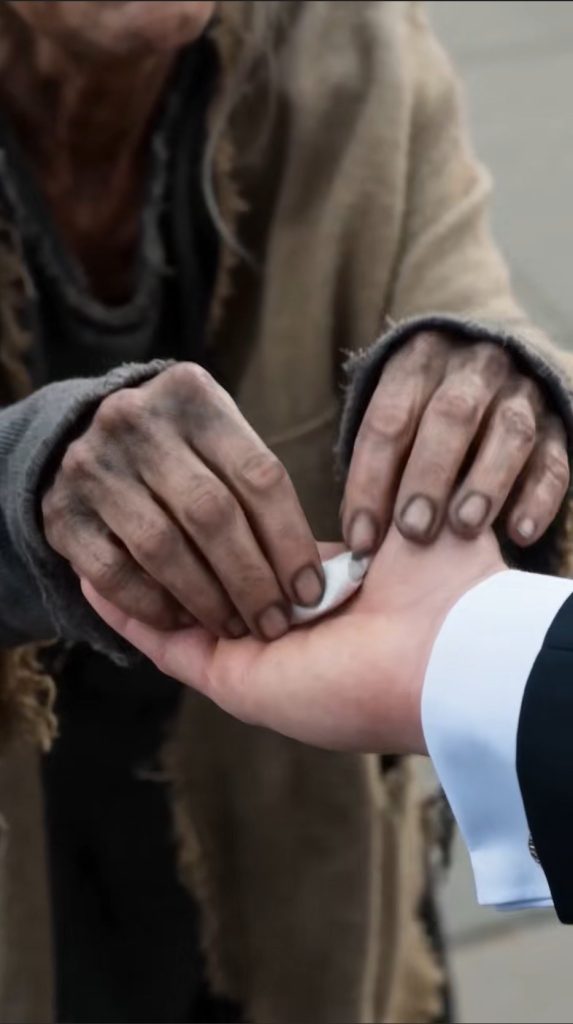
She simply opened her palm, revealing a tiny piece of folded paper.
For a moment, he stared at it. Then, impatiently, he took it from her fingers.
Inside was a single handwritten instruction.
Open the photo hidden in your favorites.
His irritation faded.
He looked sharply at the woman, searching her face for an explanation.
But she remained silent.
Slowly, he reached into his pocket and pulled out his phone.
His bride leaned closer, confusion gathering in her eyes.
He opened his photo gallery.
There, among thousands of memories, was a single old photograph already marked as a favorite.
He didn’t remember saving it.
His thumb hovered above the screen.
Then he tapped it.
The photograph was faded, clearly scanned from something much older.
A little boy stood outside a modest apartment building, wearing a coat that seemed strangely familiar.
The groom leaned forward.
His chest tightened.
He knew that boy.
The crooked front tooth. The tiny scar near his chin. The coat he remembered wearing when he was five.
It was him.
But the little boy wasn’t standing alone.
His small hand was wrapped securely around the fingers of a young woman with bright eyes and a gentle smile.
A woman who was looking down at him as though he were the most precious thing in her world.
The groom slowly raised his eyes.
The woman in the photograph and the exhausted stranger standing before him were the same person.
Older now.
Worn down by years.
Almost unrecognizable.
But those eyes hadn’t changed.
Beside him, his bride saw the resemblance.
Her hand went slack.
The bouquet slipped from her fingers, scattering flowers across the stone.
Neither of them bent to retrieve it.
The groom stared at the image again.
Something stirred deep inside him.
Not quite a memory.
A feeling.
Warm fingers carefully rinsing shampoo from his hair.
A soft voice singing beside a kitchen window while rain struck the glass.
Someone carrying him through the darkness when fever made his little body shake.
Then another image flashed through his mind.
A hospital ceiling.
Bright lights.
His father’s voice.
And after that—
Nothing.
An entire piece of his childhood swallowed by silence.
The woman shifted her worn shoe beside the fallen bouquet.
She had waited without pleading, without defending herself, as if she understood that one photograph could say what years of explanation never had.
Her eyes filled.
“You used to call me Mom.”
The groom’s lips parted.
He looked at his phone one final time, then back at the face he had somehow forgotten.
His voice came out almost soundless.
“…Mom?”
And beneath the stunned silence of the wedding guests, a buried past was beginning to find its way back. 👇
The woman’s knees nearly buckled.
She caught herself against the cold stone railing, pressing one hand to her mouth as though the sound of that single word had physically struck her.
Before she could answer, a familiar voice cut through the silence.
“Daniel. Step away from her.”
His father was standing halfway down the steps, his expensive gray suit immaculate, his expression frighteningly controlled.
Daniel turned toward him.
“Dad… who is she?”
His father didn’t look at the woman.
“Someone who has been trying to interfere with our family for years. Give me the phone.”
Daniel instinctively pulled it closer to his chest.
The woman flinched at the older man’s voice. It was a tiny movement, almost invisible, but Daniel saw it.
His bride, Emily, stepped beside him.
“Mr. Whitmore,” she said carefully, “why is there a photograph of Daniel as a child with this woman?”
“Because photographs can be manipulated.”
The woman finally spoke.
“Then tell him about the hospital, Richard.”
His father’s expression changed.
Only for a second.
But it was enough.
Daniel felt something cold move through his stomach.
“What hospital?”
Richard stepped closer, lowering his voice.
“Son, you’re overwhelmed. This isn’t the place.”
“No,” Daniel said.
His voice was trembling now.
“You told me my mother abandoned me when I was five. You told me she walked out while I was in the hospital.”
The woman closed her eyes.
Richard’s jaw tightened.
“And that’s exactly what happened.”
“No,” she whispered. “I was there every night.”
The silence became unbearable.
Daniel looked from one face to the other, trying to understand how two people could remember the same childhood so differently.
Then the woman reached inside her coat.
Security moved again.
She stopped immediately.
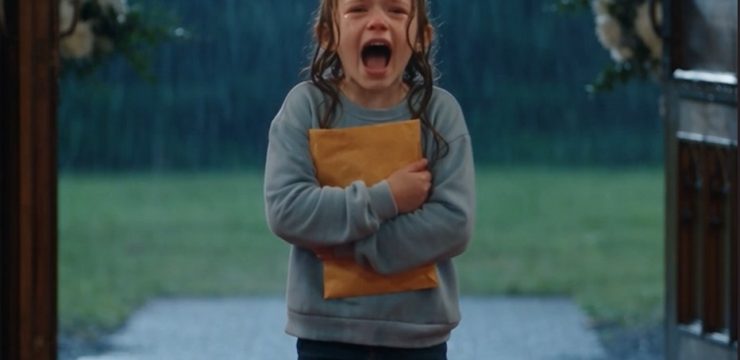
“Please,” she said. “It’s only an envelope.”
She held it toward Daniel with both hands.
Inside were hospital records, old court documents, and a stack of letters. Each envelope carried his childhood name, written carefully in blue ink.
Some had been returned unopened.
Others bore delivery confirmations.
Daniel recognized the address.
It was the house where he had grown up.
His hands began shaking.
Richard’s face drained of color.
“Those documents don’t prove anything.”
The woman looked at him.
“They prove you knew where I was.”
Daniel pulled out a yellowed hospital record.
His eyes stopped on one sentence.
Mother present at admission. Child transferred following request by father.
He looked up.
“You said she never came.”
Richard said nothing.
“You told me she didn’t want me.”
Emily gently touched Daniel’s back, but he barely felt it.
Richard finally exhaled.
“Your mother wasn’t capable of raising you. I did what I believed was necessary.”
The woman shook her head.
“You took him while I was working nights to pay his medical bills.”
Her voice cracked.
“You told the court I had disappeared. By the time I found out what you’d filed, you’d already moved him away.”
Daniel stared at his father.
Richard’s silence was no longer calm.
It was calculation.
“You had no stability,” he said sharply. “No money. No future. I gave him everything.”
The woman stepped forward.
“You gave him everything except the truth.”
A murmur moved through the guests.
Daniel suddenly remembered something else.
His father’s hand gripping his shoulder beside a hospital bed.
A promise that everything would be better if he stopped asking about his mother.
And the years afterward, when every question had been answered with the same cold sentence.
She chose to leave.
Daniel lowered his head.
“Did you know she was looking for me?”
Richard looked away.
That was his answer.
But Daniel needed to hear it.
“Dad.”
Richard’s mouth tightened.
“Did you know?”
“Yes.”
The word landed harder than shouting.
Daniel stumbled backward.
Emily caught his arm.
For thirty years, Daniel had carried the quiet shame of being unwanted. Every birthday, every school ceremony, every time another child ran into his mother’s arms, he had wondered what was wrong with him.
And the man who had comforted him through that pain had helped create it.
“Why?” Daniel whispered.
Richard’s eyes hardened.
“Because she would have taken you away from me.”
The woman shook her head.
“I wanted him to have both his parents.”
“You wanted control,” Richard snapped.
“No,” she answered. “I wanted my son to know he was loved.”
Richard turned toward the security guards.
“Remove her.”
Nobody moved.
Daniel stepped between them.
“Don’t touch my mother.”
The words came out quietly.
But they changed everything.
Richard stared at his son as though seeing a stranger.
“Daniel, think carefully about what you’re doing.”
Daniel looked at the documents.
Then at the woman standing in borrowed-looking clothes, holding herself together through sheer determination.
“I think,” he said, “I’ve spent my whole life believing the wrong person.”
Richard’s expression collapsed into anger.
He warned Daniel about the family business, his inheritance, the reputation they had spent decades building.
Daniel listened without interrupting.
Then he removed the watch his father had given him that morning.
He placed it on the stone railing.
“You can keep all of it.”
Richard looked at the watch.
For the first time, he seemed to understand that the son he had controlled was no longer standing before him.
Emily stepped closer to Daniel.
“We’ll get the documents examined,” she whispered. “We’ll find out everything.”
Daniel nodded.
Then he turned back to the woman.
“What’s your name?”
She swallowed.
“Margaret.”
He repeated it softly, testing the unfamiliar sound.
“Margaret.”
A tear slipped down her cheek.
“You used to call me Maggie when you were little. You couldn’t pronounce Margaret.”
Daniel let out a broken, disbelieving laugh.
His face crumpled almost immediately afterward.
“I’m sorry,” he whispered.
Margaret shook her head.
“Please don’t apologize.”
“I told you to move.”
Her lips trembled.
“I’ve heard worse, sweetheart.”
He reached for her.
But stopped inches away.
For a terrible moment, he didn’t know whether he had the right to embrace someone he couldn’t fully remember.
Margaret made the decision for him.
She opened her arms.
And Daniel stepped into them.
He was taller than her now, broad-shouldered and dressed in a tailored wedding suit. But when she placed her palm against the back of his head, he folded toward her like the little boy in the photograph.
She held him without speaking.
His shoulders began shaking.
Behind them, Emily covered her mouth.
Even the guests who had been recording lowered their phones.
Nobody wanted to disturb that embrace.
The church bells began ringing again.
This time, nobody cheered.
Months followed in which the truth had to survive more than one emotional reunion.
Lawyers examined the records. Hospital staff confirmed Margaret’s presence during Daniel’s illness. Archived correspondence revealed that Richard had concealed information during their custody proceedings and continued intercepting attempts at contact afterward.
Daniel learned that Margaret had challenged those proceedings repeatedly, spending nearly everything she earned on legal fees and searches that led nowhere.
Richard’s carefully maintained story finally collapsed under the documents he had believed nobody would ever see.
The court reopened the old matter. Evidence of false statements and concealed correspondence led to criminal proceedings, and Richard was eventually convicted for offenses connected to the deception.
He lost his position in the family company when the board discovered how long he had used company resources to help conceal his actions.
But the hardest consequence came quietly.
Daniel visited him once before sentencing.
They sat across from each other in a bare interview room.
Richard looked older without his expensive suit.
“I was afraid of losing you,” he finally admitted.
Daniel studied his father.
“You were so afraid of losing me that you made sure I lost her.”
Richard lowered his eyes.
Daniel stood.
“I won’t pretend you never raised me. But I can’t trust you with my life anymore.”
He left without making promises he wasn’t ready to keep.
Outside, Emily waited beside the car.
She didn’t ask whether he’d forgiven his father.
She simply took his hand.
Rebuilding a relationship with Margaret was harder than Daniel expected.
They shared blood, but thirty years had made them strangers.
Sometimes he called her Margaret because the word Mom still caught painfully in his throat.
Sometimes she reached to straighten his collar, then withdrew her hand, afraid she was being too familiar.
One evening, while eating dinner in her little apartment, Daniel noticed that she had cut the crusts from his sandwich.
He smiled faintly.
“You still do that?”
She looked embarrassed.
“You hated the crusts.”
“I eat them now.”
“I know,” she said. “Emily told me.”
He looked at her for a long moment.
“It’s okay,” he said. “You don’t have to know everything about me yet.”
Margaret nodded, blinking quickly.
“Then you’ll have to teach me.”
“I will.”
Their first Christmas together was small.
Emily cooked too much food. Margaret insisted on washing the dishes. Daniel stood in the kitchen doorway watching them argue gently over who should dry the plates.
It was an ordinary disagreement.
Somehow, it nearly brought him to tears.
Later that evening, Margaret handed him a small wooden box.
Inside were childhood drawings, faded ribbons, and birthday cards she had written every year.
Thirty of them.
Some were addressed to a little boy.
Others to a teenager.
The last few simply began, My dear Daniel.
He opened one from his eighteenth birthday.
She had written about wondering whether he was tall, whether he still loved rain, whether he had somebody to celebrate with.
At the bottom were four words.
I am still here.
Daniel closed his eyes.
For years, he had imagined a mother who had forgotten him.
Instead, she had remembered everything.
Then Margaret reached into the box and removed one final photograph.
It was the original picture from the church steps.
Daniel turned it over.
On the back, in uneven children’s handwriting, were the words:
Me and my favorite person.
Daniel stared.
Margaret smiled through her tears.
“You made me write that after we took the picture. You told me it was the most important photograph in the world.”
Then she explained the last mystery.
Years earlier, Daniel’s grandmother had quietly helped Margaret preserve copies of the old family photographs. Before her death, she had also placed the scanned picture into the family digital archive, marking it as a favorite.
When Daniel inherited and transferred those family files onto his phone, the old favorite had come with them.
He had never noticed.
Margaret had learned about it through his grandmother’s final letter, which asked her to keep trying and explained where she might find the picture if she ever had a chance to speak to him.
Daniel looked at the photograph again.
The tiny boy had been smiling so confidently because he had never doubted whose hand he was holding.
And somehow, across three decades of separation, that little boy had left his grown-up self a way home.
Daniel turned toward Margaret.
“Mom?”
She looked up immediately.
This time the word came without hesitation.
“Can we take another picture?”
Emily brought the camera.
They stood beside the kitchen window, where rain was tapping softly against the glass.
Margaret held Daniel’s hand.
Emily slipped an arm around both of them.
Nobody posed perfectly.
Margaret laughed halfway through. Daniel leaned his forehead against hers, and Emily captured the moment before either could look away.
Later, Daniel placed the new photograph beside the old one.
Two pictures.
Thirty years apart.
The same hands, finally finding each other again.
And when Margaret began humming the little song she used to sing beside the kitchen window, Daniel remembered the melody.
This time, he sang along.
Outside, the rain kept falling.
Inside, nobody was missing anymore.