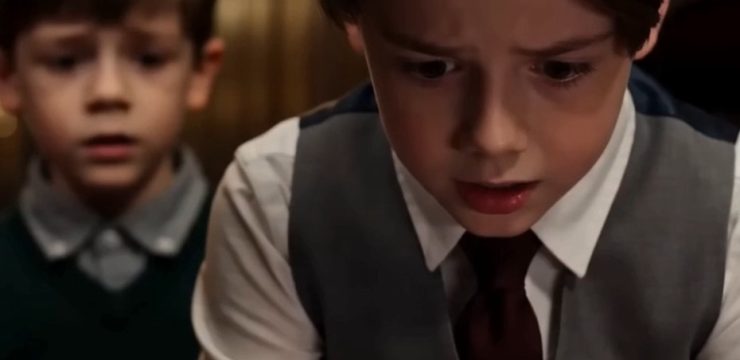
The last chord had barely faded when a tray shattered against the ballroom floor. A woman stood among the serving staff, staring at the boy at the piano as if the music had exposed something terrible. Beside him, a silver-haired man was crying.
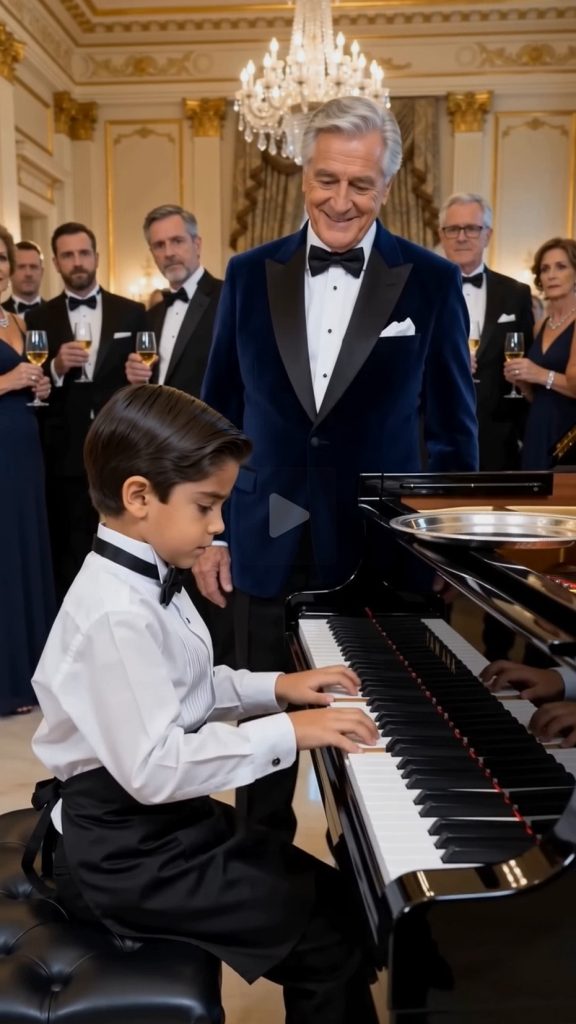
Only minutes earlier, the boy had been almost invisible.
He wore a white shirt, black tie, and black apron, and carried a silver tray past tables crowded with champagne. Crystal chandeliers glowed over guests accustomed to being impressed by wealth, not by anyone hired to serve it.
Nobody had asked his name or age. Nobody wondered where he had learned to move so carefully through a room that barely acknowledged him. To them, his uniform explained everything worth knowing.
Then he stopped by the black grand piano.
A silver-haired gentleman in a navy suit stood nearby. The boy looked up at him, his question quiet and respectful.
“Excuse me, sir. May I play?”
A few guests exchanged indulgent smiles. The gentleman lifted his hand, offering permission with the easy amusement of someone expecting a harmless little performance.
“Sure, kid. Go ahead.”
The boy set his tray aside and eased onto the bench. For a moment his hands rested above the keys. Then he began.
The first passage swept through the ballroom so quickly that conversation broke apart. A guest froze with a glass inches from his mouth. Near the dance floor, a woman turned so suddenly that champagne nearly spilled over her fingers.
The child was not hunting for the right notes. He knew exactly where every one belonged.
His fingers moved with astonishing control, one demanding phrase tumbling into the next. Beneath the chandeliers, the grand piano seemed to fill the entire room, leaving no space for whispers or polite laughter.
Faces changed. Guests who had smiled at his request now leaned forward, confused by the distance between the boy they had dismissed and the musician they were hearing.
But the gentleman in the navy suit was no longer watching with amusement.
His smile disappeared. The color drained from his face.
He knew this music.
Not simply its difficulty or its breathtaking speed. He knew the variation itself, a fierce classical composition whose full score had never been published. Years earlier, a brilliant pianist had played it once in private before disappearing after a scandal ruined her career.
As far as anyone knew, only three had ever heard that performance through to the end: the pianist, the silver-haired man, and the child she had been carrying when she vanished.
The older man stared at the boy’s hands. Each phrase brought back a memory that the rest of the room could not possibly understand.
The boy played on, unaware of the expression forming beside him. His shoulders remained still while the music grew more demanding, until the last chords rolled out beneath the chandeliers.
Then it was over.
No one applauded. The silence was too complete, too bewildered. The boy lowered his hands and stared at the keys, looking suddenly smaller than he had a moment before.
The silver-haired man came closer. Tears shone in his eyes, and when he spoke, he seemed to be addressing someone he had searched for longer than the boy had been alive.
“I finally found who I’ve been looking for.”
The boy lifted his head. “You know that song?”
The man’s voice shook.
“I wrote it… for your mother.”
A sharp crash tore through the silence.
The woman supervising the servers had dropped her tray. Broken glass lay at her feet, but she was already moving, her face twisted with fear rather than surprise.
She reached the piano, caught the boy by the arm, and whispered, “No more. We have to leave. He cannot know who you are.”
And what she feared he would discover was still unsaid. 👇
The boy’s fingers tightened around the edge of the piano bench. He looked at the woman gripping his arm, then at the silver-haired stranger whose face seemed to have lost twenty years in a matter of seconds.
“Mom?” he whispered. “What is he talking about?”
The woman did not answer. Her eyes remained fixed on the gentleman in the navy suit, but the fear in them was directed somewhere beyond him.
“Elena?” the older man breathed.
She flinched.
It was only one word. A name. Yet hearing it spoken aloud in that ballroom seemed to strip away every year she had spent trying to become someone else.
“Please, Julian,” she whispered. “Not here.”
Before he could respond, a voice cut across the room.
“I believe we’ve had quite enough entertainment for one evening.”
A tall man in an expensive charcoal suit stepped forward from beside the head table. Victor Vale, chairman of the prestigious music foundation hosting the gala, wore the controlled expression of someone accustomed to having every uncomfortable situation removed before it reached him.
“Security,” he said quietly. “Escort the staff out.”
Elena’s hand tightened around her son’s wrist.
Julian turned toward Victor. Something changed in his expression, something colder than disbelief.
“Don’t touch them.”
Victor offered a thin smile.
“Julian, surely you understand. This is a private event. We can’t have employees creating disturbances.”
“Then perhaps,” Julian replied, “you should explain why you’re so frightened of a child playing the piano.”
The ballroom grew still.
Victor’s smile faltered for a fraction of a second.
The boy looked between the adults, struggling to understand the danger that seemed to have appeared out of nowhere.
“Mom,” he said, pulling gently against her grip, “you taught me that piece.”
Elena closed her eyes.
Julian stared at her.
“You taught him?”
She nodded, almost imperceptibly.
“In our apartment,” the boy continued. “You said it was the only music you never wanted me to forget.”
A painful silence followed.
For years, Elena had lived quietly, working wherever she could, protecting her son from the history attached to her name. She had traded concert halls for service corridors, expensive gowns for a black uniform, and applause for the ordinary comfort of knowing her child was safe.
But she had never completely abandoned the piano.
Whenever they were alone, she had taught him the music she remembered. Sometimes she stopped in the middle of a passage, unable to continue. He had learned to wait until her hands stopped trembling before asking her to begin again.
Julian took a step toward her.
“I looked for you,” he said. “After the accusations. After you disappeared. I wrote letters. I called everyone who might have known where you went.”
Elena looked at him with an expression that made him stop.
“They told me you believed them.”
“Believed what?”
“That I stole your composition. That I took money from the foundation. That everything I had accomplished was a lie.”
Julian turned slowly toward Victor.
“You told me she confessed.”
Victor’s jaw tightened.
“She signed a statement. We all remember the scandal.”
Elena’s voice was barely audible.
“You made sure I signed it.”
Victor stepped closer.
“Careful, Elena. There are things in your past you would be wise not to revisit.”
For the first time, the boy saw his mother stand perfectly still without lowering her eyes.
“You threatened to destroy whatever life I tried to build,” she said. “You said nobody would employ me. Nobody would believe me. And you knew I was expecting a baby.”
Several guests shifted uneasily.
Julian’s breathing grew shallow.
Elena looked down at her son.
“I thought that if I disappeared, he would leave us alone.”
The boy stared at her. He had known they struggled. He had seen how hard she worked and how carefully she counted their money. But he had never known that the silence surrounding her past had been something she was forced to carry.
Victor gave a dismissive laugh.
“An unfortunate story. But accusations don’t become facts simply because they’re emotional.”
He turned toward security again.
“Remove them.”
“No.”
The boy’s voice was small, but it carried through the room.
Elena looked at him sharply.
He stepped away from the piano bench and moved beside her.
“You keep saying my mother did something wrong,” he said, facing Victor. “But you haven’t told us what she actually did.”
Victor’s expression hardened.
“This is a matter for adults.”
“Then answer them.”
Julian’s voice was no longer trembling.
He reached into the inside pocket of his jacket and removed a folded document.
“Three months ago, the foundation’s auditors found discrepancies in accounts dating back to the year Elena disappeared. Scholarship money had been transferred into companies that had nothing to do with music education.”
Victor’s eyes moved toward the paper.
Julian continued.
“The transfers were authorized under your signature. And the documents supposedly proving Elena’s involvement were submitted by your office.”
The chairman said nothing.
“An independent examination found that several of those documents had been altered.”
A woman seated among the foundation trustees rose slowly from her chair.
“Julian,” she asked, “are you saying the audit connects Victor to the missing funds?”
“I’m saying the full report is already with the trustees. And the authorities.”
Victor’s composure began to fracture.
“You had no right to investigate confidential foundation records.”
Julian stared at him.
“Those were scholarships for children who couldn’t afford lessons.”
Elena’s hand flew to her mouth.
The realization struck her before anyone explained it. The money she had supposedly stolen had gone exactly where Victor wanted it to go, while her signature and reputation had provided the perfect distraction.
For seventeen years, she had believed she lacked the evidence to challenge him.
Now the evidence was standing in the room with her.
Victor moved toward Julian, lowering his voice.
“Think very carefully about what you’re doing.”
Julian did not move.
“I should have done it years ago.”
Then Elena spoke.
“I kept something.”
Everyone turned.
Her hands shook as she reached inside her apron and withdrew a small, carefully folded envelope. She had carried it for years, transferring it from one hiding place to another, unable to throw it away.
Inside were copies of financial records she had taken before her disappearance.
“I didn’t understand all of it then,” she said. “I only knew the amounts didn’t match what they accused me of taking.”
She handed the papers to the trustee.
“They told me nobody would believe a frightened young woman against the chairman of a foundation.”
The trustee examined the first page, then looked toward Victor.
“These are original transaction references.”
Victor’s face had gone gray.
“Those papers were taken without authorization.”
Elena met his eyes.
“Yes. Because you were destroying everything that could prove what you had done.”
No one spoke.
The security guards remained where they were, waiting for instructions that no longer seemed to belong to Victor.
Finally, the trustee turned to the other board members.
“Mr. Vale, your authority is suspended effective immediately. The board will cooperate fully with the investigation.”
Victor looked around the ballroom.
The people who had surrounded him moments earlier were now refusing to meet his eyes. The power that had once made his words unquestionable was disappearing in plain sight.
He opened his mouth, but no one moved to defend him.
Elena watched him leave under the supervision of the venue’s security director. She did not smile. She simply held her son’s hand, as though she needed to feel something real.
In the months that followed, the investigation uncovered the full extent of the financial deception. Victor was prosecuted and ultimately convicted for his role in the stolen scholarship funds and falsified records. The foundation removed his name from its honors and recovered assets for the students he had cheated.
Elena’s public exoneration came with a formal apology.
But the first thing she did after receiving it was close the letter and sit quietly beside her son.
“Does this mean you can play again?” he asked.
She looked at her hands.
“I don’t know.”
He took one of them between his.
“You don’t have to do it for anyone else.”
That was when she began to cry.
Not the desperate tears of someone who had nowhere left to turn, but the quiet, exhausted tears of a woman who had finally been given permission to stop running.
Julian visited often afterward.
He never asked Elena to forgive him for failing to see the truth sooner. Instead, he listened when she spoke about the years she had lost, the performances she had missed, and the humiliation of entering rooms where nobody knew that she had once filled concert halls with music.
One afternoon, he placed the original handwritten score on her kitchen table.
“I kept this,” he said. “I could never bring myself to finish publishing it.”
Elena touched the worn paper.
“I thought you’d destroyed everything connected to me.”
“I thought you never wanted to hear from me again.”
For a long moment, neither spoke.
Then she turned a page.
Something handwritten near the bottom caught her attention.
She stopped breathing.
Julian leaned closer.
Beneath the final passage, in faded ink, was a dedication she had never seen before.
For Elena, And For The Little One Who Heard This Music Before The Rest Of The World.
Elena pressed her fingertips against the words.
Julian smiled through tears.
“You were carrying him when you first played it. I remember how you laughed afterward and said he had been moving the entire time.”
She turned toward her son.
He looked at the inscription, then back at his mother.
“You mean…” His voice cracked. “I was there?”
Elena nodded.
“You were always there.”
The boy looked down at the score.
All those years, he had believed his mother taught him the piece because it reminded her of the life she had lost. Only now did he understand that the music had also been written for the life she was about to bring into the world.
He slipped his arms around her.
She held him tightly.
For once, there was nothing she needed to hide.
A year later, Elena stood in a modest music studio made possible by the foundation’s restored scholarship program. Julian had helped establish it, and several of the former gala guests had contributed instruments and funding after learning what had happened.
Elena now taught children whose families could never have afforded private lessons.
Her son practiced beside her, no longer carrying serving trays through rooms where people mistook his circumstances for his worth.
One afternoon, when the final student had gone home, he sat at the piano and looked toward his mother.
“Will you play with me?”
Elena smiled.
She sat beside him, close enough that their shoulders touched.
Julian watched from the doorway as the familiar melody began, softer this time, with none of the fear that had once followed it.
Outside, the afternoon sun slipped across the windowsill.
Elena’s hands moved freely over the keys, her son’s fingers keeping pace beside hers.
And when the final note faded, there was no frightened woman rushing forward, no angry voice ordering anyone to leave, and no secret waiting to destroy them.
Only a mother, her son, and the music that had finally brought them home.