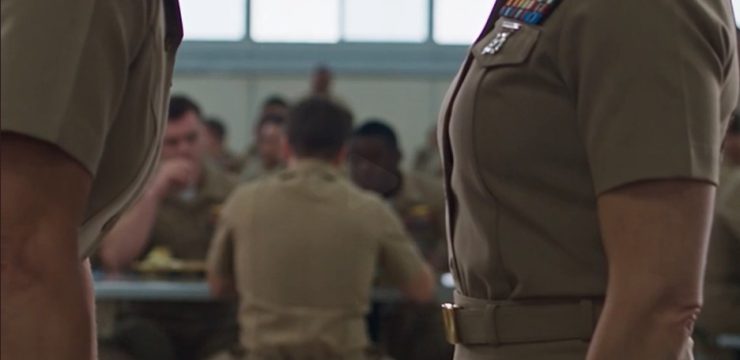
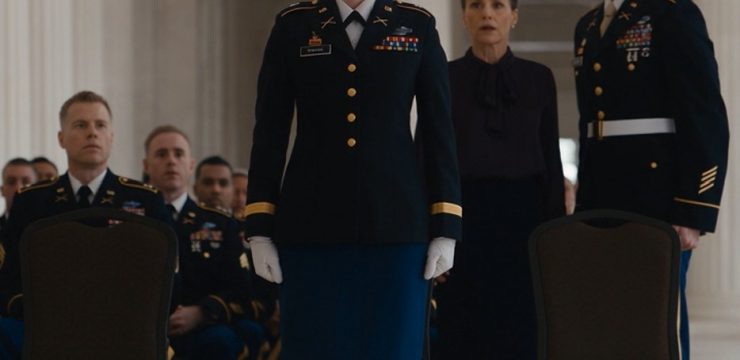
The entire room had been led to believe I was a disgrace to the Navy. But when a decorated officer in dress whites entered the crowded veterans’ hall and turned toward me instead of the stage, my stepmother’s confident smile began to disappear.
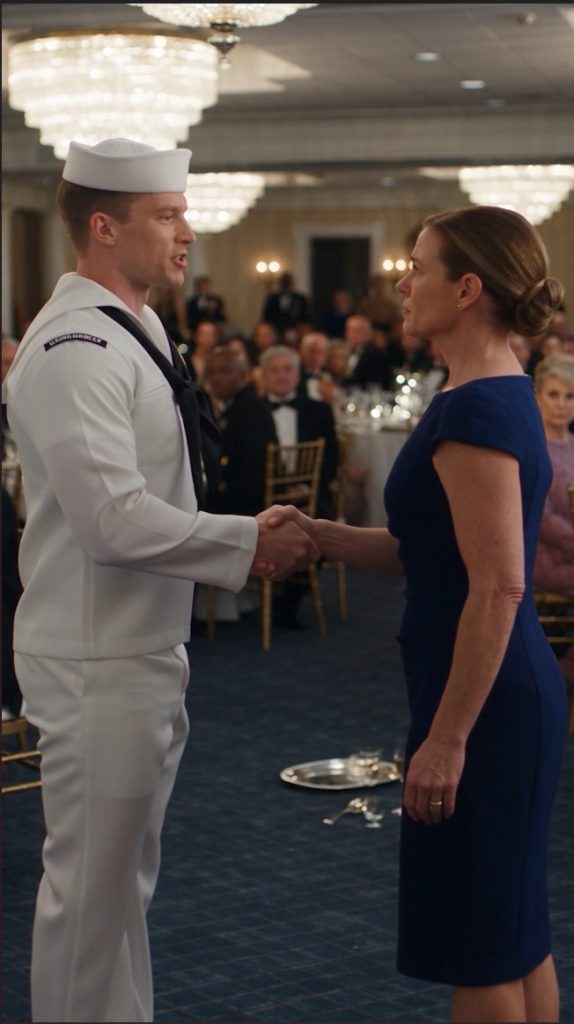
And I knew the secret I had kept for months was about to become impossible to hide.
I had returned to my small Georgia hometown for my father’s veterans’ ceremony, hoping to spend one quiet evening in the back row. I hadn’t been home in months, but Gladys had made certain everyone knew her version of why.
“She already left the Navy,” someone whispered as I passed through a hallway.
Then came my stepmother’s familiar laugh.
“She never could get anything right.”
Gladys had spent years turning my silence into evidence of weakness. What she never understood was how much strength it sometimes took not to answer.
Even at the coffee shop, two men spoke loudly enough for me to hear.
“Heard she quit.”
“Guess she couldn’t handle military life.”
I left my coffee untouched.
At Dad’s house, Gladys inspected me the moment I stepped inside.
“You’re wearing that?”
“I just got here.”
“Tonight is important, Andrea. Donors, city officials, the pastor. Your father deserves an evening without embarrassment.”
She moved closer, lowering her voice.
“I heard you left the Navy.”
I held her gaze.
“At least people respected you when you were serving.”
The words hurt more than I wanted to admit. But I refused to give her the reaction she wanted.
In the kitchen, Dad stood surrounded by seating charts, looking more tired than I remembered.
“You made it,” he said quietly.
“I promised I would.”
His eyes softened. For a brief moment, I wanted to tell him everything.
Then Gladys appeared.
“Andrea will sit in the back tonight.”
She pushed a dish towel into my hand.
“Make yourself useful.”
Dad’s phone rang before either of us could respond.
“Yes, sir,” he answered, straightening immediately. “We’ll be ready at six.”
Something in his voice caught my attention.
Gladys barely noticed.
“And don’t wear anything military tonight,” she told me afterward. “You’ll only confuse people.”
Outside, I reached into my coat pocket and felt the stiff edge of an official card.
I left it there.
By evening, the Veterans Hall was packed. American flags hung along the walls, elderly veterans occupied the front rows, and Gladys greeted donors and officials with a smile I had rarely seen at home.
I slipped into the last row.
“That’s Robert’s daughter.”
“I heard she left the Navy.”
“What a shame.”
Then Gladys approached carrying a tray of drinks.
“If you won’t sit with the family,” she whispered, forcing it into my hands, “you might as well serve them.”
I took the tray without speaking.
A woman nearby offered a sympathetic smile.
“What do you do now, dear?”
“I work in Virginia.”
“Still with the Navy?”
I opened my mouth.
Before I could answer, the emcee tapped the microphone.
“Ladies and gentlemen, we’d like to recognize a very special guest joining us this evening.”
The rear doors opened.
A Navy officer stepped inside wearing immaculate dress whites.
Conversation faded almost instantly.
He advanced toward the stage, his polished shoes striking the floor with measured precision.
Then he stopped.
His gaze traveled across the packed hall, passing the officials, the veterans, and my father.
Until he found me.
Gladys went still.
The officer turned away from the stage and walked directly down the aisle toward my seat.
Slowly, I lowered the tray.
He stopped in front of me.
My father had risen halfway from his chair. Gladys stood frozen beside him.
And as every eye in the room followed his movement, the officer straightened his shoulders and raised his hand in a flawless military salute.
For one suspended second, nobody spoke.
What followed that salute was something Gladys had never imagined. 👇
My fingers moved almost instinctively toward my forehead before I caught myself. I was wearing civilian clothes, standing beside a table covered in half-empty glasses, with a dish towel still hanging from my wrist.
The officer lowered his hand.
“Commander Andrea Mitchell,” he said clearly. “It’s an honor to finally meet you in person, ma’am.”
A glass slipped from someone’s fingers behind me.
The sharp sound of breaking glass seemed impossibly loud.
Across the aisle, Gladys gripped the back of a chair.
“Commander?” she repeated, barely audible.
The officer glanced at the tray beside me, then at the dish towel.
Something tightened around his eyes, but his voice remained steady.
“Captain Daniel Reeves. Naval Station Norfolk. I’ve been asked to escort you to the podium.”
I felt the room turning toward me.
Every whispered conversation. Every pitying smile. Every person who had watched Gladys hand me that tray.
All of them were looking now.
“Captain,” I said quietly, “I wasn’t expecting a formal introduction.”
“Your father requested that you be given the opportunity to speak for yourself.”
My breath caught.
Dad was standing near the front row, one hand resting against his chair. He looked frightened, but he didn’t look surprised.
Gladys stepped forward.
“There’s obviously some misunderstanding,” she said, producing the bright, practiced smile she used with important guests. “Andrea hasn’t explained her situation to us.”
Captain Reeves regarded her without answering.
Then he turned back to me.
“Commander, they’re ready when you are.”
I could have walked away.
For months, I had protected my privacy because my assignment required discretion. Even when my transfer became official, I preferred keeping my professional life separate from the complicated little world I had grown up in.
But Dad was watching me.
And for the first time in years, he wasn’t asking me to endure something quietly.
I removed the dish towel from my wrist and folded it beside the tray.
Then I followed the captain.
The aisle seemed longer than it had when I entered. I could hear my shoes against the polished floor and the faint rustling of people shifting in their seats.
At the podium, Captain Reeves spoke into the microphone.
“Commander Mitchell has recently completed a demanding assignment in Virginia involving operational planning and the coordination of personnel across multiple commands. Her work has earned formal recognition from senior Navy leadership.”
He paused.
“Contrary to what some of you may have heard, she did not leave the Navy. She was promoted.”
A murmur moved through the hall.
Gladys slowly lowered herself into a chair.
The captain continued, explaining that the evening’s veterans’ program had included a special invitation for me to recognize the service members who had shaped my career.
Then he stepped aside.
The microphone stood waiting.
I looked at the audience, at familiar faces suddenly unable to meet my eyes.
“I wasn’t planning to say much tonight,” I began.
My voice sounded steadier than I felt.
“I came because my father served his country long before I understood what that meant. He taught me that service isn’t about receiving applause. It’s about doing the right thing when nobody is watching.”
Dad pressed his lips together.
I glanced toward Gladys.
“I’ve also learned that silence can be misunderstood. Sometimes people assume that if you don’t defend yourself, there must be nothing worth defending.”
The room became very still.
“But I didn’t come here to embarrass anyone. I came to honor my father.”
I stepped away from the microphone, thinking that would be enough.
Then Gladys stood.
“Well,” she announced with a brittle laugh, “this is certainly a surprise. Andrea never told her own family. You can hardly blame people for wondering.”
I stopped.
She was still trying to turn the room.
Still searching for a way to make my silence look like dishonesty.
Dad rose slowly.
“Gladys,” he said, “sit down.”
She stared at him.
“Robert, I’m simply explaining—”
“No.”
One word.
He had rarely spoken to her that way.
She went pale.
Dad moved toward the microphone, holding a folded piece of paper.
“I need to say something,” he told the emcee.
My stomach tightened.
I recognized the paper immediately.
It was the letter I had written him three months earlier, shortly after my promotion had been confirmed.
I had explained why I couldn’t discuss certain assignments, told him how much his example meant to me, and asked him not to make a fuss.
What I hadn’t known was that he had been carrying it ever since.
Dad unfolded the letter with trembling hands.
“Andrea told me about her promotion,” he said. “She asked me to keep it private until she could speak about it publicly.”
Gladys shook her head.
“You told me she wouldn’t discuss her work!”
“That’s what she asked of me.”
“You let me believe she’d failed?”
Dad looked directly at her.
“I told you she was still serving. More than once.”
The words seemed to knock the breath from Gladys.
He continued.
“And when you started telling people otherwise, I asked you to stop.”
I looked at him.
He hadn’t told me any of this.
Gladys’s expression hardened.
“If you’d been clearer, none of this would have happened.”
Dad folded the letter again.
“I was clear enough. You chose not to listen.”
A terrible silence followed.
Then an elderly veteran stood in the second row.
“I was at the coffee shop Tuesday,” he said. “You told us your stepdaughter had washed out.”
Another woman spoke.
“You told the church committee the same thing.”
Gladys looked around, searching for someone who might defend her.
No one did.
She turned toward me.
“Andrea, surely you understand I was worried about the family.”
I thought of the unfinished coffee, the whispers in the hallway, the tray pressed into my hands.
“No,” I said softly. “You were worried about what people thought of you.”
Her face changed.
For a moment, I saw something unfamiliar beneath her anger.
Fear.
Not of losing me. Not of what she had done.
Fear of losing control.
She reached toward Dad.
“Robert, we’re going home. We can discuss this privately.”
He didn’t move.
“I’ve spent years asking Andrea to keep the peace,” he said. “I kept telling myself things would improve.”
His voice broke.
“They didn’t.”
Gladys withdrew her hand.
“Are you choosing her over your wife?”
Dad looked exhausted.
“I’m choosing to stop pretending I don’t see what’s happening.”
She stood motionless.
Then she picked up her purse and walked toward the exit.
Nobody followed.
The sound of the heavy doors closing behind her echoed through the hall.
For several seconds, Dad remained at the microphone, staring at the empty doorway.
Then his shoulders dropped.
I crossed the stage before I could reconsider.
He reached for me.
“I’m sorry,” he whispered against my hair.
Those two words hurt more than anything Gladys had said.
Because they were the words I had needed when I was younger, when I still believed that if I stayed patient enough, eventually someone would notice.
“I should have protected you,” he said.
I held him tighter.
“I needed you to believe me.”
“I did believe you.”
“Then why didn’t you say anything?”
He stepped back, his eyes wet.
“Because I was afraid of another failed marriage. And I let that fear make decisions for both of us.”
There was nothing comfortable about hearing it.
But for once, Dad wasn’t hiding behind excuses.
“I can’t undo those years,” he continued. “I know that.”
“No,” I whispered. “You can’t.”
He nodded.
“I’d still like to do better with whatever time we have.”
I looked at his worn face and took his hand.
“Then start tomorrow.”
The ceremony continued, although something in the atmosphere had changed. Veterans came forward to shake my hand, not with the exaggerated admiration I’d feared, but with the quiet respect of people who understood that service was often invisible.
The woman who had asked whether I was still in the Navy approached me near the refreshments.
“I owe you an apology,” she said. “I should have asked you instead of listening to rumors.”
“Thank you,” I answered.
Across the room, the two men from the coffee shop approached Dad. I watched one of them remove his cap and speak to him quietly before turning toward me.
Neither offered an excuse.
That mattered.
When the hall finally emptied, Captain Reeves handed me a small envelope.
“Your father asked me to bring this,” he said.
Inside was an old photograph.
Dad stood on a Navy pier decades earlier, much younger, holding a little girl in an oversized sailor’s cap.
Me.
On the back, in his unmistakable handwriting, were words he’d written years ago.
She says she’s going to be a Navy officer someday. I hope she becomes whatever makes her happy. But if she chooses this life, I hope she never forgets how proud I already am.
My eyes blurred.
Captain Reeves smiled gently.
“Your father included that photograph in his request for tonight’s ceremony.”
I looked up.
“You knew?”
“He wanted to honor your accomplishments without announcing anything you hadn’t authorized. We confirmed what could be shared before accepting.”
I turned toward Dad.
He was standing near the doorway, looking uncertain.
Suddenly I understood the seating charts. The phone call. The way he’d straightened when he answered.
He had been arranging an evening to honor me while trying to respect the boundaries I’d given him.
He simply hadn’t known how to protect me from Gladys until tonight.
I crossed the empty hall and handed him the photograph.
“You kept this?”
He smiled through tears.
“Everywhere I was stationed.”
Outside, the Georgia night had turned cool. The lights along the parking lot reflected on damp pavement, and somewhere beyond the building, crickets sang beneath the trees.
Dad walked beside me toward the car.
“Gladys called,” he said. “I told her I won’t come home tonight. I need time to think, and things between us can’t continue this way.”
I nodded.
He had made his decision. Whatever happened to his marriage would be handled without asking me to sacrifice my dignity again.
In the months that followed, he kept his word. He began counseling, established firm boundaries with Gladys, and eventually separated from her. There were difficult conversations, and some mornings when he sounded lonelier than he wanted to admit.
But he never asked me to apologize for telling the truth.
We learned how to talk again.
Not just about my career, or his health, or the weather in Virginia.
About the years we’d lost.
About the things we should have said.
And about how forgiveness didn’t require pretending the past had been different.
The following spring, Dad visited me in Norfolk.
We walked beside the water as the evening sun settled over the harbor. He listened while I told him about my work, my colleagues, and the ordinary frustrations of a life he had once known so well.
For the first time, I didn’t feel the need to prove anything.
Before we left, he asked for a photograph of us together.
I handed my phone to a passing couple and stood beside him.
He slipped an arm around my shoulders.
“Proud of you, Commander,” he murmured.
I laughed softly.
“You can call me Andrea.”
He smiled.
“I know.”
The camera clicked.
And when I looked at the photograph later, what struck me wasn’t my uniform or the ships in the distance.
It was my father’s hand resting gently on my shoulder.
For the first time in years, neither of us was standing alone.