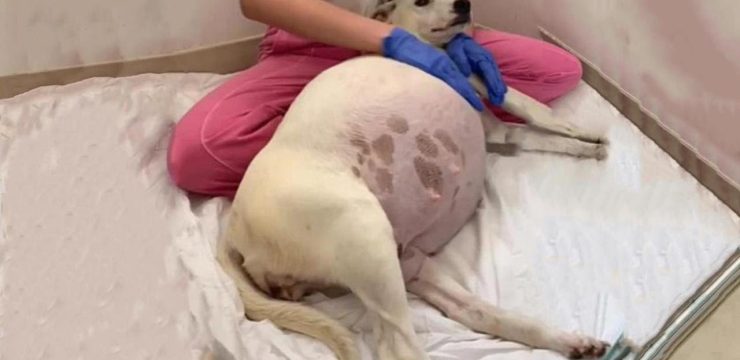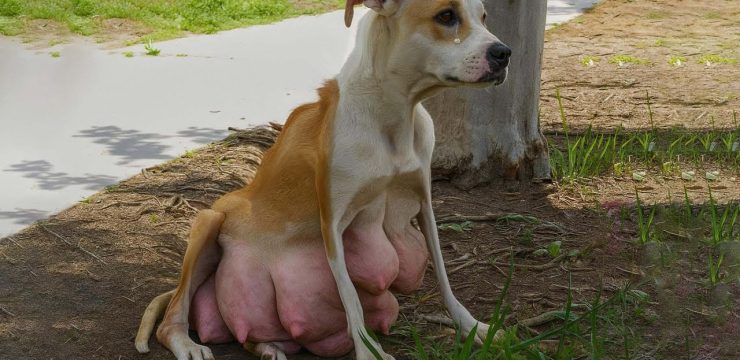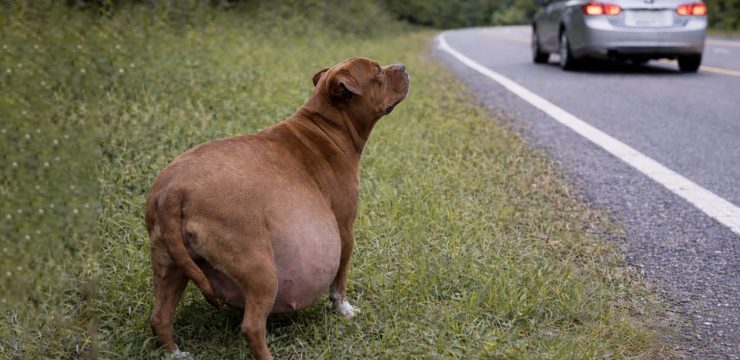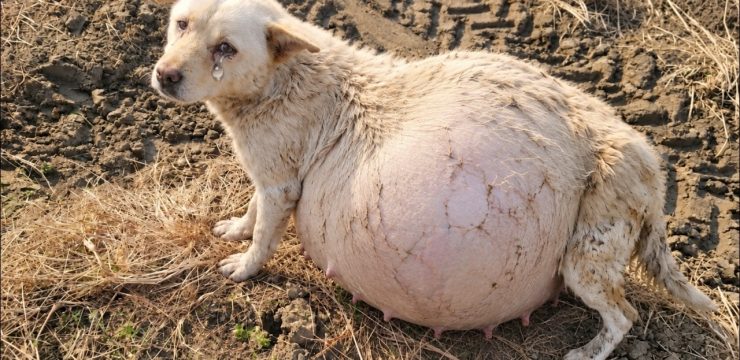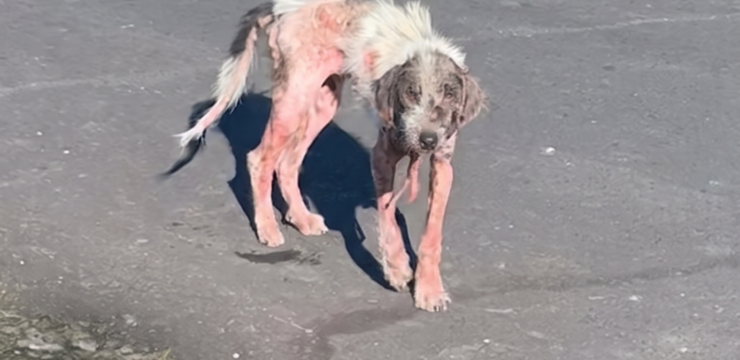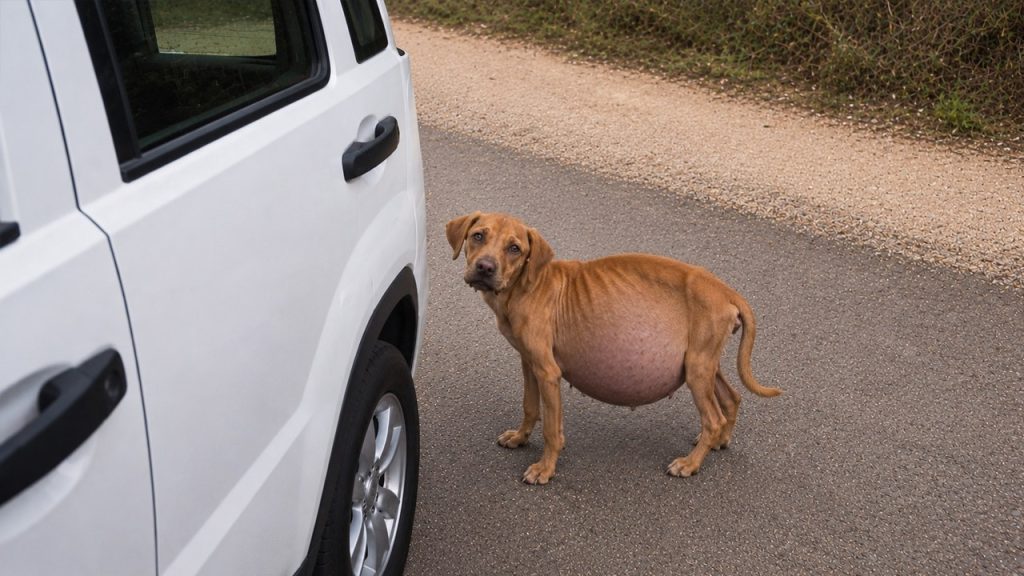
For a puppy so young, even the simplest comforts were beyond reach. Rest should have offered relief. Instead, Undi’s abdomen was so distended that even settling down was painful. She was weak, anemic, and visibly afraid. Her small body needed urgent attention, and there was no time to mistake her condition for a simple upset stomach.
Undi was taken to an emergency veterinary clinic, where her swollen abdomen demanded immediate care. The veterinarians were dealing with a puppy who had very little strength to spare. Her condition called for treatment, careful observation, and answers to a troubling question: what was making so much fluid collect inside her belly?
The first procedure revealed the problem’s seriousness. More than three liters of fluid were drained from her abdomen. For a puppy who was already thin and exhausted, that amount was staggering. Removing it addressed the painful swelling, but it did not solve the problem. The fluid began collecting again, showing that something deeper was wrong.
The medical team could not simply move ahead with surgery. Undi’s white blood cell count was elevated, and her overall condition was too fragile for an immediate operation. This was not giving up. It was recognizing how much care she needed first. Antibiotics, pain medication, and attentive supportive treatment became essential parts of her care.
Throughout this difficult period, Undi showed a side of herself that made her struggle even more moving. Despite her pain and weakness, she remained friendly with her caregivers. She was well behaved, and her appetite was surprisingly good. Those qualities could not erase the seriousness of her illness, but they revealed that there was still so much life in this little dog.
Her willingness to eat mattered, too. It was one of the encouraging details in a situation filled with uncertainty. Yet a good appetite did not mean she was safe. Fluid continued to return, and the people treating her still had to understand why. A puppy could be affectionate and eager for food while remaining desperately unwell. Undi was living proof of that difficult contrast.
Further examinations finally offered an explanation. A CT scan and a liver biopsy revealed a congenital abnormality. Undi’s liver was unusually small, too small to carry out essential functions as it should. An abnormal blood vessel was also involved, contributing to the accumulation of fluid in her abdomen. She had been born with this condition.
The diagnosis brought both sorrow and a measure of clarity. The underlying defect could not be completely cured. No treatment could make everything normal. But the veterinarians also found reason for cautious hope. Undi’s condition was not excessively aggressive, and with appropriate medical management, it could be controlled.
That distinction changed the shape of her future. A cure was not possible, but a better life might still be within reach. Her recovery would depend on suitable treatment and continued care rather than one dramatic procedure. For those looking after her, progress meant paying attention to what her body could manage and helping her become stronger without pretending that her medical challenges had disappeared.
Slowly, the little puppy who had once been able to do little more than sit began to improve. The combination of veterinary treatment and devoted care made a meaningful difference. Undi gained strength, and the fear and physical distress that had defined her earliest days of rescue no longer dominated every moment. Her story was moving toward something that had once seemed painfully distant: the chance to enjoy being a young dog.
And then came a change that said more than any reassuring words could. Undi was able to run and play across open fields alongside other dogs. The puppy whose swollen abdomen had made lying down unbearable was now moving with a freedom that once seemed out of reach. She was stronger and visibly happier, taking part in the kind of ordinary play that makes a dog’s life feel wonderfully full.
Her improvement did not mean the congenital condition had vanished. That was never the promise. What mattered was that careful treatment had helped bring her symptoms under control and given her room to grow into herself. It was a quieter kind of triumph than a perfect medical cure, but no less meaningful. Undi did not need a flawless body to experience comfort, companionship, and joy.
Her loving new family became an important part of that happier chapter. The once fragile puppy was now a lively, mischievous young dog, enjoying the life that had opened up to her. In an orange shirt decorated with daisies, Undi looked every bit like the playful little companion she had become. It was a charming detail, but the real beauty of the moment was not the shirt. It was the healthy energy and happiness she could now express.
The contrast with her first days was hard to forget. By the roadside, she had been thin, trembling, and struggling under the weight of a swollen abdomen. At the clinic, she had needed urgent treatment and testing before anyone could fully understand what was happening. Now she had care, a family, and the opportunity to share happy moments with other dogs. None of those changes required pretending her diagnosis was easy.
Undi’s journey reminds us that hope does not always mean an illness disappears. Sometimes it means finding the right care, accepting what cannot be cured, and still making room for a life filled with affection. She had been a frightened puppy who could barely rest. She became a beloved dog who could run, play, and enjoy the warmth of a family. That is a second chance worth celebrating.