Nobody in that salon saw it coming. Not the receptionist who smiled too wide at the wrong people. Not the junior employee who simply did a job with quiet, unhurried kindness. And certainly not the old man who walked through the door that afternoon looking like someone who didn’t belong.
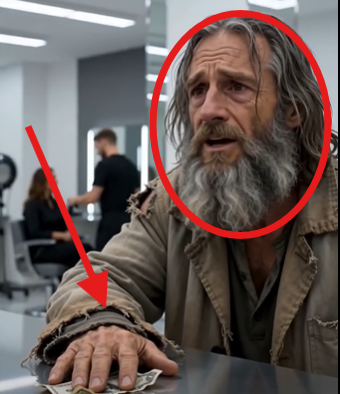
He was the kind of man most people glance at once and then forget. His clothes were clean but worn. His hands, spotted with age, moved slowly. He carried himself with the careful dignity of someone who has learned, over many decades, that the world will not always make room for you — and has made peace with that fact.
When he stepped up to the front desk, the receptionist’s smile flickered, then steadied into something polite but distant. The kind of smile that says, I see you, but not really. She answered his question with the minimum required and turned her attention elsewhere. There was no warmth. No offer to help further. Just the bare transaction of acknowledgment.
But then something shifted.
A younger employee — not the one behind the desk, but someone working nearby — noticed the old man still standing there, quietly uncertain. And without being asked, without calculation, without a glance toward any manager or camera, this person simply walked over and helped him. Genuinely helped him. Took the time. Made him feel like a human being who mattered.
It was such a small thing. The kind of gesture most people don’t even register as a choice. But for the old man, it registered completely.
He stood a little straighter. Something in his eyes, which had carried a certain resigned heaviness when he walked in, began to clear.
The salon went on buzzing around them. Music played softly. Conversations overlapped. Nobody was paying attention to the quiet exchange happening in the corner between an unremarkable old man and a kind young employee.
Nobody, that is, until he reached into his coat pocket.
His fingers moved slowly, deliberately. When his hand emerged, it held a card — thick, heavy, the kind that costs more to print than most business cards are worth. It was gold. Not in the gaudy, look-at-me sense, but in the understated way of things that don’t need to shout about their value because their value is simply beyond question.
The card trembled slightly between his fingers. Age does that to hands. But his voice, when he spoke, was perfectly steady.
“You gave me dignity before you knew my name.”
The young employee looked confused, a little embarrassed. “Sir, you really don’t have to give me anything. I was just doing my job.”
The old man shook his head slowly.
“No,” he said. “You were doing more than your job. You were being a decent person. There’s a difference.”
He turned the card over in his fingers, and that’s when the receptionist stepped closer. Maybe she was curious. Maybe something in the atmosphere of the room had shifted enough that she felt it too. She leaned in just slightly — and then she went pale.
Embossed across the front of the card was a logo. Not just any logo. The logo of the largest luxury hotel chain in the city. The kind of name you see on buildings that take up half a block. The kind of establishment where presidents stay and celebrities book entire floors.
The room went quiet in that particular way that happens when something significant is occurring and everyone present suddenly understands it, all at once, without being told.
The old man looked at the kind young employee with an expression that was warm and direct and completely unhurried.
“I came here today looking for someone honest,” he said simply. “Someone who treats people well not because of what those people can do for them, but because it’s the right way to live.”
He placed the card firmly in the employee’s hand.
“My hotels need a new grooming director. The salary starts tomorrow.”
The silence in that salon became something you could almost touch.
The young employee stood completely frozen, the card sitting in an open palm, eyes wide and unblinking, processing something that didn’t yet feel real.
The receptionist found her voice first. It came out barely above a whisper.
“Sir… we didn’t know.”
Three words. Small, desperate, wanting to explain everything and excuse everything and perhaps rewind the last hour of choices made in this room.
The old man turned to look at her. His expression was not angry. There was no dramatic fury, no pointed accusation. His gaze was almost gentle.
But his eyes were cold.
And in that coldness was an entire verdict — delivered quietly, without theater, with the absolute certainty of a man who has lived long enough to know exactly what he is looking at when he sees it.
“That,” he said, “was the test.”
He didn’t add anything else. He didn’t need to.
There are moments in life when everything a person has ever believed about fairness and character and the way the world actually works gets confirmed in a single breath. This was one of those moments. The lesson that echoed through that room was ancient and simple and still, somehow, one that human beings keep needing to relearn: how you treat someone when there is nothing in it for you is the truest measure of who you are.
The receptionist had failed. Not because she was evil. Not because she was cruel in any dramatic sense. But because she had looked at an old man and quietly decided he was not worth her full humanity. That decision cost her more than she realized.
The young employee had won something that morning without even trying to play any game. They had simply shown up as a decent person and, in doing so, had been seen by exactly the right pair of eyes.
Life is strange and generous in that way sometimes.
You never know who is watching. You never know what a single act of genuine kindness might quietly become. But the people who understand that truth — who live by it not as strategy but as character — are the ones who tend to find themselves, one unexpected afternoon, holding a golden card.