He wasn’t looking for anything that morning.
He had simply stopped to buy bread, the way he did every Saturday, moving through the motions of a life that had long ago learned to function without a missing piece at its center. The autumn leaves were falling in slow, unhurried spirals. Traffic hummed steadily behind him. The smell of warm pastry drifted from the bakery window. Everything was ordinary. Everything was exactly as it should have been.
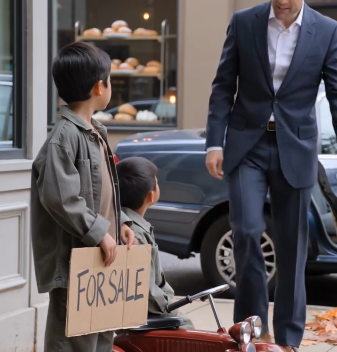
And then two small boys stepped in front of him, and nothing was ordinary ever again.
They were selling a red pedal car on the sidewalk. The older one held a handwritten sign. The younger one clutched his brother’s sleeve and said nothing, watching strangers walk past with the careful, quiet eyes of a child who has already learned that the world does not always stop for people like him.
The man almost walked by.
He would spend the rest of his life grateful that he didn’t.
He stopped, looked at the little car, and asked the boys what they were doing out here alone. The older one answered politely, with the kind of careful dignity that only comes from a child who has watched his mother hold everything together on her own. They needed medicine, he explained. Their mother was sick upstairs. They didn’t want to ask strangers for help. So they decided to sell something of their own.
That sentence nearly broke the man in half before he even understood why.
Then the boy held out a prescription slip, asking if the man might know where the nearest pharmacy was, and the man looked down at the paper — and saw her name.
He read it once.
Then he read it again, because the mind protects itself, and sometimes it takes two attempts before the heart will accept what the eyes have already seen.
It was her.
The woman he had searched for in the months after she vanished. The woman whose absence his family had eventually explained away as a choice she had made, a door she had closed. The woman he had last seen with tears on her face and no explanation he had been wise enough to ask for. He had told himself, eventually, that she had moved on. People do that. Life continues. You learn to let the unanswered questions grow quiet.
But here was her name, written on a prescription, held in the hands of a child standing on a sidewalk.
He looked at the boys again.
And this time, he truly looked.
The resemblance did not arrive gently. It struck him like something physical — a recognition that moved through his whole body before his mind had caught up. The shape of the older boy’s face. The way the younger one tilted his head. The particular stillness they both carried when they were listening carefully.
He knew that stillness. He had seen it in photographs of himself as a child.
“Where is your mother?” he asked, and his voice had already begun to fracture.
The older boy pointed across the street, toward a faded apartment building above a pharmacy. “She’s upstairs,” he said simply.
The man looked at the red pedal car again.
“What did your father give you?” he asked carefully.
The boy rested his small hand on the steering wheel with a kind of reverence. “This,” he said. “Mom told us he bought it before I was born. She said we should keep it because it was from him, even though he wasn’t with us.”
The man’s hands began to tremble.
Because he remembered that car. He had seen it in a shop window years before and had stood there longer than made sense, imagining — the way young men in love sometimes allow themselves to imagine — what it would feel like to watch his son race it down a hallway someday. He had bought it on an impulse, tucked it away like a quiet promise to a future he believed was coming.
He had never told a single soul about that car. Not one person.
The younger boy finally spoke, his voice barely above a whisper. “Mom says our father isn’t a bad man. She says he just never knew.”
The man stood so abruptly that both boys stepped back, startled, afraid they had somehow said the wrong thing. But he wasn’t pulling away from them. He lowered himself to his knees right there on the sidewalk, in front of the bakery window and the falling leaves and everyone passing by, and he gathered both children into his arms and held them with the desperation of someone who has just understood the full weight of everything they lost.
“I didn’t know,” he said, and the tears came without any attempt to stop them. “I promise you. I never knew.”
The older boy held on for a moment. Then he leaned back and looked at the man with eyes that held equal parts hope and heartbreak — the unmistakable expression of a child who wants to believe but has learned caution the hard way.
“If you’re really our dad,” he said quietly, “why did Mommy cry when she burned all your letters?”
The world stopped.
Burned all your letters.
The man lifted his eyes toward the apartment building across the street. Something cold moved through him — not grief, not yet, but the first shape of an understanding far more painful than simple loss.
Because he had written to her. For years after she disappeared, he had written. Long letters, short ones, letters that asked questions and letters that simply said he still thought of her. He had written until his family told him it was time to accept the silence and move forward.
She had never written back.
He had believed that was her answer.
But she had burned his letters in tears.
Which meant she had never read them. Which meant someone had made certain of that. Which meant the silence between them had not grown on its own — it had been carefully, deliberately arranged.
Two children had grown up without their father. A woman had raised them alone, believing herself forgotten. And a man had spent years learning to live with an absence he was never supposed to stop questioning.
Somewhere between love and now, someone had made a choice that shattered three lives — and made sure no one ever found out.
Until two small boys tried to sell a red pedal car on a Saturday morning to buy their mother’s medicine.
And a man stopped to buy bread.