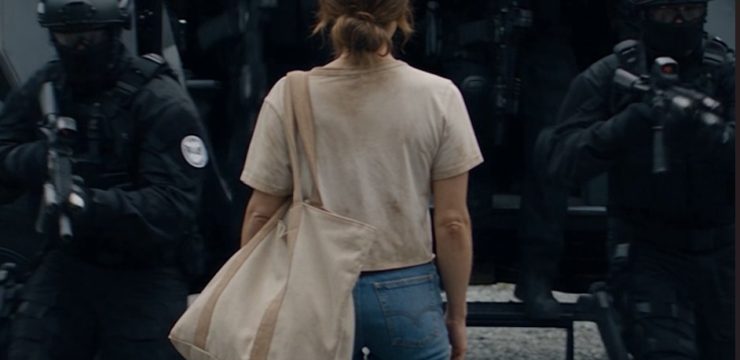
The cemetery was quiet that afternoon — the kind of quiet that settles deep into your chest and refuses to leave. Wind moved through the oak trees overhead, scattering dried leaves across the rows of gray headstones. He had come alone, the way he always did on this day, to stand before the name carved into marble and remind himself that some losses never fully heal.
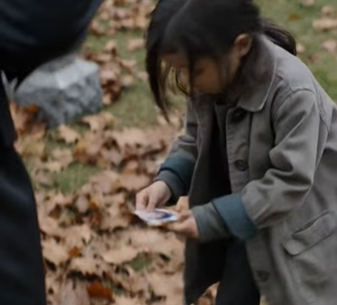
He knelt down and placed a single white rose against the base of the stone.
That was when he heard it.
A small voice. Barely above a whisper.
“Is that my mommy?”
He turned around so fast his knees nearly gave out beneath him.
Standing just a few feet away was a little girl — no older than five — with dark, serious eyes and tangled hair pressed flat by the cold. She was clutching a worn photograph in both hands, holding it out toward him like an offering. He looked down at the image.
His breath stopped.
It was her. The woman he had loved. The woman he had buried.
The cemetery, the wind, the leaves, the gravestone — all of it disappeared behind the sound of that one sentence.
He slowly pulled back and stared at the child in front of him.
“Who raised you?” he asked, his voice barely holding together.
The little girl looked down at the photograph, rubbing the corner of it gently with her thumb — a nervous habit, tender and heartbreaking all at once.
“A woman from the church took me first,” she said softly. “Then another lady came and said she was sent by my mommy’s family.”
His heart began pounding harder, the kind of pounding that fills your ears and makes it difficult to think clearly.
“What lady?” he pressed.
The girl hesitated, and in that pause, something cold moved through the air between them.
“She wore black gloves,” she whispered. “And smelled like roses.”
The color drained from his face.
Because he knew exactly one person who always wore black gloves and carried the scent of rose perfume wherever she went.
His mother.
He stood up too quickly, nearly stumbling over his own feet, then looked back down at the little girl as though afraid she might vanish if he so much as blinked.
“What is your name?” he managed to ask.
The child answered quietly, her chin barely lifting from her chest.
“Clara.”
That name hit him like something breaking open inside his ribcage.
Years ago, when he and the woman in that photograph had spoken softly about the future — about what their life together might look like — they had agreed on only one name for a baby girl.
Clara.
No one else had ever been part of that conversation. No one else on earth knew that name existed between them. No one except the two of them.
His mother had not only lied to him.
She had known all along.
Known the baby had survived.
Known exactly where she was.
And chosen, deliberately, to hide her from him for five long years.
He reached down and took the little girl’s freezing hands into his own, wrapping them carefully as though they were something fragile and irreplaceable.
“Did the woman who raised you ever tell you why your mother died?” he asked gently.
Clara shook her head slowly. “Only that she cried a lot before I was born. And that she kept saying something over and over — ‘He doesn’t know. He doesn’t know what they did.'”
He turned back toward the gravestone, his eyes filling with the kind of grief that doesn’t ask permission before it arrives.
The memories came back in broken flashes — pieces of a night he had spent years trying not to revisit. His mother insisting he stay away from the hospital. His brother taking his phone away without explanation. His father speaking in that flat, controlled voice, saying everything had already been “handled.”
Handled.
Not mourned. Not survived. Not explained.
Handled — like it was a business matter. Like a life had simply been folded away and filed.
Then Clara reached into her ripped coat pocket and pulled out something small, holding it toward him with both hands.
A silver hospital bracelet.
Faded. Bent. Worn soft at the edges from years of being carried and held.
He took it with trembling fingers and turned it over.
Beneath the mother’s surname, in faded blue ink, were two words that stopped his heart entirely:
Baby Girl — Held.
He had never held her.
Which meant someone else had.
Someone who had been present in that hospital room after the birth. Someone who had looked down at this child — his child — and made a choice to keep her hidden.
Someone inside his own family.
He looked at the bracelet. He looked at the gravestone. He looked at his daughter.
And in that single, devastating moment, grief transformed into something harder and colder and undeniable — certainty.
His family had not been protecting him from tragedy.
They had built it from the ground up, brick by brick, lie by lie.
He gathered Clara into his arms and held her close, pressing his face gently into her hair.
“You’re coming with me now,” he said. “You’re not going anywhere without me again.”
She wrapped her small arms around his neck and held on with the kind of trust that children somehow still manage to offer even after everything.
But before he could carry her toward the gate, a black car rolled slowly to a stop just beyond the cemetery entrance.
Clara saw it before he did.
She went rigid in his arms immediately, her whole body stiffening with fear.
“That’s her car,” she breathed.
He turned and looked.
The rear door of the vehicle opened with quiet precision.
And stepping out into the afternoon air — black gloves pulled tight over her hands, the unmistakable drift of rose perfume carried on the wind — was the one person he thought he had already grieved and released from his heart entirely.
His mother stood at the cemetery gate, looking directly at him.
And she did not look surprised.