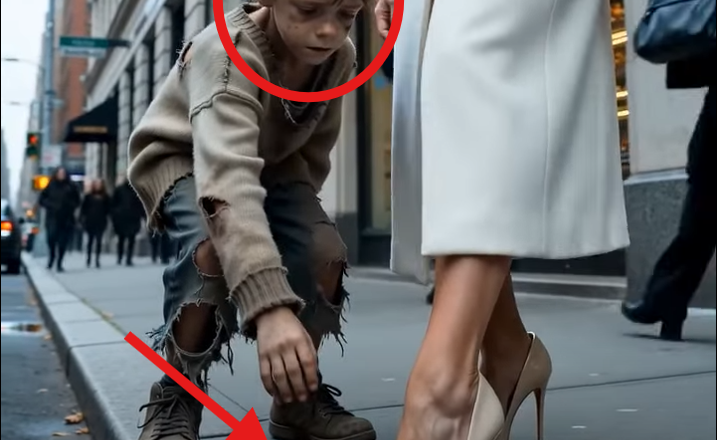
He stepped back so fast his heel slipped in the puddle behind him, arms wrapping protectively around something small pressed against his chest.
“Don’t touch it,” he whispered, his voice barely above the sound of rain. “It’s mine.”
The woman dropped to her knees right there on the sidewalk. She didn’t think about her coat, the kind that costs more than most families spend on groceries in a month. She didn’t think about the mud or the cold or the strangers walking past. Her eyes were fixed on the necklace hanging around the boy’s thin neck, swaying slightly as he trembled.
“What’s your name, sweetheart?” she asked softly.
The boy’s eyes darted to the alley beside the old bakery. Tucked behind a stack of cardboard boxes was a little girl, no more than four years old, watching with wide, cautious eyes and shivering inside a jacket two sizes too small.
He looked back at the woman.
“Noah,” he said quietly.
The sound that left the woman’s lips was not the sound of someone wealthy or composed. It was not the sound of a person in control of anything at all. It was the sound of something cracking open after years of being held tightly shut.
“My son’s name was Noah,” she whispered.
The boy shook his head slowly, as though he’d heard promises before and learned not to trust them.
“I don’t have a mother like you,” he said.
Those seven words hit her somewhere deep, somewhere she had spent years trying to protect. She looked down and noticed the bread crushed beneath her shoe — a loaf he had dropped when she startled him, the kind of bread that was probably meant to be dinner for two children who had nothing else.
She looked at the little girl again.
“That’s my sister,” Noah said, following her gaze. “She’s four. She hasn’t eaten today.”
The woman’s hands began to shake. She pressed them together in her lap like she was praying, or maybe trying to hold herself together.
“Who raised you, Noah?” she asked gently.
He thought about it for a moment, like the question deserved to be answered carefully.
“My mom,” he whispered. “Not my real one. She found me near a bus station when I was little. She said someone had taken me from a woman who cried for me. A woman who never stopped looking.”
The tears came before she could stop them. They slipped down her face in silence as she reached into the collar of her blouse and pulled out a small golden locket, one she had worn every single day for years. Her fingers fumbled with the clasp as she opened it.
Inside was a photograph, faded with age and soft at the edges. A baby. A tiny, perfect baby with round cheeks and dark eyes, lying in a hospital blanket.
On the back of the photo, written in pen that had bled slightly into the paper over time, was one word.
Noah.
The boy stared at it. His lips parted slightly. His chin trembled in the way children’s chins do when they are fighting something too big for their small bodies to contain.
The woman looked up at him and her voice came out barely a sound at all.
“I never stopped looking,” she said. “Not for a single day. Not once.”
For a long moment, neither of them moved. The city kept going around them — cars and footsteps and the distant sound of someone’s radio — but in that small square of sidewalk, time seemed to stand completely still.
Then the little girl stepped out from behind the boxes.
She walked across the wet pavement on unsteady legs and slipped her tiny hand into her brother’s, looking up at the crying woman with the kind of open, unguarded curiosity that only very young children still carry. She didn’t understand what was happening. She only knew her brother had stopped running.
That was enough for her to stop too.
And that was the moment the woman broke completely and beautifully open.
She rose to her feet and walked into the bakery without a word. When she came back out, she was carrying every loaf they had left. She wrapped both children in her coat, pulling them close against her like she was afraid the wind might take them, and she whispered through tears that kept coming and coming.
“I lost you once,” she said, her arms around both of them. “I will not lose either of you again.”
Some people who walk past moments like this one don’t stop. They assume they already understand what they’re seeing — a woman on a sidewalk, two children in worn clothes, nothing remarkable. But what they miss is the quiet miracle happening right there in plain sight. The kind of reunion that doesn’t announce itself with fanfare. The kind that arrives in the middle of an ordinary afternoon, through a puddle and a dropped loaf of bread and a child who held on to a necklace because some part of him, some deep and wordless part, had always known it meant something.
There are children in this world who carry loss without ever being told what it is. They feel it the way you feel weather changing — something in the air, something in the bones. And there are mothers who carry the same loss in reverse, walking through years of ordinary days with an extraordinary grief tucked quietly inside their chests.
When those two kinds of carrying finally find each other, the word for it isn’t luck.
The word for it is grace.
And sometimes, grace shows up on a sidewalk in the rain, with a muddy coat and a golden locket and a little girl who hasn’t eaten all day — and it changes every single thing.