No one saw it coming. That is the part that stays with you long after the story ends.
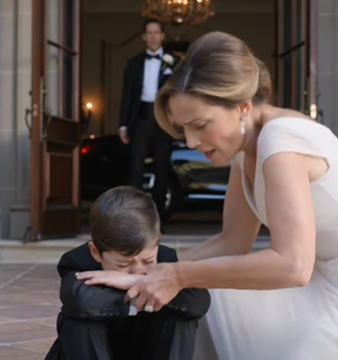
It was supposed to be a perfect wedding day. The kind of afternoon people remember for decades — flowers lining the stone steps, soft music drifting through the open doors, guests in their finest clothes gathered to witness two people say forever to each other. Everything had been planned. Everything had been prepared. And then a small boy walked out of the crowd, lifted his arm, and pointed directly at the bride.
Not at the groom. Not at the altar. Not at anyone standing in the place where children usually point during ceremonies — at something shiny, something amusing, something innocent.
He pointed at her.
And every adult on those steps felt the same chill move through them at the same moment, because something in the child’s face told them this was not a tantrum. This was not confusion. This was not a little boy overwhelmed by the noise and the fuss and the beauty of a big occasion.
This was a child who had made a decision.
He had decided that staying quiet had become more frightening than whatever punishment might follow speaking up.
An older woman in the crowd moved first. She knelt down beside him, her knees on the stone, her eyes searching his small face. That was when she saw it — the mark around his wrist. A red line, raw and unmistakable, the kind left by something that had held too tight for too long.
“Who did this to you?” she asked gently.
The boy’s lower lip trembled. He didn’t answer her. He kept his eyes fixed on the groom, as if the groom were the only person in the world he trusted enough to tell.
Near the doorway, the bride moved to recover. “He’s just upset,” she said quickly, her voice smooth and composed. “He doesn’t understand what he’s saying.”
But it came too fast. Too practiced. Too perfectly ready for a moment that should have caught her off guard.
The groom heard the speed in her voice.
He turned and looked at her — really looked — for the first time since the boy had appeared. He noticed the small step she had taken backward. He noticed the fear moving behind her eyes. He noticed the one thing she had not done in the thirty seconds since a child appeared with an injured wrist:
She had not asked what happened to him.
Then the boy whispered again, soft enough that only the nearest people heard — but loud enough that it carried.
“She said if I showed you, the little girl wouldn’t come home.”
The groom’s face changed. Not into confusion. Into recognition.
Because there was a flower girl missing.
A small child who was supposed to be part of the ceremony, who everyone had assumed was with the styling team, or resting somewhere in the happy noise of the day. No one had thought to check. No one had questioned her absence. Children wander. Children fall asleep in corners. No one had worried.
The older woman looked up sharply. “What little girl?”
The boy swallowed. His voice barely held.
“My sister.”
The bride went pale.
The groom stepped down one stair — slowly, deliberately — and that single movement said more than any words could. Because anger would have looked like a human reaction. What the groom wore on his face in that moment was something quieter and far more devastating.
It looked like understanding arriving all at once.
The boy raised his injured wrist slightly, almost as if he were ashamed now that people could see it clearly.
“She tied my hand when I tried to open the side room,” he said. “She told me if I kept crying, she would lock my sister in there until after the ceremony was finished.”
The steps went completely silent. Not the hush of reverence. The silence of people trying to process something that did not fit inside a normal day.
The groom’s gaze moved from the child’s wrist to the open doorway behind the bride. Then to the corridor inside, past the candles and the flowers, into the darker hallway beyond.
The bride shook her head once, weakly. “It isn’t like that.”
Those four words were the mistake that sealed everything.
Because innocent people, when a child is hurt, explain what happened to the child. Guilty people explain away the danger they’re in.
The older woman rose to her full height.
“Where is the girl?” she asked. No softness this time.
The boy looked only at the groom. Not at the women around him, not at the guests, not at the beautiful flowers or the open church doors.
Only the groom.
“Behind the blue door,” the boy said quietly. “The one with the ribbon on the handle.”
No one spoke.
The groom moved past the bride without a word, stepping into the corridor, his eyes finding the door that had been closed all morning — a door no one had thought to question, decorated with a small strip of pale ribbon the way you might dress something up to make it blend into a celebration.
It had been there the whole time.
And in that single moment, every guest standing on those steps understood something that no amount of white flowers or wedding vows could undo:
The little girl behind that door had been waiting for someone brave enough to come find her.
And it was a small boy with a bruised wrist who had finally made that possible.
Some people spend their whole lives waiting for a hero to arrive. Sometimes the one who shows up is the last person anyone expected — small, frightened, and carrying more courage than most adults ever have to find.