Nobody in that bank paid much attention when the small boy walked through the glass doors.
He was barefoot. His clothes were wrinkled. He clutched a brown envelope to his chest like it was the only thing he owned in the world — and maybe it was.
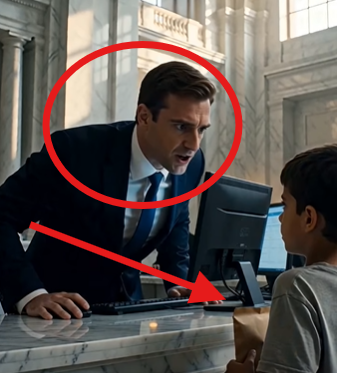
The teller at window three glanced up, then looked back down. The security guard near the entrance shifted uncomfortably. A few customers in line exchanged quiet glances. Children like this one didn’t walk into places like this. Not alone. Not looking the way he did.
He stepped up to the counter.
His voice was small, but steady.
“I need to check an account,” he said. “My grandmother told me to come here.”
The teller hesitated before pulling up the screen. She typed in the account number the boy recited from memory — the digits he had clearly been taught to remember. Her fingers slowed. Then stopped altogether.
A police officer who had been standing near the door noticed the teller’s expression and walked over.
“What account?” he asked.
The teller blinked hard, still staring at the screen. Then she said the words no one in that building was prepared to hear.
“This account holds twelve million dollars.”
A gasp moved through the room like a wave.
The little boy just stood there. Confused. He didn’t react the way you might expect a child to react upon hearing a number that large. He didn’t jump. He didn’t smile. He looked like a boy who simply didn’t fully understand what twelve million meant in the real world.
He only asked, in that same quiet voice:
“Then… can I take some out for my grandma?”
That single question broke the silence harder than the amount itself ever could.
The teller looked at him carefully for the first time.
“For your grandmother?”
The boy’s fingers tightened around the brown envelope. His chin trembled just slightly.
“She died this morning,” he whispered. “Before she passed, she told me to come here if the landlord ever tried to throw me out.”
The officer’s expression shifted. Whatever assumption he had walked over with quietly left the room.
The boy slowly opened the envelope and pulled out a folded piece of paper, its corners soft from being held too many times, too tightly. It was handwritten. Old ink on old paper.
“My grandmother said to give this to the bank manager,” he said.
The teller accepted it with unsteady hands.
Before she could open it, a voice came from behind the counter.
“Let me see that.”
The bank manager had stepped out of his office. An older man. Perfectly pressed suit. Silver hair. The kind of calm, commanding presence that made people immediately step aside and listen.
He unfolded the letter.
His eyes moved across the lines slowly.
Then his face went very still.
“What does it say?” the officer asked.
The manager looked up. When he spoke, his voice came out low and stunned.
“It says the boy is the sole heir to the estate of Eleanor Vale.”
A murmur rolled through every corner of that bank.
Even the teller stepped back.
Everyone in that city knew the name Eleanor Vale. She had been one of the bank’s most significant long-term investors — a woman of considerable wealth, extensive property holdings, and more quiet influence than most elected officials ever accumulated in a career. She was spoken of with a particular kind of respect that only comes with decades of earned power.
And the little boy standing barefoot on that polished marble floor was her heir.
But the manager wasn’t finished.
His eyes dropped back to the page. Something in his face shifted again — more personal this time. More unsettled. He swallowed once before continuing.
“There’s more,” he said quietly.
The boy looked up at him.
The manager read the final lines aloud:
“Tell my grandson that I kept him hidden because my own family would destroy him if they knew he existed. If he is standing in your bank alone, then I am already gone.”
The room went completely silent.
The officer stared at the child. The teller looked as though she might be sick. The customers and staff stood frozen in place, each one quietly processing the same realization — the little boy they had watched walk in and be met with suspicion, the boy they had looked past and underestimated — was not merely wealthy.
He was alone.
Entirely, heartbreakingly alone.
The boy’s eyes filled with tears. He looked from one adult face to another, searching each one for something familiar, something safe. Then he asked the only question that actually mattered to him at that moment.
“So… can I still go home today?”
That was the moment the room changed.
The manager stepped around the counter without a word. He crouched down to the boy’s level — really looked at him, eye to eye, for the first time — and when he spoke again, his voice held none of the authority of his position. Just something quieter. Something human.
“You’re coming with me,” he said gently. “You are not going home alone.”
The boy blinked at him.
“Did Grandma know you?”
The manager’s expression tightened. He looked at the letter once more, then back at the child’s face — studying it, as though seeing something there he hadn’t expected.
“Yes,” he said quietly. “And I believe she knew something else, too.”
The boy frowned. “What?”
The manager glanced toward the teller’s screen. Toward the late woman’s signature on the documents. Then back at the boy’s face.
And with the entire bank listening, he said:
“She didn’t just leave you her money.”
A small pause filled every corner of the room.
His voice dropped lower.
“She left you this bank.”