Nobody in the lobby paid him much attention when he walked in.
That was the point.
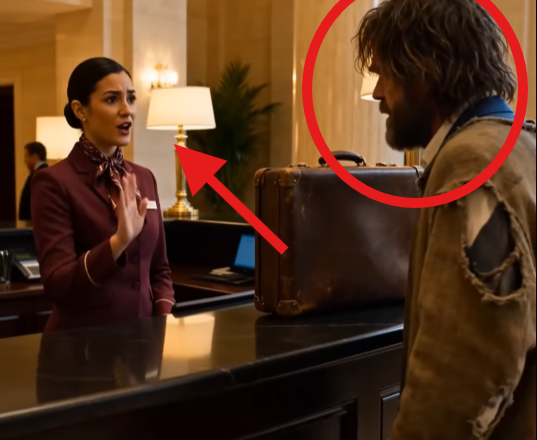
He wore a weathered coat — the kind that had seen too many winters and not enough dry cleaners. His shoes were scuffed at the toes. His hands were rough, the knuckles a little swollen from years of work nobody ever noticed. He carried a briefcase so old the leather had cracked along the edges, the brass clasp worn to a dull, tired gold. He walked to the front desk of the Grand Whitmore Hotel — a five-star establishment known for its marble floors, its crystal chandeliers, and its very particular standards about who belonged inside its doors.
The receptionist looked up.
And then she looked away.
Not because she was busy. Not because there was a line. She simply decided, in the space of a single glance, that this man was not worth her time. She shuffled papers. She clicked her keyboard. She adjusted the flower arrangement on the counter. She did everything a person does when they are trying very hard to pretend another human being does not exist.
He waited.
He was patient. Patient the way people become when life has taught them that the world moves on its own schedule and rarely consults the people standing quietly at its edges.
Finally, he set his briefcase on the counter.
“I’d like to speak with the manager on duty,” he said.
The receptionist barely looked up. “The manager is unavailable. Do you have a reservation?”
“I don’t need a reservation,” he said quietly. “I own the hotel.”
The lobby didn’t go silent right away. It took a moment — the way it always does when something extraordinary interrupts the ordinary rhythm of a Tuesday afternoon. A couple near the fountain looked up from their phones. A businessman mid-conversation on his earpiece paused. Even the bellhop near the door went still.
The receptionist let out a short, uncomfortable laugh.
“Sir, I’m going to have to ask you to—”
“Call security if you’d like,” he said. He wasn’t angry. That was the thing that unsettled her most. He wasn’t performing outrage. He was simply standing there, calm and certain, the way a man stands when he already knows how the story ends.
Security arrived. A broad-shouldered guard placed a hand on his shoulder.
The man reached into his briefcase. He placed a folder on the counter. Then another. Then the ownership papers — notarized, official, bearing the name of the holding company that had purchased the Whitmore Group eleven years ago. His name was at the top, as it had always been.
The receptionist stared at her own photo — her employee badge image — in a document he held between two fingers.
Her voice came out very small. “Sir… I didn’t know.”
He looked at her with an expression that was neither cruel nor forgiving. Not yet.
“That,” he said gently, “is the problem.”
He opened another folder. Inside were pages of documented complaints — from guests who had been made to feel unwelcome, from job applicants who had never received callbacks, from members of the housekeeping staff who had been spoken to as though they were furniture. Every page told the same story in a different voice.
Ignored. Dismissed. Judged before they ever opened their mouths.
He touched the old briefcase the way you touch something sacred.
“My father built the foundation of everything I have,” he said. “Not because he was powerful. Because he refused to let people’s cruelty define his worth. He carried this briefcase to every job interview he was turned away from — because of how he looked, how he spoke, where he came from. People decided he was nothing before he sat down. Before he said a single word.”
The receptionist’s lips were trembling now.
“I was just following standards,” she whispered.
“No,” he said. “You were following pride. Your own. And you used it like a door with no handle on the outside.”
“Please.” Her eyes filled. “I need this job.”
A long pause settled over the lobby.
When he finally spoke, his voice was quieter than it had been all afternoon. And somehow, that made it land harder.
“So did every person you turned away before me.”
She had no answer for that. There isn’t one.
Two board members had stepped off the elevator somewhere in the middle of all this. They stood frozen near the stairwell, watching. The security guard had already stepped back on his own. When the owner looked at him, the man lowered his eyes.
“I’m sorry, sir.”
“Learn from it,” the owner said. That was all.
He turned back to the receptionist one last time.
“You didn’t fail because you didn’t recognize me. I wasn’t dressed for recognition. I understand that.” His voice didn’t harden. If anything, it became gentler — and that gentleness was the sharpest thing in the room. “You failed because you believed a person only deserved dignity after you confirmed they had power. And that belief doesn’t belong in any place that calls itself a home for guests.”
Tears slipped freely down her face.
“Pack your things,” he said.
He picked up his old briefcase — the same one his father had carried through every closed door, every cold waiting room, every humiliation that was never deserved — and he walked to the elevator.
Before the doors closed, he turned and looked at the lobby one last time. At the marble floors and the crystal light and the people who had watched everything unfold in stunned, searching silence.
“From this day forward,” he said, “no one is invisible here.”
The doors closed.
And the hotel that had once judged a man by his coat finally understood who had been holding the keys all along. Not just to the building. To what it was supposed to stand for.
Some lessons arrive loudly. Others arrive in a worn coat with a cracked briefcase and the patience of someone who has been waiting a very long time to be seen.
This one arrived quietly.
And it changed everything.