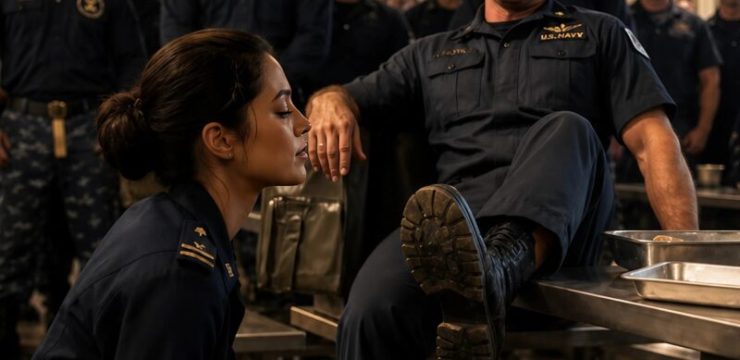
She had built a life that looked perfect from every angle.
The kind of life that made other women quietly envious — the tailored dresses, the dinner reservations at restaurants where the lighting was always flattering, the practiced smile that said I have arrived without ever raising her voice. She had learned long ago that elegance was armor, and she had worn it so long she sometimes forgot what she looked like underneath.
That evening was no different from any other, or so she believed.
She sat at her usual corner table, the one with the view of the city and the soft candlelight that never asked too many questions. Her guests were laughing. The wine was good. The conversation floated the way conversation does when everyone at the table has decided, without saying so, to keep things light.
And then the little girl appeared.
She was small — too small to be wandering alone through a room like this — with bare feet on the marble floor and eyes that held the particular kind of stillness that only children who have seen too much ever carry. She wore a shirt that had been washed so many times the color had given up trying. In her hand, she clutched something folded and damp, pressed close to her chest like it was the most important thing in the world.
The woman noticed her the way you notice something that doesn’t belong — and then, a breath later, noticed the eyes.
She knew those eyes.
God help her, she knew them.
There are faces that grief burns into you permanently, no matter how many years you spend trying to smother the memory beneath new clothes, new cities, and carefully curated silences. You can redecorate the whole house of your life and still find that one face waiting behind every door you were afraid to open.
The little girl’s eyes were her sister’s eyes.
Elena’s eyes.
The same Elena who had disappeared the night their father passed away, leaving behind nothing but whispered accusations and a family that found it easier to call her reckless than to ask what had really happened. The same Elena that the woman — in her most honest, most ashamed moments — had blamed for leaving. For not being stronger. For not staying.
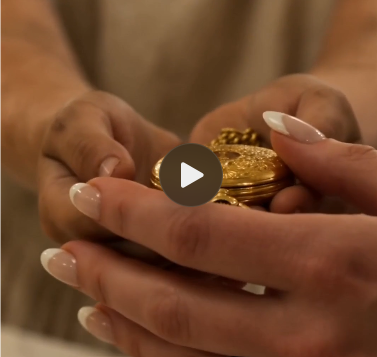
The woman’s fingers tightened around the delicate gold watch at her wrist, the one she had carried like a wound she refused to let close.
“Who is your mother?” she asked, her voice barely above a breath.
The little girl looked at the floor, as though saying the name out loud might shatter something in the room.
“Elena,” she whispered.
The woman felt the floor tilt beneath her. A waiter moved toward her instinctively, but she raised one hand to stop him. She did not want to be steadied by a stranger. Not in this moment. Not with Elena’s daughter standing barefoot in front of her, waiting with the patience of someone far too young to have learned patience the hard way.
The child reached into her pocket and drew out the folded napkin, pressing it forward with both hands.
“She wrote this for you,” the girl said quietly. “She told me if I got scared, I should give it to the woman wearing the watch.”
The woman’s hands shook as she unfolded it.
The handwriting was thin. Unsteady. But unmistakably Elena’s.
I tried to come back. They told me you hated me. They told me you threw the watch away. I kept mine all these years because I wanted our daughters to know we were once sisters — before everything else got in the way.
She read the word daughters twice.
Then a third time.
Her eyes dropped back to the little girl, and something inside her that had been locked for a very long time began to crack open at the seams.
This child had been carrying this message across the city, alone, barefoot, in the rain — because her mother trusted that somewhere inside the woman who had grown too proud to look back, the sister still existed.
“Where is she?” the woman asked.
The girl pointed toward the tall windows, where rain was running down the glass in long silver lines.
“In the old church,” she said. “She said she wanted to see you before she sleeps.”
The woman did not pick up her purse.
She did not excuse herself to her guests or smooth her dress or check her reflection in the mirrored wall. She did not consider, for even a single second, what this would look like to the people watching.
She took the little girl’s hand and she ran.
Through the golden light of the dining room, past the shocked and silent faces, past every careful, constructed thing she had ever done to make herself untouchable — she ran, because for the first time in twenty years, she had somewhere that actually mattered to be.
Outside, on the wet pavement, the little girl looked up at her with tears sliding quietly down her cheeks.
“Are you mad at Mommy?”
The woman dropped to her knees right there on the sidewalk, in the rain, in her beautiful dress, and pulled that child into her arms as though she could hold together everything that had been broken by pulling her close enough.
“No, baby,” she whispered, sobbing into the little girl’s hair. “I’m not mad. I’m just late.”
She looked down at the watch still open in her palm.
Inside, worn soft at the edges, was a photograph — two sisters, side by side, before the years had made them strangers.
And for the first time in two decades, the woman with the perfect life finally understood that the most important thing she had ever lost was not something money could replace or pride could recover.
It was the sister who had kept the other half of the watch.