Nobody noticed him when he first walked in.
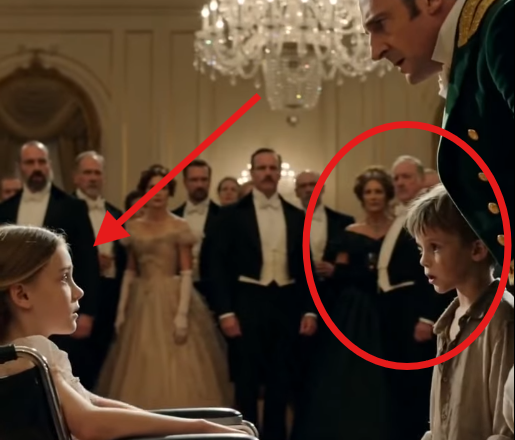
He stood near the entrance of the grand ballroom, barefoot, his clothes worn thin at the elbows, his hands rough from a life that hadn’t been kind. The chandeliers above him blazed with light that didn’t belong to someone like him — and everyone in that room made sure he felt it. Guests whispered. Shoulders turned. Eyes slid away the way they always do when someone doesn’t fit the picture.
But he stayed.
He stayed because of the girl in the corner.
She sat in her wheelchair at the edge of the dance floor, dressed in pale pink, her small hands folded neatly in her lap. She had been watching the dancing all evening — not with envy, exactly, but with something quieter and more painful than that. The kind of longing that comes from wanting something so deeply you’ve already learned how to grieve it before it’s even gone.
She wasn’t asking for anyone’s attention. She had stopped doing that a long time ago.
Most people at that party looked at her the way people look at something fragile — with careful, practiced pity dressed up as kindness. They smiled too softly. They spoke too gently. They treated her like she was already broken, already finished, already a story that had reached its end.
She had grown so tired of that look.
What no one knew — what she had never told anyone — was that she had been writing something down in private. A small drawing, folded into a square, tucked into the side pocket of her wheelchair. A girl in a pink dress standing beneath a chandelier, holding someone’s hand, both feet on the floor. And at the bottom, in her own careful handwriting, seven quiet words that carried the full weight of everything she had never been able to say out loud:
I don’t want pity. I want one real dance.
She must have dropped it somewhere during the evening without realizing it.
Because the barefoot boy found it.
He didn’t fold it back up and leave it on a table. He didn’t hand it to one of the well-dressed adults circling the room. He read it. He understood it. And then he walked straight across that polished floor toward her — past the stares, past the whispers, past every invisible wall that had been built to keep someone like him away from someone like her.
He crouched down beside her wheelchair and looked at her the way almost nobody had in a very long time.
Not with pity. Not with discomfort. Just directly, openly, like she was a person worth seeing.
“I think this belongs to you,” he said softly, holding out the folded drawing.
She looked at it. Then at him. Her breath caught somewhere in her chest.
“I knew you were waiting for someone to ask,” he whispered.
The whole room seemed to slow down in that moment. Her father, standing a few feet away, noticed the exchange and stepped forward instinctively — the protective, terrified instinct of a parent who has spent years trying to shield his daughter from one more disappointment.
But before he could reach her, something extraordinary began to happen.
The girl’s hands moved to the armrests of her wheelchair.
Slowly. Carefully. With every ounce of effort she had.
She began to rise.
Just a little at first — just enough to make the room go completely silent. Her knees shook. Her breath came in shallow waves. Her fingers found the boy’s hand and locked around it like a lifeline, like the one thing keeping her from falling back into the place she had been sitting for so long.
Her father’s face went white.
“Please,” she whispered, looking at him through tears that had already started falling. “Please don’t stop me.”
He froze where he stood. His hand rose slowly to cover his mouth.
The boy stayed perfectly still beside her, steady and calm, his worn and calloused hand holding hers with a gentleness that had nothing to do with how he looked or where he came from. He didn’t try to lift her. He didn’t rush. He just held on and let her find her own way up.
“Look at me,” he said softly.
She did.
And in that moment, something shifted in her face. The resignation that had lived there all evening began to loosen. She didn’t look like a girl trapped anymore. She looked like a girl fighting her way back to herself — one trembling, magnificent inch at a time.
One step forward.
Then another.
A cry broke from somewhere deep in the crowd. Not a dramatic sound — more like something released, something that had been held too tightly for too long. Several guests who had been whispering behind their hands now stood completely still, watching something they didn’t have a name for but recognized in their bones.
The girl was crying openly now, tears streaming freely down her face. But she kept moving.
“I can feel my legs,” she whispered — not to the crowd, not to her father, just to herself, like she was telling herself something she needed to believe.
Her father broke completely at that.
“How?” he asked, his voice barely held together. “How is this possible?”
The boy gently guided her into one small, slow turn beneath the chandelier light. Her pale pink dress moved softly around her. The light caught the tears on her face and made them look like something precious.
In the middle of that grand ballroom, surrounded by people who had spent the whole evening seeing everything except what actually mattered, a boy with no shoes and nothing to offer but his presence gave a girl the one thing that all the money in that room never could have bought her.
The courage to stand.
Some gifts don’t come wrapped in anything beautiful. Some of the most important things we ever receive arrive in torn pockets, in rough hands, in quiet voices that simply say — I see you. I know what you’re waiting for. Let me stand here with you while you find your way.
The chandelier light kept blazing. The crowd kept watching.
And the girl kept dancing.