The lobby was quiet the way lobbies get quiet when something is wrong — not peaceful, but held. The kind of stillness that settles over a room when people are watching and waiting and pretending they are not.
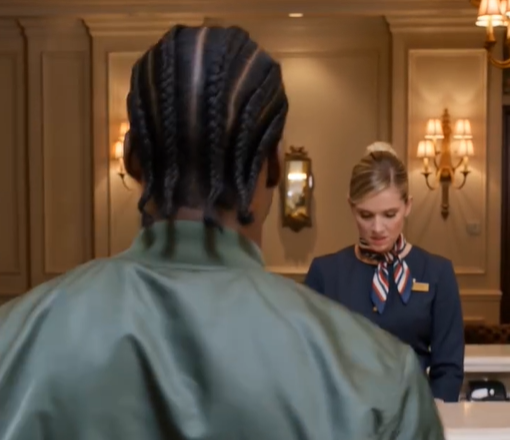
He had not announced his return.
No press release. No advance phone call. No assistant walking ahead of him to smooth the path. He had simply come back — one night early, alone, wearing a plain green jacket — and walked through the front doors of the hotel that bore his name.
That was the first thing nobody expected.
The second thing nobody expected was what happened the moment he stepped toward the reception desk.
The receptionist reached beneath the counter and raised a spray can toward his face.
The whole room froze.
He stepped back, eyes stinging, and people around the lobby stood motionless as if someone had pressed pause on the world. Security guards nearby did not move. Did not reach for him. Did not reach for her. Just stood there, watching, the way people watch when they already know what they are not supposed to say.
And that was the moment everything shifted.
Because he looked down at the spray can she had dropped, turned it over in his hand, and understood something that had nothing to do with self-defense.
This was not something she had brought from home.
This was hotel-issued. Authorized. Prepared and placed under that counter with a specific purpose in mind — and a specific person in mind. The label, the make, the way it had been stored: it all spoke of intention. Of planning. Of someone who had known he might return and had made arrangements accordingly.
His voice came out low and controlled, the kind of quiet that carries more weight than shouting ever could.
“Who gave you this?”
She backed up half a step.
The arrogance that had been in her posture moments before had quietly dissolved into something that looked a great deal more like fear.
“I… I thought—”
“No,” he said. “You didn’t think. Someone told you what to do.”
Across the lobby, the elderly concierge had gone completely gray. His hands were still at his sides, but his jaw had tightened in that particular way that men of a certain age hold themselves together when they are carrying something they should have put down a long time ago.
He knew what tonight meant.
The owner had come back without warning. Without ceremony. Which meant that whoever had been running things inside these walls during his absence had no time to prepare. No time to clean up. No opportunity to rearrange what had been rearranged, or lock what had been left unlocked, or remove what should never have been there at all.
The owner turned back to the receptionist.
“Say his name.”
Before she could answer, the private side entrance opened and a gust of cold night air rolled across the marble floor.
A hotel manager walked in — sharply dressed, perfectly composed, moving the way confident men move when they believe they still have control of a room.
He slowed when he saw the crowd.
Then he saw the spray can.
And the color left his face entirely.
It was not the look of a man encountering a misunderstanding. It was not confusion, not outrage, not the indignation of someone wrongly accused. It was the specific, unmistakable look of a man who realizes that the thing he spent weeks hiding has just been placed in the hands of the person it was hidden from.
The owner let out a short, bitter laugh — the kind that does not sound like laughter at all.
“You told her I was a threat before I even arrived,” he said quietly. “Why would you do that?”
The manager tried to gather himself.
“Sir, this is a misunderstanding—”
But the concierge had finally had enough.
His voice was shaking, but it did not stop.
“He’s been using the penthouse after hours.”
The lobby went absolutely still.
“People who never checked in. Cash envelopes. Private keycards. No cameras running on that floor.”
The manager had gone white.
And then the receptionist — quietly, almost to herself — said the part that explained everything:
“He told me that if a man in a green jacket came in asking questions… don’t let him get upstairs.”
Silence settled over the room like a held breath.
The owner stood very still.
Because now he understood with perfect clarity. She had not reached for that spray can because she thought he was dangerous. She had reached for it because someone who knew exactly who he was had put it there, had prepared her, had counted on the confusion and the chaos buying just enough time.
Time for what?
He looked toward the elevators. Toward the penthouse floor.
He handed the spray can to the nearest guard.
“Lock the front doors,” he said, and his voice was steady now — past anger, past pain, settled into something harder and clearer than either. “No one leaves.”
Then he walked toward the elevators with the measured pace of a man who already knows that whatever has been hidden cannot stay hidden much longer.
Because the manager had panicked before he even reached the desk.
And people only panic like that when the truth is still upstairs, waiting.