The showroom was gleaming. Polished floors reflected the overhead lights like mirrors, and the cars on display looked more like sculptures than vehicles. Chrome. Glass. Power. Everything in that room was designed to make someone feel something — usually desire, usually status.
But the little boy who walked through the door that afternoon wasn’t thinking about any of that.
He was just excited.
He’d seen the red supercar in a magazine his mother used to keep on the coffee table. She’d been gone for two years now, but that magazine never moved. And somewhere in the quiet grief of growing up without her, the boy had decided — one day, he wanted to see that car up close. Not to own it. Just to see it. To feel what it felt like to stand next to something beautiful.
He came in wearing his backpack, sneakers that had seen better days, and the kind of wide-eyed wonder that only children carry naturally. He walked straight to the red car and stood there, hands clasped behind his back, just looking.
That’s when the salesman approached.
He took one look at the boy — the worn jacket, the scuffed shoes, the absence of any adult with a checkbook — and made a decision.
“You can’t be in here,” the salesman said flatly. “This isn’t a place to hang around.”
The boy looked up, confused. “I’m waiting for my dad. He said he’d meet me here.”
The salesman didn’t soften. He reached out and grabbed the boy by the shoulder, steering him toward the door. “Kids don’t just wander in here. Move along.”
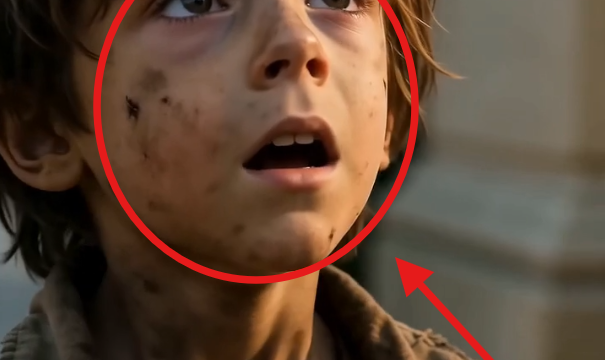
The boy stumbled. His cheek caught the edge of something on the way — a sharp, accidental contact that left a red mark across his face. He didn’t cry out. He just sat down on the floor near the entrance, pulled his knees to his chest, and waited.
He waited with the quiet dignity of a child who had already learned that the world doesn’t always treat people the way they deserve to be treated.
When the father walked in, he saw his son immediately.
Sitting on the floor. Cheek marked. Backpack still on. Eyes dry but distant.
He crossed the room in three strides and knelt down in front of him.
“What happened?”
The boy looked up. “I told him I was waiting for you.”
The father’s jaw tightened. He looked at the salesman, who was already backing away, something like panic replacing the arrogance that had been there moments before.
“Sir, I didn’t know—” the salesman started.
The father cut him off with the simplest, most devastating sentence.
“That is exactly the problem.”
The showroom manager rushed forward, recognizing the shift in the room’s atmosphere. “Mr. Bennett, please. We can fix this.”
The salesman froze at the name. Every customer in the showroom went still. Mr. Bennett — whose company owned this building. Who had come here, on this particular day, to buy the first car his son had ever chosen for himself.
The father stood slowly and looked around the room. His voice was steady, controlled, the kind of calm that carries more weight than any raised voice ever could.
“My son walked in here curious. Kind. Excited. He came dressed like himself — like a child — and your employee decided he only deserved respect if he looked like money.”
The manager swallowed hard.
“My son needed nothing from anyone in this room except basic human decency.”
The salesman whispered, “Please. I need this job.”
The father looked at him for a long moment.
“My son needed kindness.”
No one spoke. The gleaming showroom, with all its expensive beauty, felt suddenly hollow.
Then the father gently reached down, lifted the boy’s backpack from the floor, and settled it on his son’s shoulders. He took his hand and helped him to his feet.
“You’re done here,” he said quietly to the salesman.
He meant it.
Then the boy turned. He looked at the red car — the car from his mother’s magazine, the car he had waited so long to see — and something moved across his face. Not anger. Something older than that.
“Dad?”
“Yeah, buddy?”
The boy glanced at the salesman’s trembling hands, then back at his father.
“Can we go somewhere else?”
“Of course,” his father said. “What are you thinking?”
The boy was quiet for a moment, looking around at the customers who had watched everything unfold.
“I want to buy a car from a place where nobody gets treated like they don’t matter just because of how they look.”
The father felt something break open in his chest. He thought about his wife. About the lessons she had woven into their son’s heart before she left them — quietly, patiently, with the kind of love that outlasts even death.
Nice things don’t matter if people use them to feel bigger than others.
She had said that once at the dinner table, and apparently, their son had never forgotten it.
The father looked at the red supercar one last time. Beautiful, expensive, meaningless.
Then he looked at his boy.
He smiled through the ache of missing her, through the pride that made his throat tight.
“You know what?” he said softly. “That kind of thinking is worth more than every car in this room.”
He put his arm around his son’s shoulders and walked him out through the gleaming glass doors, into the afternoon light, leaving behind a showroom full of people who had just witnessed something that no price tag could ever reflect — the quiet, unshakeable dignity of a child raised right.
And somewhere, in the way the boy held his chin up as they walked away, his mother was still teaching.