Life in a military camp runs on structure. Every morning begins the same way — roll calls before the sun fully rises, uniform inspections under watchful eyes, brief conversations exchanged between canvas tents. Soldiers follow orders without hesitation. No one argues. No one stands out. The rhythm of discipline holds everything together, like stitches in a wound.
That ordinary morning felt no different from any other. Until a voice — sharp, arrogant, and completely out of place — cut through the quiet like a blade.
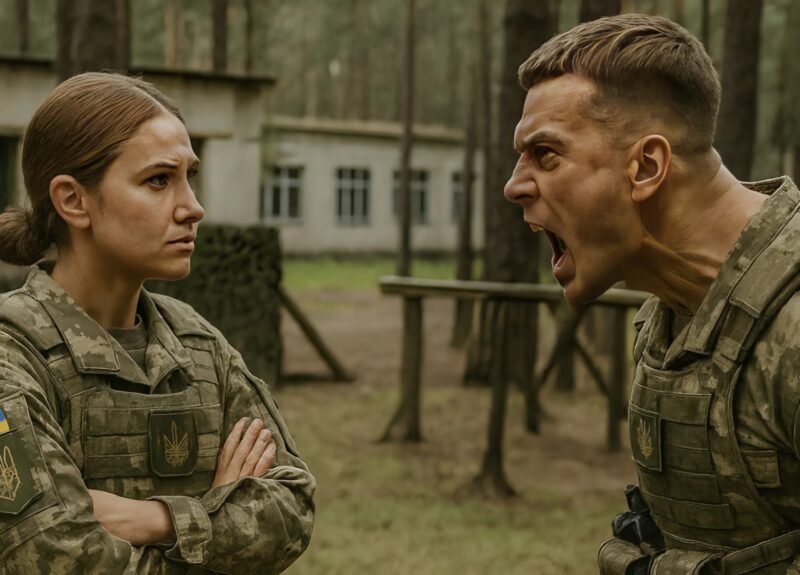
“Bring me coffee, woman!” the young lieutenant barked, his eyes fixed on the new recruit who had only just arrived the day before. “That’s what you’re here for. To serve us.”
The words landed like a slap across the face of every person standing within earshot.
Everyone froze. Time seemed to stop. Even the birds went quiet.
The young woman didn’t flinch. She didn’t lower her gaze. She didn’t stammer or apologize or shrink into herself the way he clearly expected her to. Instead, she calmly folded her arms across her chest, squared her shoulders, and looked him directly in the eye.
“I’m a soldier,” she said, her voice steady and clear. “Just like you. I’m here to defend my country. Not to make coffee.”
A collective gasp rippled through the crowd of onlookers.
“How dare you talk back to a superior officer?!” he roared, stepping forward, closing the distance between them as if his proximity alone could intimidate her into submission.
Dozens of eyes locked onto the scene. Nobody moved. Nobody spoke. They all wanted to see how this extraordinary act of defiance would play out — and whether this woman, who had barely unpacked her bags, truly understood what she had just walked into. The lieutenant was not a man people challenged lightly. He had spent his entire adult life in uniform, had earned every stripe through iron discipline, and ruled his unit through fear as much as respect.
But she wasn’t afraid. She stood perfectly still — calm, firm, and completely unshaken. There was no trembling in her hands, no wavering in her gaze, no crack in the quiet dignity she wore like armor.
Whispers spread through the camp like wildfire after that. Some soldiers muttered that she was reckless, that she had no idea what she had just done to herself. Others said it quietly, almost with reverence — that she had nerves of steel. That they had never seen anyone stand up to him like that. Not once. Not ever.
The lieutenant wanted desperately to forget it ever happened. But the camp had a long memory, and so did fate.
Their unit came under heavy enemy fire not long after. There was no warning. The ground shook violently beneath their boots. The air split apart with the force of explosions, smoke and dust swallowing everything in sight. The cries of the wounded rose above the thunder of artillery, raw and desperate, cutting through the chaos in a way that no training could ever fully prepare you for.
In the confusion and panic of retreat, the lieutenant was struck in the leg. He went down hard, falling face-first into the mud. The impact knocked the breath from his lungs. He tried to rise, but his body refused. Around him, soldiers scrambled toward cover, their instincts overriding everything else. In the smoke and noise, no one noticed he had fallen.
No one except her.
She saw him go down. And without a single moment of hesitation, she turned around and ran back — straight into the fire, against every instinct that screams at a person to survive. Bullets tore through the air above her head. Shrapnel exploded in the earth around her feet. She dropped to her hands and knees, crawled through the mud and blood, and when she finally reached him, she grabbed him under his arms and began to pull.
He was heavy. She was exhausted. Pain shot through her body with every inch of ground she covered. But she did not stop. She did not let go.
She dragged him all the way to safety.
In the hospital, he regained consciousness slowly, as if fighting his way back from somewhere very far away. A white ceiling above him. The steady drip of an IV beside him. Pain radiating through every part of his body. And there, sitting in the chair beside his bed — bandaged, hollow-eyed, and bone-tired — was the same young woman he had shouted at in front of everyone.
He stared at the ceiling for a long time before he could find the words.
“All my life,” he finally whispered, his voice rough and quiet, “I believed in my men. I believed that strength and protection were things that only men could offer.” He paused, the weight of what he was about to say pressing down on him. “I thought women were just… there. On the sidelines.”
He turned his head slowly and looked straight into her eyes.
“But the only one who came back for me,” he said, “was you. You didn’t leave me behind. You are stronger than any of us. A true soldier. A real hero.”
She was quiet for a moment. Then she shook her head gently and spoke in a voice that carried no pride, no bitterness — only a bone-deep sense of purpose.
“I only did what anyone wearing this uniform should do.”
And in that moment, for the first time in his long career, he truly understood the meaning of service. Not the kind that comes with rank or commands or the sound of boots on a parade ground. The real kind. The kind that shows up in the middle of chaos, without hesitation, without expectation — and refuses to leave anyone behind.
Real strength, he finally learned, has nothing to do with who gives the orders. It has everything to do with who stays when everything falls apart.