Alex and Anna had always considered themselves practical people. They didn’t rattle easily, didn’t lean into superstition, and prided themselves on thinking things through before jumping to conclusions. But three months into parenthood, their nerves were worn thin in ways they never could have predicted — and when their beloved dog started behaving strangely every single night, even the most levelheaded couple on the block was bound to start asking uncomfortable questions.
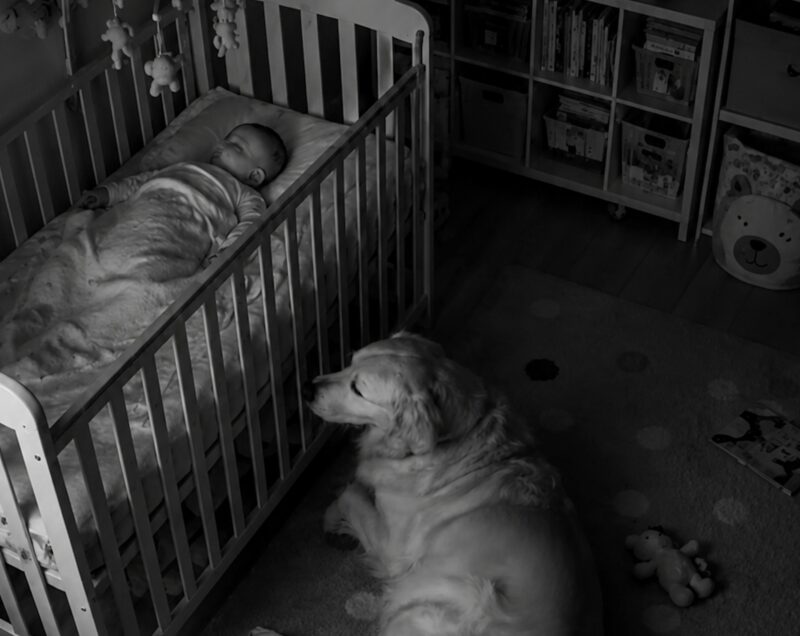
Their son had arrived in the spring, small and red-faced and utterly dependent, turning their quiet home upside down in the most beautiful way imaginable. The sleepless nights were brutal. The joy was indescribable. And somehow, in the middle of all that beautiful chaos, life found a kind of rhythm — however fragile and exhausting it was.
Max, their seven-year-old Golden Retriever, had been part of the family long before the baby came. He was the kind of dog that strangers stopped on the sidewalk to pet, the kind that leaned against your leg when you were sad without you ever having to say a word. Gentle, steady, and warm — that was Max. He’d never been a problem, not once in seven years.
So when his behavior began to shift, it caught them completely off guard.
It started subtly, the way most unsettling things do. Each evening, after Alex and Anna settled the baby into his crib, turned off the nursery light, and retreated to their own room, Max would rise quietly from his spot on the living room rug. No fuss. No noise. He would simply pad down the hallway and disappear into the nursery, where he would remain until morning.
At first, they smiled about it. Of course he loves the baby. Of course he wants to be close. That’s just Max being Max.
But then they started noticing the details — and the details were harder to explain away.
Max wasn’t sleeping in the nursery. He was standing guard. His head stayed raised throughout the night, his dark eyes moving steadily between the crib and the far wall. Sometimes he would rise suddenly, cross the room to the window, listen for a long moment with his ears pitched forward, and then return to his position beside the crib without a sound.
“That’s not normal dog behavior,” Anna said quietly one night, watching him from the doorway.
“Maybe he’s anxious,” Alex offered. “New baby, new smells, new sounds. Dogs pick up on stress.”
But the explanation didn’t sit right with either of them, because the thing about Max was that he had never been an anxious dog. He was the opposite of anxious. He was the dog you leaned on when you were anxious.
Anna’s worry began to grow in the quiet hours of the night, the way worry always does when you’re already running on almost no sleep and your whole heart is sleeping in the next room in a crib.
What if he jumped up? What if those big, heavy paws accidentally came down somewhere they shouldn’t? What if, despite every gentle thing they knew about him, something in Max had shifted since the baby arrived?
They didn’t want to believe it. But they also couldn’t ignore it.
“Let’s put in a camera,” Alex said. “We watch the footage, we see what’s actually happening, and then we know.”
A small night-vision camera went up in the corner of the nursery the very next day. That evening, they followed their usual routine — bath, feeding, lullaby, lights out — and then they made themselves stay out of that room until morning.
Alex was the one who pulled up the footage first. For a long stretch of time, it showed exactly what they might have expected: Max lying calmly beside the crib, occasionally lifting his head, his tail sweeping the floor in a slow, contented rhythm. Nothing alarming. Nothing strange.
And then, in the deep quiet of the middle of the night, everything changed.
Max’s head snapped toward the baseboard on the far wall. His body went rigid. A low growl built in his chest — not aggressive, not panicked, but focused. Controlled. The growl of an animal that has identified a threat and is already calculating what to do about it.
Then the first rat came through the crack.
Anna made a sound she couldn’t name when she saw it. Then the second appeared. Then the third. Within moments, several large rats were moving fast along the baseboard, heading directly toward the baby’s crib.
Max moved faster.
He lunged forward, planting himself between the wall and the crib, barking with an authority that sent the rats scrambling backward. He drove them toward the crack without hesitation, without pause, without letting a single one get anywhere near the baby. When the last one disappeared beneath the floorboards, he stood at that spot for a long time, watching. Waiting. Making absolutely certain they weren’t coming back.
Anna was shaking by the time the footage ended.
When the pest control specialists arrived that morning and opened part of the nursery floor, even they were visibly shaken by what was underneath. A massive nest. Dozens of tunnels carved through the subfloor. Evidence that rats had been living beneath that house for a very long time — and slipping through that crack beside the crib, night after night, for weeks.
The specialists were clear: if the problem had gone undetected much longer, the situation could have become genuinely dangerous for the baby.
That evening, Anna sat on the nursery floor beside Max for a long time. She wrapped both arms around his neck and pressed her face into his golden fur.
“We almost didn’t trust you,” she whispered. “We almost took you away from him. And the whole time, you were the only one keeping him safe.”
Max turned his head slowly and looked at her with those calm, steady eyes. His tail swept the floor once. Twice. Three times.
When night fell, he walked back to his spot beside the crib — not because anyone asked him to, not because he was trained to, but because that’s what you do when you love someone.
You stay.