Nobody expected her. Nobody was prepared for her. And nobody — not a single soldier in that heavily guarded corridor — would ever forget what happened the morning a seventy-year-old woman walked through those doors.
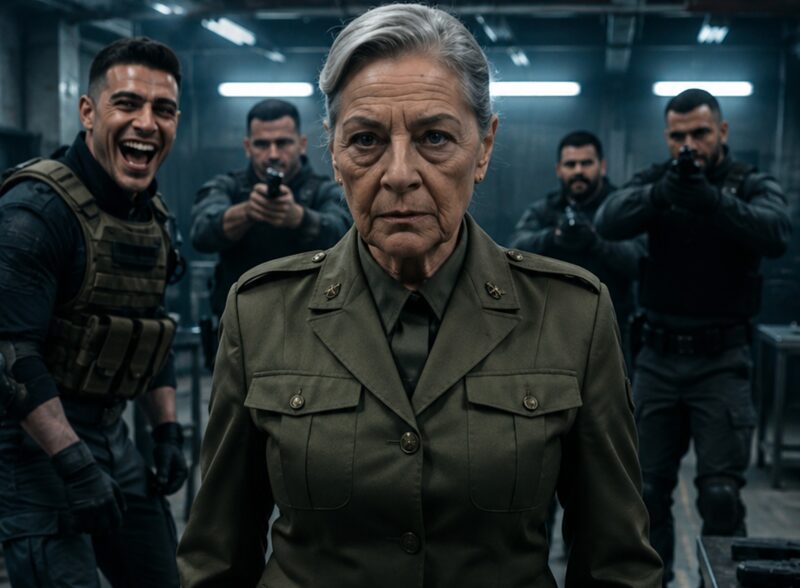
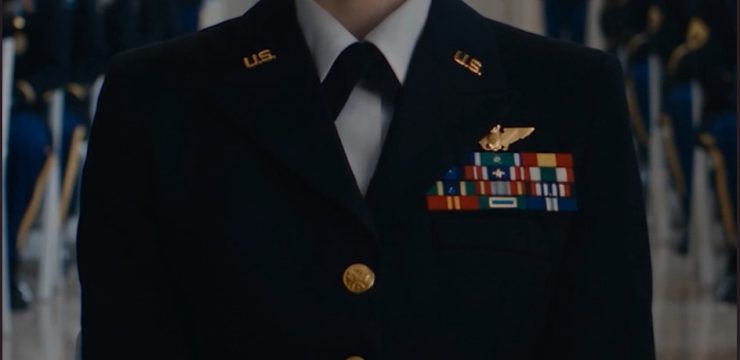
She moved with quiet confidence, her dark green military uniform crisp and unadorned, carrying none of the medals or ribbons that typically signal rank to the untrained eye. Only a few small insignia marked her collar — insignia that the young guards on duty that morning failed to recognize, or perhaps never bothered to look at closely enough.
Deep inside the sprawling military base stood a building that most personnel didn’t even know existed. It was the kind of place where colonels spoke in hushed tones over sealed folders, where intelligence officers tracked dangerous groups across encrypted screens, and where decisions were made that could determine the safety of thousands of lives. Access was granted only to those with the highest levels of authorization. Every entrance was monitored. Every visitor was expected and accounted for.
That morning, a group of senior officers had gathered in the main hall. A detailed map of a border region filled the large screen at the front of the room — the site of a critical operation that was days away from execution. The atmosphere was tense, focused, and serious.
Then the security alarm sounded.
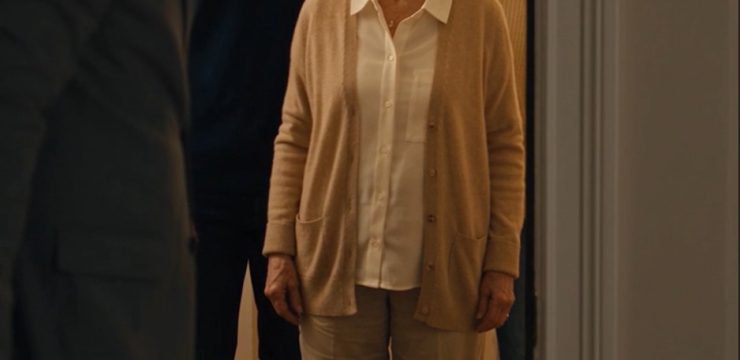
Seconds later, the heavy reinforced doors swung open, and an elderly woman stepped calmly inside.
She looked around the room without a trace of nervousness, adjusted her gloves, and said simply, “Good morning, gentlemen.” Then she turned and walked toward the corridor leading to the main conference room.
One of the guards moved to block her immediately.
“Stop! Hands up and don’t move!”
Every weapon in the room was raised and pointed in her direction. The woman stopped. She raised her hands slowly and looked directly at the young guard in front of her.
“Lower your weapon,” she said, her voice steady and unhurried. “I am here for a scheduled meeting.”
“What meeting?” the guard sneered, loud enough for his colleagues to hear. A ripple of laughter moved through the room. “Do you even understand where you are right now?”
Sergeant Mark Davis, the shift supervisor that morning, stepped forward with the kind of smug authority that comes from never having been truly challenged.
“This is not a museum,” he said. “And it’s certainly not a nursing home. If you wandered in here by mistake, leave now and we’ll forget this ever happened.”
More laughter from the soldiers behind him.
The woman’s eyes dropped briefly to his name tag, then returned to his face.
“Sergeant Davis,” she said evenly, “do you always speak to people this way?”
“Don’t lecture me,” he shot back. “You entered a protected federal building without authorization. Show me your identification — right now — or this is going to end very badly for you.”
“My identification is in the inside pocket of my uniform,” she replied.
A younger guard stepped forward aggressively, reaching toward her. She stepped back.
“Do not touch me.”
That drew the loudest laughter yet. Comments flew from the back of the room — cruel, dismissive, the kind of jokes that come easily when a group of young men decides someone isn’t worth taking seriously. One soldier suggested she had found her late husband’s old uniform. Another laughed about her thinking this was some kind of ceremonial parade.
She stood through all of it without flinching. Without raising her voice. Without breaking her composure for even a single second.
And then something happened that silenced the entire room.
The commotion finally drew Colonel Robert Hale out of the main hall. He was the officer overseeing the classified operation, a man accustomed to commanding immediate respect.
“What is going on here?” he demanded.
Sergeant Davis snapped to attention and quickly explained — an unidentified woman, no escort, no visible credentials, possibly confused.
The colonel studied her. He didn’t recognize her either.
“State your name and explain who authorized your entry,” he said.
“My name is Evelyn Carter,” the woman replied. “I arrived as specified in the order that was issued.”
The colonel frowned. “I haven’t seen any such order.”
“You wouldn’t have,” she said. “It was sent directly to the base commander.”
He allowed himself a thin smile — the kind worn by people who believe they already know how a situation ends. “Everyone we detain here claims to be someone important. Show me your identification.”
She lowered one hand slowly. The guards tensed again. She told them to retrieve it themselves, carefully this time.
Sergeant Davis reached into the inside pocket of her uniform and pulled out a small black booklet. He opened it. He looked at the photograph. He looked at the woman.
The smile left his face entirely.
The first page read: General of the Army Evelyn Carter. Special Adviser for National Security.
The colonel took the booklet from Davis’s hand, his own confidence clearly wavering. “This could be falsified,” he said — though his voice had lost its edge.
Evelyn said nothing. She simply walked to the electronic panel beside the locked door and pressed her palm flat against the biometric scanner.
Her name appeared instantly on the screen.
A calm automated voice followed: Highest access level confirmed. Welcome, General Carter.
Every secured door in the corridor unlocked simultaneously. The officers’ phones lit up with an urgent priority notification. The room went completely still.
Sergeant Davis lowered his weapon. Colonel Hale came to attention.
“Forgive me, General,” he said quietly.
Evelyn looked at him for a long moment before she responded.
“Next time,” she said, “verify a person’s credentials before you form your conclusions about them.”
What none of the men in that corridor knew — not yet — was that in the brief minutes since she had walked through those doors, General Carter had already identified a security breach in the operation’s communications. A traitor had been feeding classified details to outside parties. The mission, and the lives depending on it, had been in serious jeopardy.
She had seen it immediately. She had already begun the process of containing it.
By the time the officers reassembled in the main hall, the threat had been neutralized — quietly, efficiently, and without ceremony — by the seventy-year-old woman they had laughed at in the corridor.
The security protocols in that building were rewritten in the days that followed. But more than the rules changed. Every soldier who had been present that morning carried something with them that couldn’t be written into any regulation — the memory of their own assumptions, and how completely, how embarrassingly wrong they had been.
Never again did any of them judge a person by their age, their appearance, or the absence of visible decoration on their uniform.
Because they had learned, in the most unforgettable way possible, that true authority rarely announces itself loudly.
Sometimes, it simply walks through the door.