There is a kind of exhaustion that goes beyond the physical. It lives somewhere deeper — in the chest, behind the eyes, in the tight clench of a mother’s jaw as she rocks her child for the hundredth time and still cannot make the crying stop.
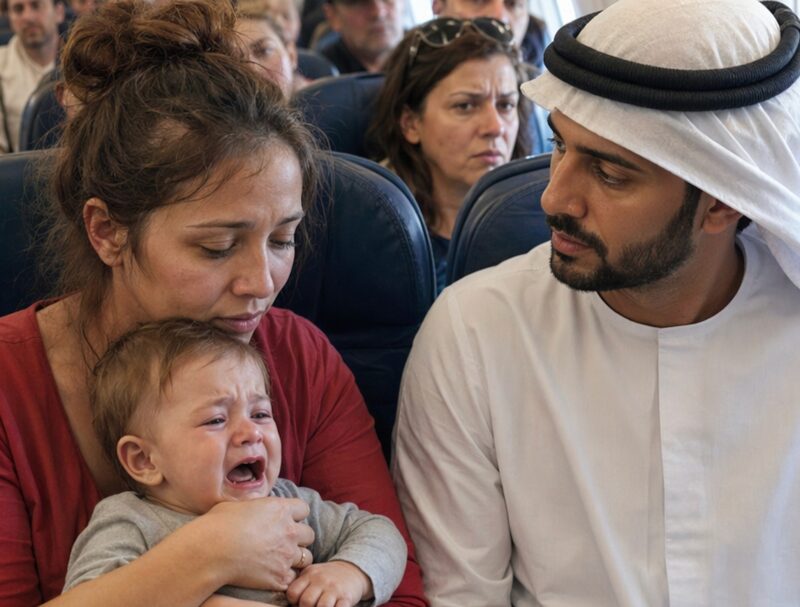
That was the exhaustion written all over her face.
The flight had been in the air for well over an hour, and the baby had been crying for nearly all of it. Not the soft, whimpering kind of crying that passengers can tune out with a pair of headphones. This was raw, desperate wailing — the kind that seemed to vibrate through the walls of the cabin itself. The little boy’s face had gone red, his tiny hands balled into tight fists, his whole body rigid with distress. He wasn’t just fussy. He was frightened, overwhelmed, and completely inconsolable.
And every single passenger on that plane could feel it.
People shifted in their seats. Heavy sighs drifted up and down the aisle. A woman near the front pressed her noise-canceling headphones harder against her ears. A man across the row tapped his fingers on the armrest in a steady, agitated rhythm, his jaw tight, his eyes fixed on the seat in front of him rather than say what he was clearly thinking. A few passengers exchanged looks — those silent, loaded glances that said everything without a single word being spoken. The tension inside the cabin had slowly climbed to something almost unbearable.
At the center of it all was a young mother who looked like she was barely holding herself together.
Her hair was disheveled, her eyes swollen and red-rimmed, her arms locked around her son as she swayed back and forth in the narrow seat. She tried everything she could think of — singing softly, pressing him gently to her chest, shifting him from one position to another, offering comfort she no longer had the strength to give. None of it worked. The baby kept crying. And with every passing minute, she seemed to shrink a little more under the weight of all those watching eyes.
She looked up more than once, catching the stares of the passengers around her, and each time she did, the apology fell from her lips in a trembling whisper.
“I’m so sorry… it’s his first time flying… he’s scared… please, I’m so sorry…”
Her voice cracked on that last word. And then, quietly, with her child still crying in her arms, she began to cry too. Tears slipped down her cheeks and she didn’t even try to wipe them away. She just held her son tighter, as if her arms alone could shield him from a world that suddenly felt far too large and far too cruel.
Then she said something that stopped even the most impatient passengers cold.
“We’re just going to see my parents,” she whispered, more to herself than to anyone around her. “It’s our first trip since his father passed away.”
A hush fell over the nearest rows. The tapping fingers went still. The heavy sighs disappeared. For a brief moment, even the irritation seemed to dissolve into something quieter and more human.
But the baby’s cries didn’t stop.
Seated beside them, in the window seat, was a young man dressed in traditional white robes — a sheikh, clearly from a family of means, his posture composed and dignified. He had heard every second of the crying, just like everyone else on that plane. His expression had remained serious throughout, his brow faintly furrowed, his gaze steady. He hadn’t said a word. He hadn’t complained, hadn’t rolled his eyes, hadn’t made a single gesture of frustration. He had simply watched. And waited.
Then something shifted in him.
He leaned forward slightly, turned toward the mother, and spoke in a calm, unhurried voice.
“May I?”
She looked at him, confused at first, not quite understanding what he was offering. He extended his arms — gently, openly, without any rush. She hesitated for only a heartbeat. Then, perhaps out of sheer desperation, perhaps out of some quiet instinct that told her this was safe, she placed her son into his hands.
The cabin went still.
People turned around. Heads lifted from pillows and screens. The sheikh cradled the child with the practiced ease of someone who had held babies before — confident but tender, secure but soft. He drew the little boy close to his chest, began a slow, steady rocking motion, and then he started to sing.
It was a gentle melody, sung low in Arabic. His voice was calm and unhurried, warm in a way that seemed to fill the space around them. There was nothing performative about it. It sounded like something remembered — something passed down, something old and deeply familiar.
The baby’s sobs began to slow. His rigid little body softened. He blinked up at the man holding him, listening. His breath came in uneven hitches at first, then gradually, impossibly, began to even out.
And then — silence.
Real silence. The kind no one on that flight had heard since takeoff.
The sheikh kept rocking, kept singing, his voice never rising above a murmur. The child’s eyes grew heavy. His small fists uncurled. He melted into the warmth of this stranger’s arms and simply… let go.
The mother stared, tears streaming freely down her face.
“How did you do that?” she breathed.
The sheikh glanced at her with a small, quiet smile, never breaking the rhythm of his rocking.
“My mother used to sing this to us when we were little,” he said softly. “It always worked.”
He looked at the exhausted woman beside him and added, with a gentleness that seemed to carry the weight of everything unsaid on that flight:
“Rest now. I’ve got him.”
She pressed her hand over her mouth. Her shoulders shook. But these tears were different from the ones that had come before. These were the tears that only fall when a person — worn all the way down to nothing — is unexpectedly, and without condition, shown kindness.
No one on that plane complained again. Not once. For the rest of the flight, the cabin was quiet — not with the silence of people suppressing their frustration, but with something rarer and harder to name. The silence of people who had just witnessed something they hadn’t expected to see, and found themselves quietly moved by it.
Sometimes, all it takes is one person willing to lean forward and ask two simple words.
May I?
And in those two words — an entire world of compassion.