Nobody used the old underpass anymore. Not after dark. Not if they could help it.
For months, the crumbling tunnel on the edge of town had earned a grim reputation that spread quietly through the neighborhood like smoke under a door. People whispered about it at the grocery store, warned their neighbors over the fence, texted their adult children to avoid that stretch of road entirely. Phones had been stolen there. Wallets snatched. A woman had her necklace torn right off her neck. An older gentleman came home one evening without his wedding ring, too shaken to even file a report until the following morning.
The community pleaded for more police presence. Petitions were signed. Calls were made.
And yet, every single time officers arrived, the suspects had vanished into the night like ghosts. The underpass swallowed them whole and spat out nothing but frustration. So residents began taking long, inconvenient detours — adding twenty minutes to their evening walks just to feel safe. The tunnel sat there, dim and damp, claimed by criminals who believed they were untouchable.
That particular evening, an elderly woman in a soft blue coat appeared at the entrance of the underpass. She walked without urgency, carrying a small handbag, her footsteps unhurried, her posture calm. She looked like someone’s grandmother heading home after a long day — a little tired, perhaps, but completely unaware of the danger ahead.
Inside the tunnel, the ceiling lights flickered weakly. Every footstep echoed. The smell of damp concrete hung in the still air. She kept walking, steady and slow, until she reached the midpoint — and three men stepped out from the shadows to block her path.
They were young, muscular, dressed in athletic gear, their arms decorated with tattoos. They carried themselves with the casual arrogance of people who had done this many times before and never once faced consequences.
The one in front grinned and said, almost cheerfully, “Well, granny, where are you off to? Let’s make this real simple. Wallet, phone, jewelry.”
His companion glanced at her handbag. “And those rings. Take them off. Do it fast, while we’re still being friendly about it.”
The woman stopped walking. She looked up at them — all three of them — and when she spoke, her voice was completely, unnervingly steady.
“I don’t have much on me. But whatever I do have, I will not hand over to men like you.”
For a brief moment, the three men just stared. Then one of them laughed — a short, dismissive sound — and said, “You’ve got some nerve, old lady.”
She held his gaze and replied quietly, “You seem to only know how to threaten the elderly and women.”
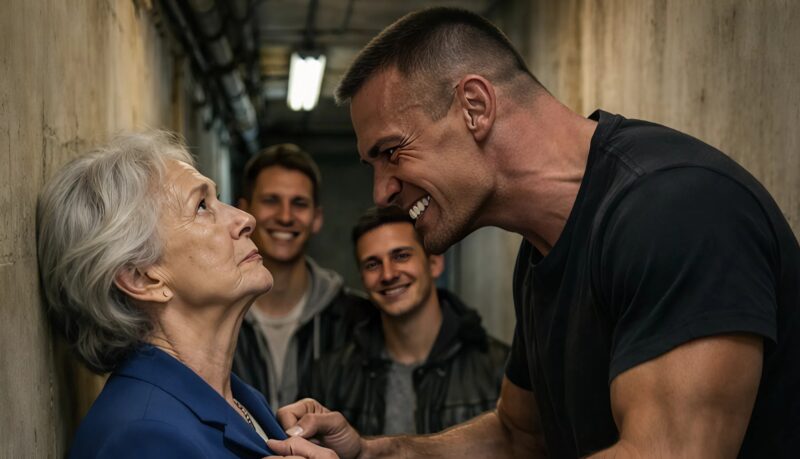
Something shifted in the leader’s expression. The smirk disappeared. His jaw tightened, and in one quick, ugly motion, he grabbed her by the collar of her blue coat and shoved her hard against the tunnel wall.
She hit the concrete with enough force to make her close her eyes. The pain was real. There was nothing theatrical about it. But she didn’t cry out. She didn’t beg. She stood there, back against the wall, eyes shut, breathing through it.
The other two watched and grinned. One of them said, “Should’ve just handed it over right away. Too late to play tough now.”
After a long moment, the woman opened her eyes. She looked at the man who had pushed her and said softly, “You’re right. I’m sorry. I’ll get the money. It’s in my pocket.”
The leader relaxed his grip slightly. “Take it out slowly. No sudden moves.”
Her hand moved into her coat pocket — carefully, slowly, exactly as instructed.
But what came out was not a wallet.
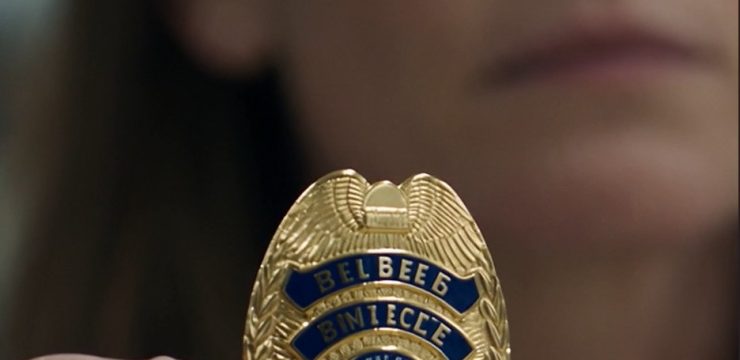
A badge caught the dim flickering light and gleamed in her palm. She raised it directly in front of the man’s face. Her voice, when she spoke again, was completely transformed — firm, clear, and absolutely unafraid.
“Chief Investigator. Investigative Committee. You are surrounded. Do not move.”
The grins died instantly. The three men barely had time to process what was happening before the sound of heavy, deliberate footsteps filled both ends of the tunnel simultaneously. Officers in tactical gear swept in from each direction — flashlights cutting through the darkness, commands echoing sharply off the concrete walls.
Within seconds, all three men were pressed against the wall, arms behind their backs, the arrogance completely drained from their faces.
One of them — the same one who had been laughing just moments earlier — had gone pale. He managed only a whisper: “What… is this a setup?”
The woman straightened her coat collar. She looked at each of them in turn, calm as a winter morning.
“We have been watching this location for a long time. Every time we came close, you disappeared. So we gave you something you couldn’t walk away from — a target you thought was easy.” She paused. “Now we have you. And we have everything we need.”
The handcuffs clicked. Not one of the three men said another word.
When they were escorted out, the woman bent down, picked her handbag up from the ground, smoothed the front of her blue coat, and walked toward the exit at the same unhurried pace she had entered with — as though she had simply finished an ordinary afternoon’s work.
The underpass, for the first time in months, felt a little less dark.
Justice doesn’t always look the way you expect it to. Sometimes it wears a blue coat and walks slowly through a dangerous tunnel. Sometimes the most powerful person in the room is the one everyone underestimates. And sometimes, the people who believe they are untouchable find out — in the most humbling way possible — that they were never as clever as they thought.
For every community that has felt helpless, for every resident who took the long way home out of fear, this story is a quiet reminder: the work of protecting people is happening, even when it isn’t visible. And courage, it turns out, doesn’t have a dress code.