It was one of those rare, unhurried afternoons when the world seems to slow down just enough to breathe. A seventy-year-old man settled onto a worn wooden bench in the park, his hands resting loosely in his lap, his face turned gently toward the sun. Around him, life moved at a comfortable pace — parents strolled with strollers, children zipped by on bicycles with reckless joy, and somewhere far off, a dog barked at nothing in particular. For a man who had spent decades in the kind of world most people never see, this kind of quiet was something close to sacred.
He wasn’t bothering anyone. He wasn’t asking for anything. He was simply an old man enjoying an ordinary afternoon, the kind of simple pleasure that comes only after a long life of hard-earned years.
That peace didn’t last.
Three young men came swaggering across the park path, their voices sharp and loud, their eyes barely lifting from their phones except to glance around looking for something to entertain them. They looked to be in their early twenties — the age when too many young men confuse cruelty for confidence and mistake vulnerability for weakness.
One of them stopped directly in front of the old man, blocking his sunlight, and flashed a smirk that had nothing friendly in it.
“Hey, old man. Move it. We want to sit here.”
The elderly gentleman looked up at him, unhurried, and replied in a voice as even and steady as still water.
“There are plenty of empty benches in this park. You’re welcome to choose any one of them.”
That was the wrong answer — or rather, it was exactly the right answer, and that’s precisely what set them off. The boys exchanged glances, and just like that, something ugly surfaced in their expressions. They hadn’t expected pushback. They hadn’t expected dignity.
“Don’t tell us where to sit,” another one snapped, stepping closer.
What followed was the kind of behavior that makes decent people look away in shame. The three of them circled the old man verbally — taunting him, laughing at him, hurling cutting remarks designed to embarrass and demean. They were performing for each other, feeding off the energy of the pack. They were absolutely certain that the gray-haired man in front of them was helpless, that his age made him an easy target, that there would be no consequences.
People like that are always certain — right up until the moment they’re not.
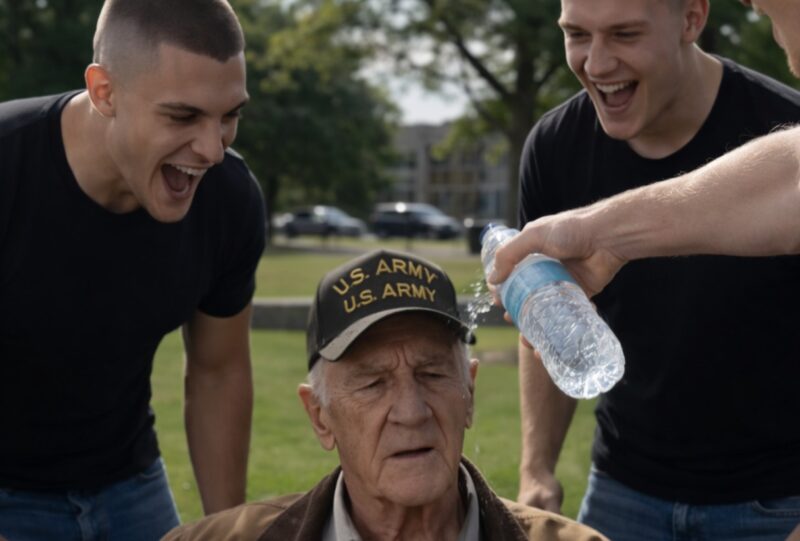
One of the young men grabbed a plastic water bottle, unscrewed the cap, and without a word of warning, poured the entire contents directly over the old man’s head. Water streamed down his cap, soaked through the collar of his jacket, and pooled on the bench beside him. Beside him, one of his companions burst into laughter and immediately raised his phone to film the whole thing, pointing the camera straight at the old man’s face.
“This is gonna go everywhere,” he crowed, clearly delighted with himself.
The third — perhaps wanting to outdo the others, perhaps simply that reckless — clenched his fist and stepped forward with the clear intention of striking the old man directly in the face. He was done with words. He wanted a moment. He wanted a reaction. He was absolutely convinced that the soaking-wet elderly man sitting before him would not — could not — do a single thing about it.
He was wrong in a way he will never forget.
The moment that fist came swinging forward, the old man moved. Not slowly. Not hesitantly. He rose from that bench in a single fluid motion and executed a block so clean, so practiced, so perfectly timed that the punch never landed. The young man’s arm was redirected like it had hit a wall, and for just a heartbeat, confusion washed across his face.
That heartbeat was all it took.
The second young man tried to move in from behind — a coward’s angle — but before he could take two steps, the old man had already turned, seized his arm with a grip like iron, pivoted his body with the kind of controlled economy that only comes from thousands of hours of training, and sent him sprawling onto the grass. He hit the ground so fast he didn’t even have time to process what had happened.
The first one came rushing forward again. He received a short, decisive push to the chest that sent him stumbling backward several feet, arms wheeling, all that false bravado completely gone. The third — the one holding the phone, the one who had been so eager to document everything — stood frozen to the spot, phone still raised, mouth open, unable to move.
In the span of a few seconds, three young men who had believed themselves untouchable were standing in a park looking confused, frightened, and very small.
The old man calmly adjusted his wet cap. He looked at each of them in turn with eyes that had seen things far more serious than this moment, and he spoke with the quiet authority of a man who had never needed to raise his voice to be heard.
“You picked the wrong person,” he said. “I’m a former special forces soldier. Age changes. Skills don’t.”
Not one of the three said a single word. They turned and they left — quickly, without looking back, without the laughter they had arrived with.
Here is the part that carries the real weight of this story. The footage that one of those young men had recorded with such glee — intended to mock an old man, intended to go viral as a humiliation — did exactly what he hoped. It spread across the internet rapidly and was seen by enormous numbers of people.
Only no one was laughing at the old man.
They were watching in stunned silence, then sharing it with a kind of fierce satisfaction that only comes when justice shows up unexpectedly and reminds us all that the world occasionally gets things exactly right. What was meant to be a clip of cruelty became something else entirely — proof that wisdom, discipline, and quiet strength don’t expire with age.
Some people spend a lifetime building something inside themselves that no one can ever see — until the moment it matters most. That old man on the bench wasn’t a victim. He never was. He was simply waiting, the way men like him always wait — patient, still, and absolutely ready.