Nobody in the diner moved.
Not the waitresses. Not the bikers. Not even the man everyone called Rex. The words hanging in the air seemed too strange, too heavy to belong in a place like this — a roadside diner smelling of burnt coffee and old leather.
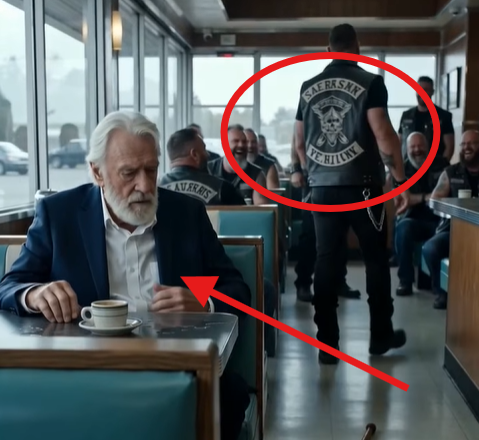
Your grandfather’s cane.
Rex stared at the old man as if he had misheard him entirely. His jaw tightened, his eyes narrowed, and for a moment the whole room held its breath.
Then the door swung open.
Two men in dark suits stepped inside, followed by a woman carrying a leather file case. They weren’t law enforcement. They didn’t need to be. The way they moved made the entire room shift without a single word being spoken. One of them bent down, picked up the fallen cane from the floor, and handed it back to the old man — Mr. Hale — with quiet, deliberate care.
Mr. Hale accepted it without ever taking his eyes off Rex.
“What kind of game is this?” Rex asked. But something in his voice had already changed. There was a crack in it now, thin and unmistakable, like a fault line running through stone.
Mr. Hale didn’t answer the question.
Instead, he said two words: “Take off the vest.”
Rex’s shoulders pulled tight immediately. “No.” One of the bikers behind him muttered his name low, a warning. But the old man simply gave the smallest nod toward the woman with the file.
She opened it. She pulled out a photograph and placed it flat on the table.
It showed a young man standing beside a motorcycle, wearing a leather vest, smiling at the camera with the kind of reckless confidence that belongs only to the young. On the inside of the collar was a faded silver hawk patch — identical to the one Rex wore.
Rex looked down at the photograph.
Then he went completely still.
Because the man in that picture had his eyes. His jawline. His exact crooked half-smile.
“His name was Ethan Hale,” the old man said. “He was my son.”
The silence in the diner stretched like something about to break.
Rex didn’t blink. “My mother told me my father was dead,” he said, his voice dropping to almost nothing.
Mr. Hale’s face tightened with a grief too old and too deep to fully hide. “He is,” he said. “For twenty-two years now.”
Rex swallowed hard. “Then how do you know me?”
The old man rested both hands on top of the cane, and when he answered, it sounded like every word cost him something real. “Because Ethan vanished before he could bring you home.”
The woman opened the file again and placed a second photograph on the table — older, worn soft at the corners. A younger Ethan stood with one hand protectively over the rounded belly of a woman outside a trailer. Rex’s face drained of color.
That woman was his mother.
“I hired people to search for Ethan for years,” Mr. Hale said quietly. “Your mother ran after he was killed. She believed I blamed her for pulling him away from the family. I never did.” His voice roughened with something between sorrow and regret. “I simply never found her in time.”
Rex stared at those two photographs as if the floor beneath him had shifted.
All the leather. All the bravado. All the laughter from minutes ago — it looked thin now, like a coat worn over something raw and unhealed.
“My mom,” he began, then stopped. He exhaled slowly. “She passed away last winter.”
The old man closed his eyes for a single breath. When he opened them, they were wet.
“She kept you from me because she was frightened,” he said. “And I stayed away too long because I was proud.” He looked directly at Rex then, with the kind of honesty that leaves no room for comfort. “We both failed you.”
That landed harder than any raised voice ever could have.
Somewhere in the back of the diner, one of the bikers quietly sank into a booth, saying nothing.
Rex looked down at the silver hawk stitched onto his vest. “My mother sewed that patch back on every time it tore,” he said softly. “She told me it was the only thing my father ever left me.”
Mr. Hale reached into his coat and withdrew a small metal tin. Inside, carefully preserved, lay an identical patch — old, faded, kept safe for decades. “Your grandmother made them,” he said. “One for Ethan. One to keep at home.” His voice fractured on the next words. “I never thought I’d see the other one again.”
Something in Rex’s face shifted completely then. The arrogance was gone. The mockery was gone. He looked younger now — not like the man the whole room had feared — but like a boy who had spent his entire life wearing someone else’s armor.
He looked at the cane. He looked at the broken glass still scattered on the floor. He looked at the old man.
“I didn’t know,” he said.
Mr. Hale nodded slowly. “I know.”
Rex took one step forward. Nobody laughed. Nobody moved. He bent down, picked up the old man’s spilled napkin from the table, and held it a moment before looking up with something raw in his expression — ashamed that such a small gesture was all he had to offer after everything.
“I’m sorry,” he said, and his voice held none of its earlier swagger. “I thought you were just some old man.”
Mr. Hale gave a quiet, sad half-smile. “I was,” he said. “Until I saw my son in your face.”
That was the thing that finally undid Rex entirely.
His eyes filled. He pulled off the leather vest, held it in his hands, and stared at the silver hawk patch sewn into the lining. For the first time in his life, he understood why his mother had cried every single time her fingers found that stitching.
“My real name isn’t Rex, is it?” he asked.
Mr. Hale’s grip tightened on the cane. “No,” he said softly. “Your name is Eli Hale. Ethan chose it for you before you were even born.”
Eli — because that was his name now, the one that had always been his — let out a breath that sounded like something breaking loose after years of being held too tightly. He sat down hard in the booth across from the old man, as though his legs had finally decided they were done pretending.
For a long moment, grandfather and grandson simply looked at each other across that same table where humiliation had started just minutes before. And then Eli asked the question that had been missing from his entire life, the one wound that had never been given a name.
“Did he want me?”
Mr. Hale answered without hesitation, without pause, without a single qualifier. “With everything he had.”
Silence again. But this time it was not cold or cruel. This time it was full — the way silence gets when something long broken finally finds its missing piece.
Mr. Hale slowly held out the cane. Eli looked confused. The old man’s voice, when it came, was barely steady. “Help me up.”
Eli stood immediately. He stepped forward and placed the cane carefully into his grandfather’s hand. Then, just as gently, he offered his arm.
The old man took it.
And in the middle of that roadside diner, with shattered glass still on the floor and black SUVs waiting just outside, the biker who had walked in laughing helped his grandfather stand — not because anyone told him to, not because he was trying to make something right, but because blood had finally, after all those lost years, found its way home to blood.