He was just an old man sitting at a bus stop in the rain.
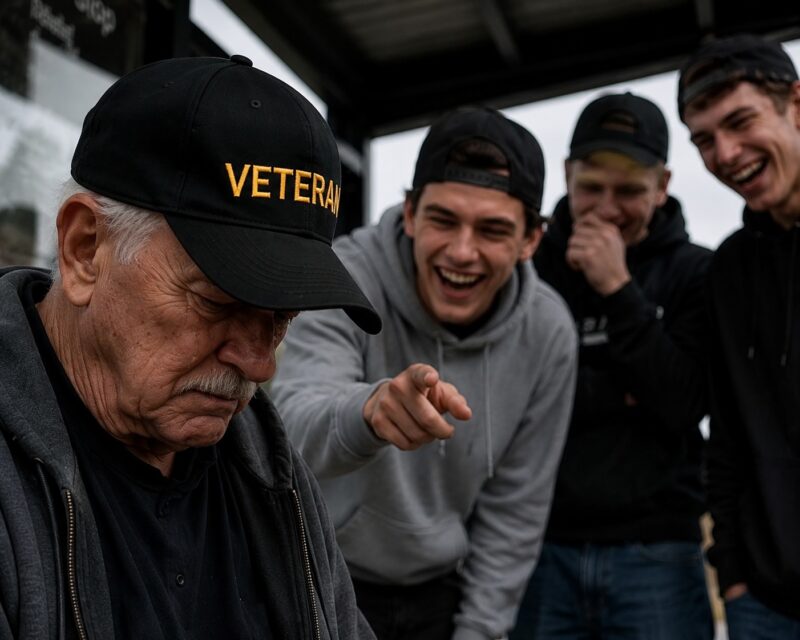
Nobody noticed him. Nobody stopped. Nobody cared. The world rushed past him the way it always does — heads down, earbuds in, too busy to look at the man with the faded “Veteran” cap and the prosthetic leg peeking out beneath his worn shorts. He had been sitting there quietly, staring at the wet pavement as gray clouds pressed down low and a cold wind cut through the street.
He wasn’t asking for anything. He never did.
After everything he had given — and lost — asking for things didn’t come naturally anymore.
This man had once run into enemy fire to drag wounded soldiers to safety. He had carried brothers on his back through conditions most people couldn’t survive in their worst nightmares. He had given his leg, his health, his youth, and the version of himself he would never get back. When he finally came home, the war didn’t stay behind. It followed him into every sleepless night, every anniversary, every quiet room where the ghosts of old friends still sat beside him.
His wife had eventually left. There were no children. His fellow veterans had either moved far away or passed on. And so most days, he moved through the world alone — quietly, without complaint, the way soldiers often do long after the uniform comes off.
He was just waiting for the bus.
That’s when three young men walked up.
They looked to be around twenty years old — baseball caps turned backward, loud voices, the kind of swagger that comes from never having faced real consequences. They spotted his prosthetic leg almost immediately. And just like that, what should have been an ordinary afternoon turned into something uglier.
“Hey old man, what’s that thing?” one of them called out, smirking and pointing directly at his leg.
The others laughed on cue.
“He looks like a robot.”
“Airport metal detectors must go absolutely insane around him,” the third one added, and they all erupted again — louder this time, feeding off each other’s cruelty the way young men sometimes do when they haven’t yet learned what shame feels like.
The old man slowly raised his eyes. He said nothing.
That silence only seemed to encourage them further.
“Does it freeze up in the winter?”
“Do you plug it in at night to charge it?”
“Better hope the battery doesn’t die before your bus shows up.”
They were doubled over laughing. A few people nearby glanced over — then walked faster, pretending not to see. Nobody intervened. Nobody said a word.
And the old man sat completely still. Only his hands, resting on his knees, slowly curled into quiet fists.
What those boys didn’t know — what they couldn’t have imagined — was the weight of the life sitting right in front of them. They didn’t know about the missions. They didn’t know about the sacrifice. They didn’t know that this man had bled for a country that now walked past him without blinking. To them, he was just an easy target. An old man with an unusual leg and nowhere better to be.
They had no idea how wrong they were about to find out they were.
Standing behind them the entire time was a tall, broad-shouldered man in a black leather vest. A biker. He had a thick beard and the kind of quiet, watchful expression that only comes from someone who has seen the world clearly enough to know exactly what he was looking at. He had been standing there, arms crossed, watching every single moment play out — and with each new punchline from those boys, his expression had darkened further.
He stepped forward. One slow, deliberate step. Then another.
The laughter began to fade.
The boys turned. The smiles dropped.
The biker walked directly up to them and spoke in a low, even voice — the kind that doesn’t need to be raised to fill a space completely.
“Aren’t you ashamed of yourselves?”
One of the boys attempted a smirk. “What’s it to you?”
The man held eye contact without flinching.
“It matters to me because this man didn’t lose his leg by accident. He didn’t lose it through carelessness or bad luck. He lost it so that punks like you could walk through these streets safely. So you could stand here today and run your mouths without a single worry in the world.”
The bus stop went absolutely silent.
“While you were busy making each other laugh,” the biker continued, “men like him were pulling wounded soldiers out of situations you’d never survive five seconds of. And the most disgusting part? He sits here without saying a single word while the three of you humiliate someone who is a thousand times stronger than you’ll ever be.”
Not one of those boys was smiling anymore.
One stared at the ground. Another jammed his hands deep into his pockets. The third opened his mouth and quietly said, “We were just joking around…”
The biker didn’t let it land.
“No. That’s not a joke. That’s shameful. There’s a difference, and it’s time you learned it.”
The old veteran hadn’t moved. He sat with his eyes lowered, hands still resting in his lap. He hadn’t asked to be defended. He hadn’t said a word. But for the first time since sitting down at that bus stop — for the first time in what may have been a very long while — he wasn’t alone.
Someone had stood beside him instead of looking away.
And in that quiet, ordinary moment at a rain-soaked bus stop, three young men got the lesson that no classroom had ever managed to teach them — that dignity doesn’t disappear just because it’s been ignored. And some debts, the ones owed to the people who sacrificed everything, can never truly be repaid. Only honored.
One act of decency. One voice willing to speak up.
Sometimes, that’s all it takes to change the entire temperature of the world.