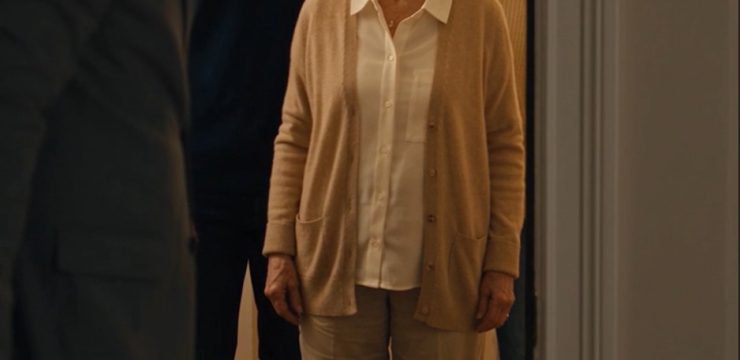
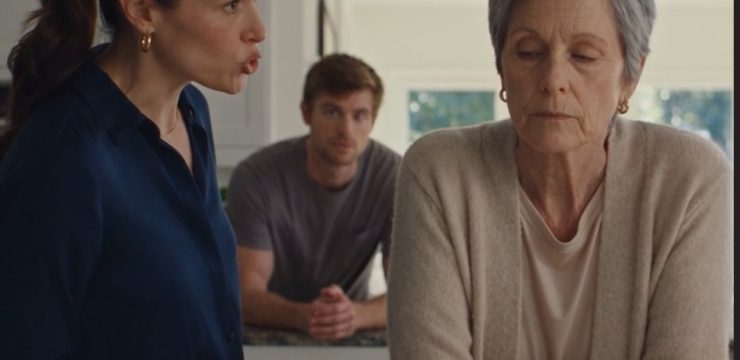
She had lived in that house her entire life. Every wall, every beam, every cracked tile in the kitchen floor held a memory. She and her husband had built it together, slowly and lovingly, year after year, one brick at a time. He was gone now, and the children — if there had ever been any close enough to call — had drifted far away. But the house remained. It was the last thing she had, and in many ways, it was still everything.
Nobody paid much attention to an old woman living alone on the edge of town. That was exactly the problem.
The men who came to her door the first time did not look like criminals. They rarely do. One of them wore a pressed collar. Another carried a folder, as if he had paperwork to discuss. They smiled when she opened the door, asked if they could come inside for a moment, said they only wanted to talk. She let them in because that is what decent people do — they open their doors.
What followed was not a conversation. It was a performance designed to strip away her dignity and replace it with fear. The leader sat across from her at the kitchen table where she used to share Sunday breakfasts with her husband and looked her dead in the eyes. He did not raise his voice. He did not need to. In a flat, emotionless tone, he explained that she should sign the house over to them. Willingly, he said. Peacefully, he said. Otherwise, he made clear, things would not go well for her.
She did not sign. Her hands were shaking, and her heart was hammering in her chest, but she did not sign.
They left. And she sat alone in her kitchen for a long time afterward, staring at the table, wondering what would come next.
She did not have to wonder long.
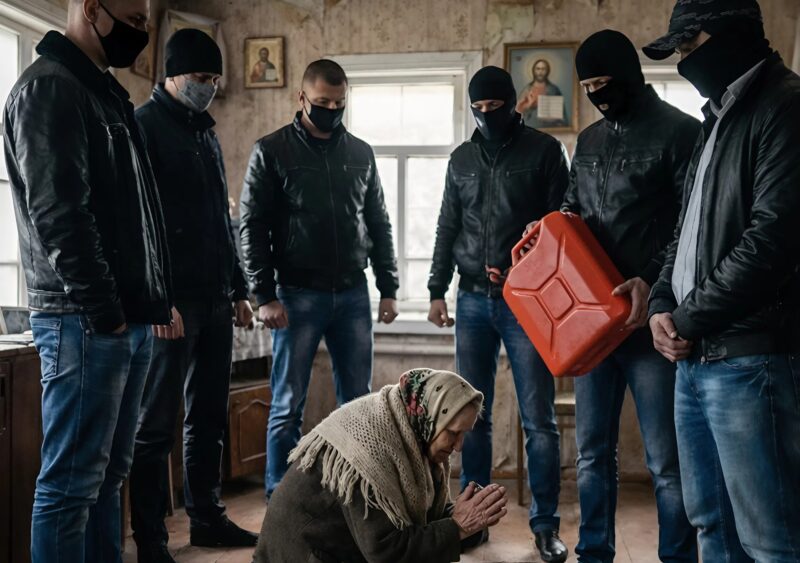
They came back on a dark night, and this time there was no pretense of civility. No folders, no pressed collars. They arrived with a canister of gasoline and a very clear message. One of them told her straight to her face: either she packed up what little she had and walked out the door on her own, or the house would burn — with her still inside it.
She fell to her knees. Not out of weakness, but out of exhaustion — the deep, bone-level exhaustion of a woman who had already carried so much for so long. She begged them. She told them she had nowhere to go. That this house was not just property — it was her life, her story, the place where every chapter of her existence had been written. She pleaded with them to leave her with at least a roof over her head.
What she got in return was laughter.
One of them sneered at her and said she did not have much time left to live anyway. That no one was going to feel sorry for her. That she would spend whatever years she had left inside a nursing home, and they would spend them inside her house. It was the kind of cruelty that does not require a raised hand. It cuts deeper than that.
Then one of them opened the canister and began to pour.
The smell of gasoline filled the air. It soaked into the floorboards her husband had laid, seeped into the walls she had painted, crept across the threshold of every room where she had laughed and cried and grown old. And in that moment, when everything she loved was about to be taken from her in the most violent way imaginable, something shifted in the darkness at the far end of the hallway.
A sound rose from the shadows. Low, steady, and utterly unmistakable.
A growl.
Not the kind you brush off. The kind that reaches into your chest, wraps itself around something primal, and squeezes. The men froze. The one holding the canister went still mid-pour.
“Did you hear that?” one of them whispered.
“Maybe it’s a dog,” another said. But his voice had already changed.
“That’s not a dog.”
He was right.
Out of the darkness came the lynx — large, muscular, with pale gold eyes that caught the dim light and held it. The grandmother had found this animal years ago as a tiny, half-dead cub, alone and starving. She had taken it in, nursed it back to health, fed it through long winter nights, and loved it the way people love the ones who have no one else. In return, the lynx had never left her side.
It moved with the terrifying swiftness that only wild things possess. One of the men went down, crying out as claws connected. The others did not wait to see what happened next. Whatever plan they had came apart instantly, replaced by something far more urgent — the overwhelming, instinctive need to run.
They ran. Out the door, into the night, leaving behind the gasoline canister, their threats, and whatever cold confidence had brought them there in the first place. They did not look back.
Inside the house, the grandmother sat on the floor where she had fallen to her knees. The lynx padded over quietly and settled beside her, warm and still, the way it always did when she needed comfort most.
The house still stood. She was still in it. And next to her was the one soul in the world she had once rescued — and who, on the night it mattered most, had rescued her right back.
Some bonds go beyond words. Some loyalty is wilder, deeper, and more honest than anything we find among people. And sometimes, the one who saves you is the one you once saved yourself — when nobody else was watching, and nobody else cared enough to stop.