It was the kind of afternoon that feels like it belongs in a memory you never want to let go of — warm sunlight filtering through the trees, the soft sound of water moving lazily along the riverbank, and the uninhibited laughter of children who had no idea that the world could be anything other than beautiful.
A group of young boys had claimed the riverbank as their playground for the day. They were doing what boys that age do best: racing handmade bark boats along the current, skipping stones across the glassy surface, and filling the surrounding forest with the kind of joy that only childhood can produce. The echoes of their laughter bounced off the trees and floated upward into the open sky. It was, by every measure, a perfect afternoon.
But perfect afternoons have a way of turning without warning.
Among the boys was Ilya, a six-year-old with the kind of curiosity that adults sometimes admire and sometimes fear. He was the one who always asked “why,” always had to look closer, always had to know. And on this particular afternoon, it was that very curiosity that led his eyes to something the others had walked right past.
There, half-buried in the wet sand near the water’s edge, was a thick rope. It was dark with moisture, coiled loosely at one end on the shore, while the other end disappeared silently beneath the surface of the river. The water around it was murky and still. Whatever was on the other end of that rope was hidden somewhere below.
“Look at that!” Ilya called out, his voice bright with excitement. “What if there’s treasure on the other end?”
His friends stopped and stared. The mood shifted almost immediately. The laughter quieted. A few of the boys took a small step back without even realizing it.
“Don’t touch it,” one of them said, his voice careful and low. “It’s probably just garbage from upstream.”
“Or it’s a trap,” another boy added, his eyes wide.
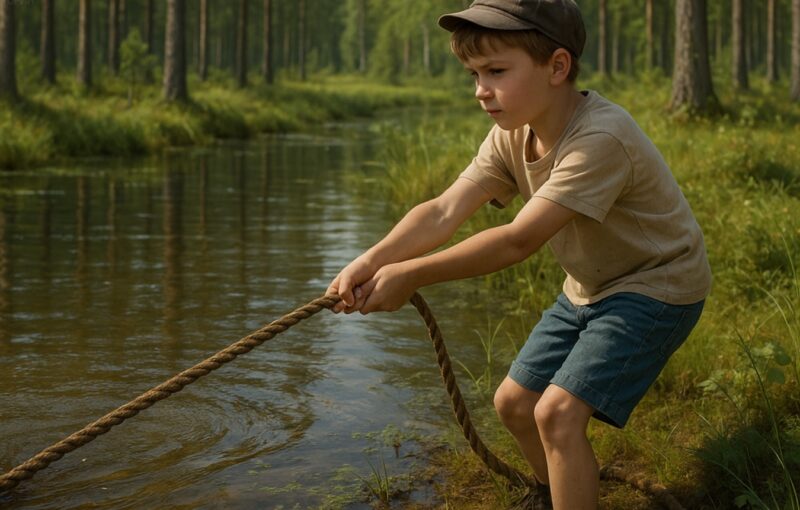
But Ilya was already crouching down. He wrapped both small hands around the rope and felt the truth of it immediately — it was cold, soaked through, and heavy in a way that told him without any doubt that something was attached to the other end. Something substantial. Something real.
He pulled.
The rope resisted. It didn’t snap back or go slack — it simply held firm, as though whatever was on the other end had weight, had presence, had mass that wasn’t going to give itself up easily. Ilya pulled harder, leaning back with the effort.
“I’m pulling it!” he shouted to his friends, but when he looked up, he saw them backing away. One boy let out a strange, nervous laugh. Another had gone pale. And then, one by one, they turned and ran — first one, then another, until the sound of their footsteps faded into the trees and Ilya was completely alone by the river’s edge.
His heartbeat was loud in his ears. His hands were trembling. Every instinct in his small body was telling him to drop the rope and follow his friends. But he didn’t. He couldn’t explain why — maybe it was stubbornness, maybe it was something deeper — but he kept pulling.
Slowly, the rope began to give.
Whatever was on the other end was moving now, dragging along the muddy bottom of the river toward him. The water near the bank began to ripple and churn. The surface broke in strange, uneven patterns. And then, rising from the dark water like something out of a nightmare, a shape began to emerge.
Ilya’s whole body went rigid. His eyes went wide. His mouth opened but no sound came out — not at first.
It was a man. A grown man, face up, eyes closed, skin pale and waterlogged, his clothing plastered flat against his body by the weight of the river. The rope was wrapped around his waist, knotted there deliberately. And on his neck — visible even through the distortion of the water — were dark bruises that told a story no child should ever have to read.
Then the scream came. It tore out of Ilya’s chest without warning, raw and ragged and terrified. The rope fell from his hands. He stumbled backward, nearly losing his footing in the wet sand, and then he ran. He ran harder than he had ever run in his life, back through the trees, back toward the village, tears streaming down his face, lungs burning, legs pumping with pure primal fear.
When the adults came — and they came quickly, their faces tight with worry — they found the man’s body had drifted slightly with the current, resting now at the edge of the shallows. A search had already been underway for him. He had been missing for an entire week, and the discovery that followed was one that the small community would carry for a long time.
The investigation that followed the discovery brought the full weight of that tragedy into the light. But for Ilya, the truth was simpler and harder than any official report could capture. He had been a six-year-old boy who grabbed a rope out of curiosity, and what he found on the other end had rewritten something inside him permanently.
The rope still lies on that riverbank. No one has moved it. No one has touched it. It remains there, half in the sand and half in the memory of everyone who knows the story — a quiet, weathered reminder that curiosity is neither good nor bad on its own. It is simply honest. It finds what is there, whether we are ready for it or not.
And sometimes, the truth waiting at the end of a rope is not treasure.
Sometimes it is something the world tried to hide beneath the water — something that needed to be found, even if the one who found it was only a child with curious hands and a brave, trembling heart.