Some stories stay with you long after you’ve heard them. They settle into your chest like a stone and refuse to leave. This is one of those stories — a tale of a young soldier, a dangerous habit, and a twist of fate so extraordinary that it almost defies belief.
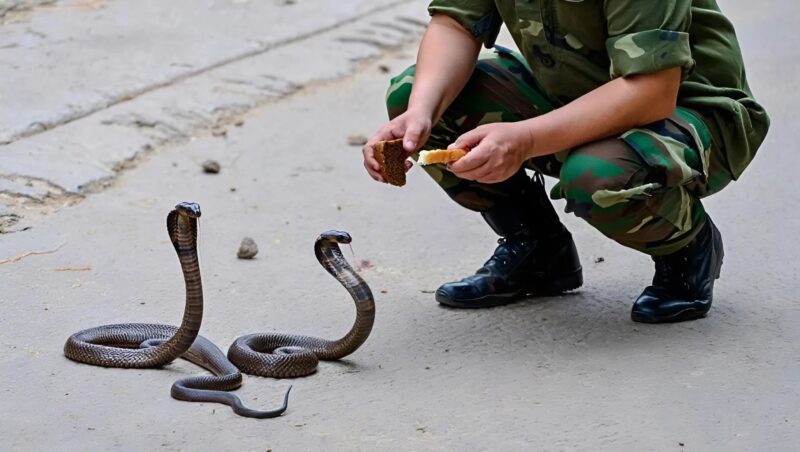
It began quietly, the way most life-altering decisions do. A soldier stationed at a remote military camp was digging a trench at the edge of the compound when he noticed something unusual beneath a cluster of sun-warmed stones. Two baby snakes — thin, fragile, uncertain in their movements — slithered out and paused, raising their tiny heads at every sound around them.
Military protocol was clear. The commanding officer had given direct orders: any dangerous creature found near personnel was to be eliminated immediately. No exceptions. No discussions. That was the rule.
But this young man hesitated. There was something about the way the hatchlings didn’t flee from him — something almost curious in the way they studied him with their small, unblinking eyes. He stood there longer than he should have. And then he walked away without following the order.
That evening, almost without thinking, he came back. He dropped a small piece of bread on the ground beside his tent and crouched down to watch. The snakes recoiled at first, pulling back into the shadows. But slowly — cautiously — they crept forward. Something shifted in him in that moment. He decided he would come back again.
And he did. He brought meat. He brought scraps from the kitchen. He told himself it was just a distraction, a small, harmless way to break the unbearable monotony of life in the field. A secret, he figured, that would hurt no one. Just two little snakes and one bored soldier.
Within days, the snakes had stopped reacting to his presence with alarm. They recognized him. They waited for him. He would crouch low, toss food gently onto the sand, and watch as they moved toward it with growing confidence. He fed them the way some people feed stray cats — with a quiet, private tenderness he would never have admitted to his fellow soldiers.
He noticed they were growing. Their movements became faster, more assured. Their bodies filled out. He told himself this was fine. He told himself he had it under control.
Then one morning, he stepped out of his tent and stopped cold. The sand around him was covered in tracks — dozens of them, crisscrossing in every direction. He had been feeding two snakes. But something far greater had been gathering in the dark.
Panic settled in slowly at first, then all at once. He understood with sudden clarity that this had gone far beyond a harmless diversion. If any superior officer discovered what he had been doing, the consequences would be severe. That same night, he made a decision. He gathered what he needed, climbed into a vehicle, and drove out to a field where he had most often spotted the snakes moving through the grass — determined to finally end what he had foolishly started.
He was gone for hours. When he returned to camp just before dawn, something was deeply wrong.
The camp was silent. Not the comfortable, sleepy silence of early morning — but a hollow, suffocating stillness that felt all wrong. No voices. No movement. No sounds from the kitchen. No footsteps of the night watch.
He moved faster, his heart pounding with every step. He reached the tents and stepped inside.
What he found there was something no human being should ever have to see. His fellow soldiers — men he had eaten with, laughed with, complained about the heat with — lay motionless. There were signs of a violent struggle. There was blood. The unit had been ambushed during the night, silently and swiftly, while the camp slept.
Every single one of his comrades was gone.
He should have been in that tent. He should have been sleeping among them when the attack came. Had he been there — had he simply stayed, like any other night — he would not have survived either.
Instead, he had been out in the dark, chasing snakes.
The creatures he had secretly fed, the ones he had worried were becoming a danger, had unknowingly pulled him away from the very place where death was waiting.
Fate, it seems, moves in ways we cannot predict or understand.
The investigation that followed was long and painful. Military authorities questioned him extensively. They searched for connections between him and the attackers, reviewed every movement he had made that night, examined every detail of his story. The circumstances looked suspicious — how had this one soldier been conveniently absent while everyone else perished?
His guilt could never be proven. But the shadow of suspicion never fully lifted either. He was eventually discharged from service and left the military for good, carrying with him a burden no one else could fully comprehend — the grief of losing his brothers, the guilt of having survived, and the haunting knowledge that a foolish, rule-breaking habit had somehow spared his life.
He had broken the rules. He had been reckless and naive. He had done something he knew was wrong.
And yet he was alive.
There is no clean lesson in a story like this. No simple moral to wrap it up neatly. Only the reminder that life is fragile, fate is strange, and sometimes the most unexpected choices — even the wrong ones — echo in ways we never imagined possible.
Some things in life simply cannot be explained. They can only be carried.