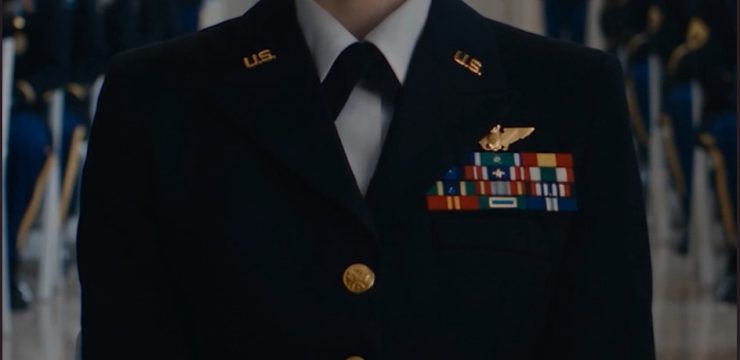
Nobody saw it coming. Not the soldiers who laughed. Not the lieutenant who thought he had all the power. And certainly not the man who ended up face-down on the floor in front of everyone.
The morning she arrived at the marine base, the air was cold and heavy with gray fog. The grounds smelled of damp concrete, motor oil, and bitter coffee drifting from the cafeteria. Metal hangars rumbled with the sound of machinery, boots thundered across the training yard, and the whole place hummed with the kind of energy that said: this is not a place for the faint of heart.
She walked in carrying a heavy bag, her posture calm, her eyes steady. And immediately, every head turned.
Not in welcome. In judgment.
Smirks spread from soldier to soldier like wildfire. Quiet comments became not-so-quiet jokes. Some men didn’t even bother lowering their voices when they said that a woman had no business being in a unit like this. The culture was brutal, the hierarchy was rigid, and she had just walked straight into the middle of it — young, composed, and completely alone.
Lieutenant Daniel Harper noticed all of it. Tall, broad-shouldered, with a jaw like carved stone and eyes that had a habit of sizing people up and finding them lacking, he understood something important in that moment: the other soldiers were watching him. Waiting to see how he would react. And so he made a decision.
He was going to make an example of her.
From the moment she set foot on the base, he was on her like a shadow. Every move she made was wrong. Every step too slow. Every response not sharp enough. He spoke to her in front of the group, his voice dripping with the kind of condescension designed not just to correct, but to humiliate. Are you sure you didn’t wander into the wrong place? The other soldiers laughed. She said nothing.
She trained. She stayed quiet. She kept her distance.
And somehow, that silence made him angrier.
By midday, the cafeteria was packed and loud — the clatter of trays, the roar of conversation, the particular chaos that comes when dozens of strong-willed people eat together in close quarters. She sat alone at a table off to the side, eating without hurry, without looking around for approval or acknowledgment.
Harper walked over and looked down at her.
“Get up,” he said flatly. “Lunch is over. This is my seat.”
The nearby tables went quiet first. Then the quiet spread.
She looked up at him, unhurried, and replied with complete evenness: “I’ll finish eating and then I’ll leave. Everything here is shared.”
For a fraction of a second, time seemed to stop.
Then his hand shot out, grabbed her tray, and slammed it onto the floor with a crash that echoed through the entire room. Food splattered across the concrete. Broken pieces of dishes skidded under tables. Laughter erupted — sharp, ugly, and loud — and a few soldiers even began to clap.
She looked at the mess on the floor. Then, without a word, she knelt down and began picking it up with her bare hands.
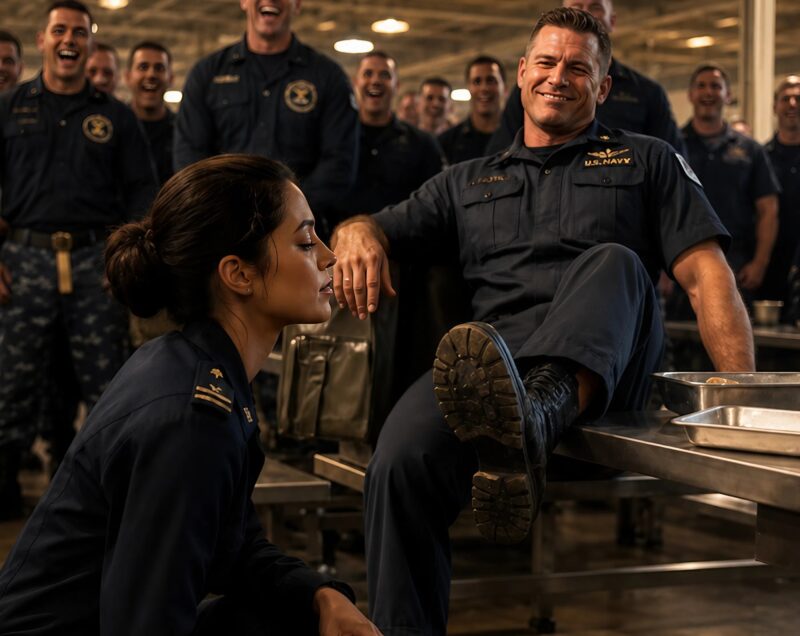
Harper lowered himself into her chair with the satisfied ease of a man who had just proven something. He propped his heavy boot up on the edge of the table, grabbed a dirty rag from nearby, and threw it directly at her.
It hit her in the face.
“Wipe my boots,” he said, grinning. “Learn your place.”
The room erupted again. Some soldiers had already pulled out phones. Everyone was waiting to watch the moment complete itself — the final, humiliating image of a young woman on her knees, cleaning the boots of the man who had broken her.
She picked the rag up off the floor. She looked at his boot for a long moment.
Then she moved.
In one fluid motion, she grabbed his leg and yanked it down hard. Harper’s balance shattered instantly. The chair flew sideways. He crashed to the floor between the tables with a force that rattled the room — and before anyone could process what had just happened, she had his arm pinned behind his back, his face pressed into the concrete, her knee holding him completely still.
The laughter stopped like someone had cut a wire.
Harper thrashed and cursed, but he could not move. She held a man nearly twice her size against the floor as if he were made of paper.
“You’ve spent a long time going after people you thought couldn’t fight back,” she said quietly, close to his ear. “You chose the wrong one.”
She released him and stood up slowly.
He lay there, breathing hard, staring up at her with an expression no one in that room had ever seen on his face before.
The cafeteria was absolutely silent.
“Before I was transferred here,” she said, her voice steady and clear enough for everyone to hear, “I was a combat instructor in a naval special operations unit. I used to take down three men your size just in warm-ups.”
A few nervous laughs broke the silence. Most people simply stared.
She picked the rag up off the floor and set it neatly on the table in front of him.
“You can clean your own boots,” she said.
Then she walked out.
Nobody called after her. Nobody laughed. And for the first time since she had arrived that morning, the men who had smirked and whispered and waited for her to fail were completely, utterly silent — because some of them, for the very first time, were looking at her not with contempt, but with something that felt a whole lot like respect.