The sun was already beating down hard when the soldiers filed onto the parade ground that morning. No one spoke. The air felt thick with tension, the kind that settles over a crowd when everyone knows something is about to go wrong but no one can stop it. The ranks formed in perfect lines, boots polished, shoulders squared — yet beneath that military discipline, every single person present felt the unease crawling up their spine.
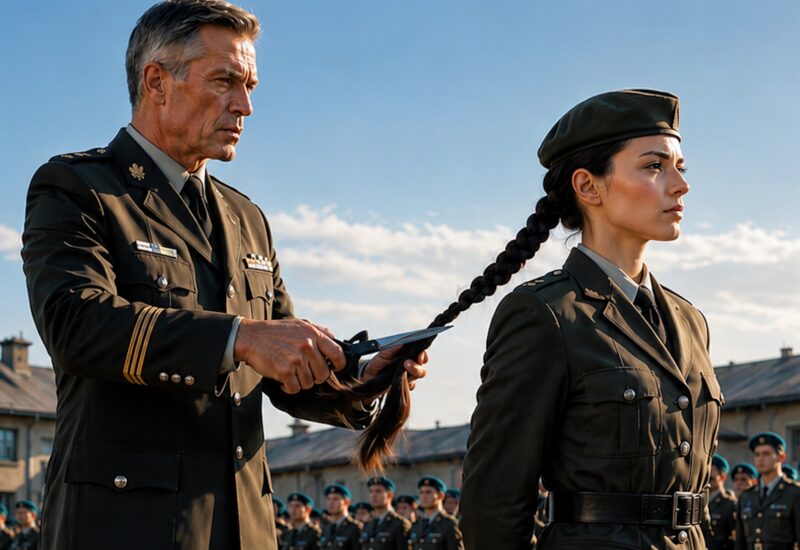
At the center of it all stood two people.
Colonel Voronov. And a young recruit named Anna.
Anna had only been at the unit for a matter of days, but her reputation had arrived before she did. She was one of the top graduates of her military academy class — an exceptional markswoman, physically disciplined, mentally sharp. She completed every requirement without complaint and pushed through exhaustion without a word. By all accounts, she was exactly the kind of soldier any commanding officer should have been proud to have under his command.
But pride was not what Colonel Voronov felt toward her.
It had started during a training exercise. One of the young soldiers took a bad fall — a failed jump that sent him crashing down hard on his back. The impact was serious. Anyone with eyes could see the boy was in pain, struggling to breathe, unable to get up on his own.
The colonel’s response was immediate and cold.
“He’ll get up on his own,” Voronov said flatly. “He’s not going to fall apart.”
He ordered the training to continue.
That was when Anna stepped forward.
She broke formation, walked directly to the injured soldier, and said clearly enough for everyone around her to hear, “He needs a doctor.”
The colonel turned slowly. “Return to formation.”
“He needs help first.”
Those five words echoed across that training ground like a stone dropped into still water. Dozens of soldiers heard them. Every single one of them held their breath.
To a man like Voronov, a public challenge was not simply insubordination — it was humiliation. And humiliation, in his mind, demanded an answer.
He waited. He planned. And then he assembled the entire unit.
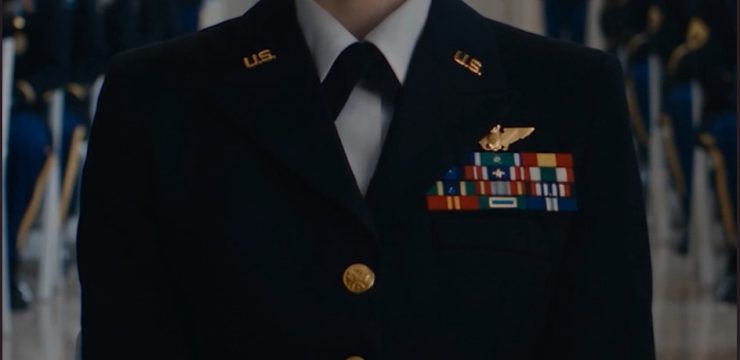
When the soldiers gathered on the parade ground, Anna was called to step forward. She walked out of the ranks calmly, her long dark braid falling nearly to her waist. It was something the other soldiers had noticed about her — she carried herself with a quiet dignity that went beyond regulation, and that braid was a part of who she was.
Voronov reached into his jacket and produced a large pair of scissors.
A ripple of nervous energy passed through the assembled ranks. No one made a sound. Everyone understood what was happening, and no one dared to speak.
Anna stood perfectly still.
The colonel grabbed her braid. He spoke loudly, deliberately, making certain every soldier heard every word. “This will teach you not to argue with people who outrank you.”
The scissors closed.
The thick, dark braid dropped to the ground.
Silence fell over the entire parade ground like a curtain.
Voronov studied her face carefully. He was waiting — expecting the crack, the tears, the trembling lip, the moment when her composure would shatter and he would have his proof that she was nothing more than a girl who had overstepped her place.
But Anna did not cry. She did not flinch. She did not move a single muscle.
Her eyes stared straight ahead. Her face was composed, almost serene — and that stillness, that unnerving, absolute calm, did something unexpected to the colonel. It made him angrier.
He stepped closer.
“Do you think you’re special?” Silence. “You’re just a recruit.” Nothing. “People like you break faster than anyone else.” Not even a blink. “Without your pretty hair, you finally look like a real soldier instead of a spoiled little girl.”
An uncomfortable murmur moved quietly through the ranks. Soldiers exchanged uneasy glances. Many of them felt something shift inside themselves — a growing discomfort that had nothing to do with the heat.
Voronov pressed on. “You think far too highly of yourself. Remember your place.”
Anna slowly turned her head. For the first time since the scissors had closed, she looked directly into the colonel’s eyes. There was no anger there. No fear. Only a steady, unflinching composure that seemed to reach right through him.
When she finally spoke, her voice was low but completely clear.
“You can cut my hair,” she said. “But I will not let you play with my honor.”
Voronov smirked. “And what exactly are you going to do about it?”
What happened next unfolded in a matter of seconds.
The colonel reached out and grabbed her shoulder — not a gesture of guidance, but of force. Whether he intended to shove her back into formation or simply assert physical dominance, no one could say for certain.
What they could say with certainty was what came next.
Anna had trained for years in military hand-to-hand combat. Her body responded before her mind had even finished processing the threat. In one fluid, precise movement, she intercepted his arm, shifted her weight, and used his own force against him.
The colonel hit the ground.
A collective gasp swept across hundreds of soldiers standing at attention.
Nobody moved. Nobody spoke.
Voronov began to rise, his face flushed, his authority shattered on the pavement beneath him. Anna had already stepped back and returned to a position of attention — composed, still, unshaken.
Not a single observer interpreted what they had seen as an act of aggression. Every person present understood exactly what it was: self-defense, clean and precise.
Then a voice broke through the silence.
“Enough.”
A general — who had arrived unannounced for a scheduled inspection and had been watching the entire scene unfold from a distance — stepped forward.
He looked at the colonel on the ground. He looked at Anna standing at attention. Then he addressed the assembled unit with the quiet authority of someone who had nothing left to prove.
“A soldier is required to respect rank,” he said. “But a commander is required to respect the dignity of those under his command. Punishment does not give anyone the right to humiliate another human being.”
The colonel lowered his gaze.
For the first time in years, he had absolutely nothing to say.