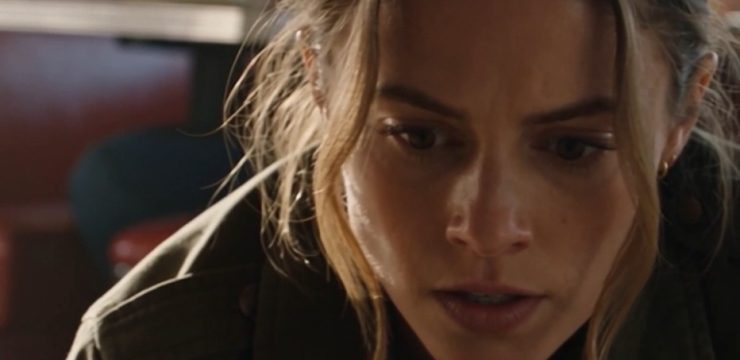
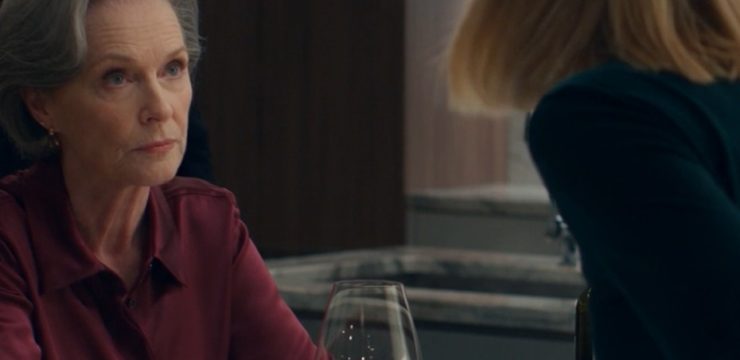
The silence that followed that name was heavier than anything a weapon could produce. It settled over the room like a cold fog rolling in off the water — thick, suffocating, and impossible to ignore. Every breath in that bar seemed to stop at once, and for a long moment, nobody moved. Nobody spoke. Nobody even blinked.
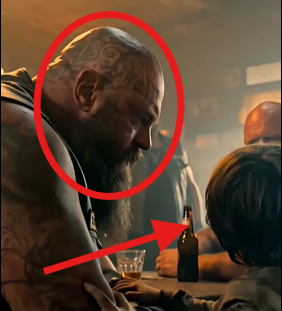
The scarred biker stood frozen behind the bar, his weathered hands gripping the counter’s edge as though the floor beneath him had suddenly shifted. He had seen a lot of things in his years — hard things, ugly things, things that would keep most men awake until dawn. But nothing had prepared him for this. A small boy, trembling and tear-streaked, standing in the doorway of a place where boys like him had no business being, speaking a name that no one in this world said casually.
He stared at the child the way a man stares at something he cannot explain. Like seeing a face from a dream standing right in front of him in broad daylight.
“John Wick?” he repeated, and the words barely made it out of his mouth before they crumbled.
The boy nodded, just once, and the tears he had been holding back finally broke free and ran down his dusty cheeks.
The biker’s eyes swept the room. Every man there was looking back at him with the same expression — stunned, unsettled, their confidence suddenly replaced by something quieter and far more dangerous. Fear. Not the ordinary kind. The kind that comes when you realize the storm you always heard about has finally arrived at your doorstep.
“That’s impossible,” the biker muttered, more to himself than to anyone else.
The boy’s breath caught in his chest.
Then, with fingers that could barely hold steady, the child reached into the pocket of his worn jacket and pulled out a small object. He held it out in the open light of the room, his palm flat, his eyes locked on the biker’s face.
A gold coin. Blood-stained. Heavy with meaning.
The crest on its face caught the overhead light and threw it back across the room like a quiet announcement.
Everything changed in that instant.
The biker moved fast — not rough, but certain — snatching the coin from the boy’s palm and holding it up close, turning it slowly, reading every detail with the kind of attention a man gives only to things that matter most. His jaw worked silently. His eyes narrowed.
It was real.
There was no mistaking it. No child could have faked something like that. No child would even know what it meant unless someone who understood its weight had placed it in his hands deliberately, with purpose, with trust.
The biker looked back at the boy. His voice came out lower now, stripped of everything except the need to understand.
“What happened to him?”
The boy’s face fell apart.
“They hurt him,” he whispered. “He told me to run.”
Those six words landed differently than anything else could have. They moved through the room like a current, touching every man in it, changing the temperature of the air itself. Because everyone in that room understood what it meant for a man like that to tell someone to run. It meant things had gone wrong in a way that almost nothing ever went wrong for him. It meant the boy had seen something no child should ever see.
The biggest man in the room was on his feet before the sentence was finished, his chair crashing backward behind him with a noise that echoed off the walls. The others were already in motion — hands moving toward weapons, eyes cutting to the exits, bodies shifting from the posture of men at rest into the posture of men preparing for something real.
The boy turned back toward the doorway, toward the rectangle of afternoon sunlight that suddenly looked far less safe than it had a moment ago.
“They’re close,” he said quietly. “They saw me.”
The biker gripped the boy’s shoulders — firm but careful, the way you hold something fragile that also needs to feel safe.
“Listen to me,” he said. “Did he send you here alone?”
The boy shook his head. The tears were falling freely now, without shame, without effort to stop them.
“He said…” The child’s voice broke and rebuilt itself in the space of a breath. “He said you’d know what to do.”
Something passed over the biker’s face then. Not grief exactly. Not anger exactly. Something older than both of those things. A kind of resolve that forms only in men who have already paid for their choices and have made peace with paying again.
He turned to the room and his voice came out like iron.
“Lock the doors.”
The bar became noise and movement — bolts slamming, furniture scraping, the unmistakable sound of men getting ready. The light in the room seemed to shift, dimming slightly as the space transformed from a place of rest into something else entirely.
But before the final lock could fall into place, a shadow crossed the bright doorway outside. Slow. Deliberate. Patient in a way that made it worse than if it had been rushing.
The boy saw it first.
His small body went completely still.
Then he spoke the words that reached into every man in that room and turned something cold deep in their chests.
“They’re not here for me.”
The biker looked down sharply, his eyes searching the child’s face.
The boy’s lips trembled with the weight of what he had been carrying since the moment his father had pressed that coin into his hands and told him to go.
“They’re here to make sure my father never gets me back.”