When I married Daniel, I truly believed I had found the kind of man you spend the rest of your life with in peace. He wasn’t loud or dramatic. He never made grand gestures or filled a room with noise. But whenever I was close to him, something inside me settled — like every anxious thought I’d ever carried simply faded away. After our wedding, we moved into an older home where his mother, Margaret, had been living since her husband passed. The house had wooden floors that creaked at every step, and in those early days, I actually loved that. It felt lived-in. It felt like family.
The first few weeks were genuinely sweet. Margaret seemed quiet and gentle, a woman who kept mostly to herself. Daniel and I were building something together, and everything felt exactly the way I had always imagined it would.
Then one night, I rolled over and found his side of the bed empty.
I didn’t panic at first. I figured he’d gone to get a glass of water or couldn’t sleep. But when nearly twenty minutes had passed and he still hadn’t come back, I stepped into the hallway — and saw a thin line of warm light glowing beneath Margaret’s door. I stood there for a moment, then told myself I was being ridiculous, and went back to bed.
The next night, the same thing happened.
And the night after that.
It became a pattern I could set a clock by. He would ease himself out of bed so carefully, so quietly, clearly trying not to wake me. And every single night, he walked down that same hallway to the same door.
I tried to reason with myself. I told myself this was nothing. I told myself I was imagining things. But something inside me — that quiet, gnawing ache that women know better than anyone — kept growing. It wasn’t anger exactly. It was loneliness. It was the feeling of being invisible in your own marriage.
When I finally asked Daniel directly what was going on, he was quiet for a long moment. Then he looked at me gently and said, “Mom gets scared at night since Dad died. I just sit with her until she falls asleep.”
He said it so calmly, without a trace of defensiveness. And somehow, that made everything harder. Because how do you argue with a man who is simply taking care of his grieving mother?
But the nights kept passing. Nothing changed. And I kept lying in our bed, staring at the ceiling, feeling like a stranger in my own home — like my husband was living some other life just a few doors down the hall.
I began noticing other things too. Margaret rarely left her room in the evenings. When she did see me, there was a tension in her face that I couldn’t quite read. She was polite, but always guarded, always careful, as if she was holding something back.
Then came the night when something inside me simply gave out.
I woke to the familiar sound of Daniel easing out of bed, and for the first time, I couldn’t just lie there and pretend. My chest was tight. My hands were trembling. I waited until I heard him move into the hallway, then I slipped out of bed and followed him in bare feet, barely breathing.
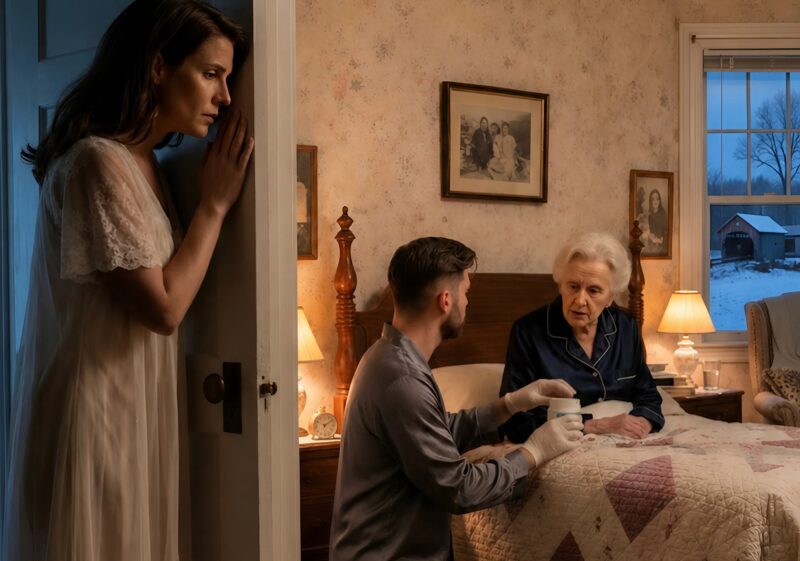
Margaret’s door was slightly ajar. A soft, warm light spilled through the gap. I pressed myself close to the wall and looked inside — and in that one moment, everything I thought I understood completely fell apart.
Margaret was sitting on the edge of her bed, and she was crying. Not the quiet, composed kind of tears you’d expect from a grown woman. She was weeping the way a terrified child cries — shaking, gasping, her hands clutched together, her eyes wide with a fear that looked ancient and deep. Daniel was kneeling in front of her, his voice low and steady, holding both of her hands in his.
And then I heard her voice for the first time without any walls between us.
“Please don’t leave me alone… He was standing by the window again… I saw the blood again…”
Daniel pressed her hands gently between his and whispered, “Mom. It was just a dream. You’re home. It’s over. You’re safe.”
I looked past them and saw a cluster of prescription bottles on the nightstand, and beside them, a framed photograph of a young man in military uniform — someone I recognized as a much younger version of the father-in-law I had never had the chance to meet.
Later that night, Daniel told me everything.
His father had not died peacefully the way the family had always described it. Years before, after suffering for a long time with severe post-traumatic stress, he had taken his own life — inside that very house. Margaret was the one who found him. And from that moment forward, her mind never fully healed. Every night brought panic attacks, visions of her husband standing at the window, his voice calling to her from the dark. She could not be alone from nightfall until sunrise without coming completely undone.
Daniel had kept all of it from me because Margaret had begged him to. She was ashamed of what she lived with every night. She was terrified that if I knew the truth, I would take Daniel away from her — the one person who kept her tethered to reality when the darkness closed in.
Sitting there in the quiet of our bedroom, listening to him tell me all of this, I didn’t feel anger. I didn’t feel betrayal, not really. What I felt was something far heavier and far more humbling.
For all those long, lonely nights — while I lay in our bed filled with jealousy and suspicion and wounded pride — my husband had been kneeling on a cold floor, holding his broken mother’s hands, and whispering to her that the nightmare was over.
I had been jealous of a woman who was simply trying to survive the night.
And that realization, more than anything else, was what truly broke me open.