He had been sitting at the bus stop for a while, silently watching the rain-soaked road stretch out before him. Gray clouds pressed low against the sky. A cold wind swept through the street, cutting through anyone who wasn’t moving fast enough to escape it. People hurried past him with their heads down, wrapped up in their own worlds, barely sparing him a glance.
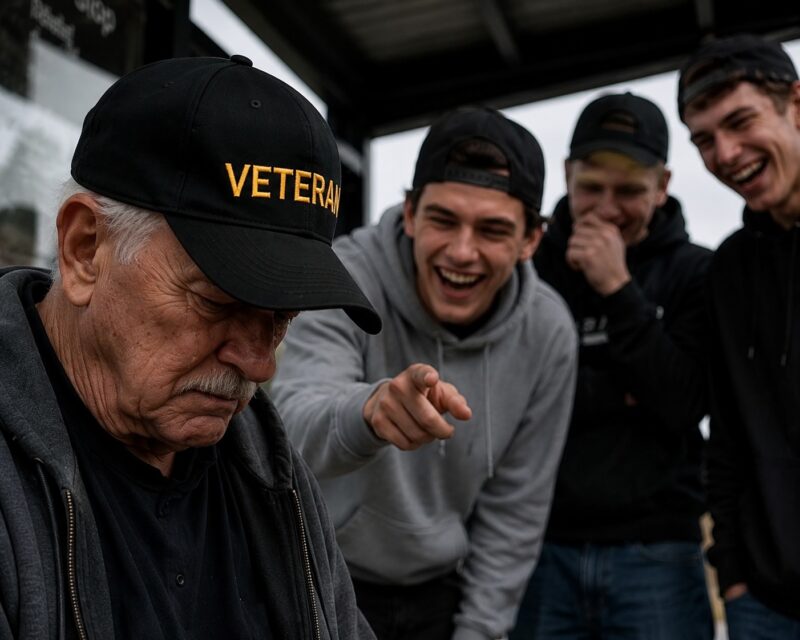
He wore a dark jacket, old and a little worn at the elbows. On his head sat a faded cap with a single word stitched across the front: Veteran. His shorts were simple, practical — and they left his prosthetic leg fully visible to anyone who cared to look.
He had long since stopped expecting people not to look.
Over the years, he’d learned to read the different kinds of stares. Some people glanced away quickly, embarrassed. Others lingered with soft, pitying eyes. Many simply looked straight through him, as if he weren’t there at all. He had made his peace with all of it. The stares didn’t hurt anymore.
What hurt was something far deeper than that.
The battlefield had taken so much from him — things that never came back and never would. It had taken his friends, men he would have trusted with his life, because he did trust them with his life. It had taken his youth, those irreplaceable years when other men his age were falling in love and building families. It had taken his health, slowly and without mercy, in ways that didn’t always show on the outside.
And it had taken the version of himself that existed before — the young man who left home full of purpose and came back someone entirely different.
After his service ended, his marriage didn’t survive the changes in him. They never had children. His old comrades had either moved far away or passed on. Most days, the quiet in his life was total and absolute.
He had learned to live inside that silence.
He was sitting with it, waiting for the bus, when three young men stopped near the station. They looked to be around twenty. Backward caps. Loud voices. The easy arrogance of people who had never once been tested by anything real. They spotted his prosthetic leg almost immediately.
“Hey old man, what’s that?” one of them called out, pointing and already grinning.
The others erupted into laughter before he even finished the sentence.
“He looks like a robot.”
“Airport security must go absolutely crazy because of him.”
“The battery’s probably about to die — better hope he can still make it to the bus.”
They fed off each other, each joke landing harder, each laugh louder than the last. A few people nearby turned to look. Nobody said a word. Nobody moved closer. Most simply walked faster, letting the scene disappear behind them.
The old man lifted his eyes slowly and looked at the boys. He said nothing.
His silence only encouraged them.
He sat there, completely still, while they performed for each other at his expense. Only his hands, resting on his knees, told a different story — his fingers tightening slowly, quietly, into fists.
Those boys had absolutely no idea who they were mocking.
They had no idea that this man had once carried fellow soldiers to safety while bullets were tearing through the air around him. They didn’t know he had lost that leg shielding someone else — putting his own body between danger and another human life. They couldn’t have known that he still woke in the dark some nights, pulled back into memories that refused to stay buried after all these years.
He had given up everything — his health, his family, the ordinary life he might have had — so that people like them could walk these streets without fear. So they could stand at a bus stop and laugh at whoever they pleased without a single consequence.
And they were using that freedom to laugh at him.
What happened next, none of them saw coming.
Standing just behind the group, quiet and perfectly still, was a large man with a thick beard and steady eyes. He wore a black leather vest, the kind that carries its own kind of history. He had been watching from the moment the boys started in on the old veteran, and with every passing joke, something in his expression had gone darker and more certain.
He took one step forward.
Then another.
The laughter began to die.
The boys turned around, and whatever they saw on the biker’s face wiped the smiles clean off theirs.
He stopped directly in front of them and spoke quietly, without raising his voice even once.
“Aren’t you ashamed of yourselves?”
One of the boys tried to play it cool. “What’s it to you?”
The biker looked at him without blinking. “It matters to me because this man didn’t lose his leg from carelessness or poor choices. He lost it for people exactly like you — so you could walk freely through these streets today and say whatever you want without anyone stopping you.”
The bus stop went completely silent.
“People like him were pulling wounded soldiers out of danger while you were still in diapers. And the worst part? He sits here quietly while the three of you treat him like entertainment. That man is stronger than all three of you put together, and you don’t even have the sense to recognize it.”
Not one of them was smiling now.
One stared at the ground. Another buried his hands deep in his pockets. The third managed a quiet, weak defense.
“We were just joking around…”
The biker cut him off, calmly and without hesitation.
“No. That wasn’t a joke. That was shameful. There’s a difference — and it’s time you learned it.”
The old veteran had stayed silent throughout the entire exchange. He sat with his eyes lowered, the same way he always had — absorbing everything, saying nothing. But something had shifted.
For the first time in that long, cold afternoon, someone had chosen to stand beside him rather than walk away.
And in the quiet that followed, even the boys seemed to finally feel the weight of what they had done.