The emergency room was having one of those rare, eerily quiet nights. Outside, a brutal rainstorm had taken over the streets — the kind of downpour that makes everything disappear behind sheets of gray water. You could barely see the parking lot through the windows. The automatic doors kept sliding open and shut in the wind, letting in nothing but the sound of rain and the occasional soaked visitor who rushed in looking shell-shocked from the weather. The nurses on duty moved slowly, filling out paperwork, checking patient charts, exchanging tired small talk. It felt like the kind of shift that drags on forever and ends without a single memorable moment.
Nobody expected what was about to walk through those doors.
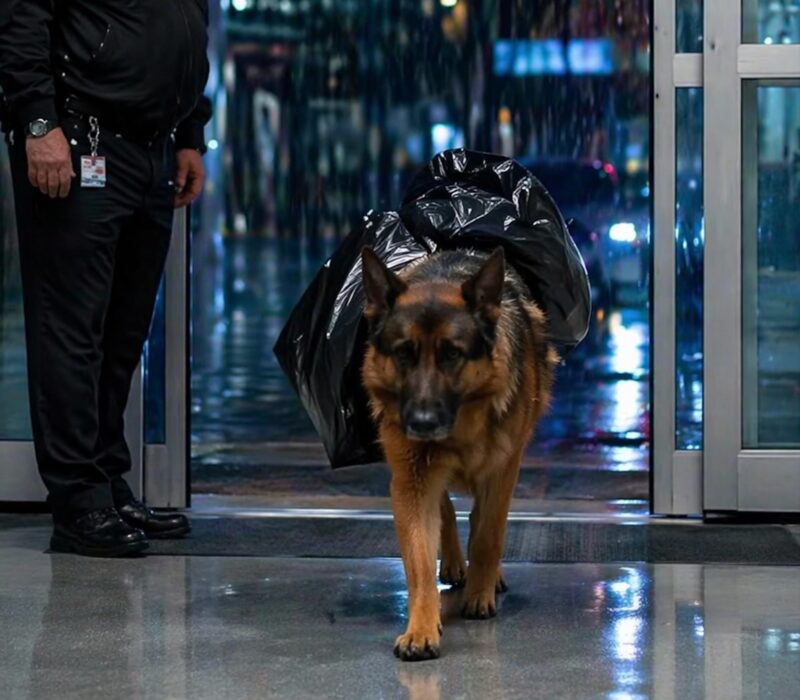
Without any warning, the automatic entrance doors flew wide open — and in ran a dog. Not a small, frightened stray. A large, powerful German Shepherd, absolutely drenched from the storm, water pouring off his thick coat with every step. But what made every single person in that waiting room stop dead in their tracks was what was strapped to his back: a heavy black garbage bag, soaking wet, tied tightly across his body.
The security guard near the entrance moved fast.
“Hey! Stop right there!” he shouted, stepping directly into the dog’s path.
The dog didn’t even flinch. He didn’t bark at the guard, didn’t snap, didn’t hesitate. He moved around him like he wasn’t even there — with the kind of focused, deliberate confidence that didn’t belong to a lost or frightened animal. His paws left wet prints across the tile floor as he made a straight line toward the nurses’ station, head low, breathing hard.
One of the nurses shot to her feet.
“Who on earth let that dog in?! Get it out of here — now!” she called out, her voice sharp with alarm.
A few of her colleagues stepped back instinctively. Someone waved their arms, trying to spook the animal into retreating. The guard caught up and reached for the dog’s collar, firmly trying to steer him toward the door.
“Come on, out — you can’t be in here!”
But the dog planted his feet and refused to budge. He stood right there at the nurses’ station, chest heaving, and began barking — loud, urgent, relentless barks. Every time someone got too close to push him away, he’d sidestep just enough to avoid them, but he never ran. He never retreated. His dark eyes were locked on the people in front of him with an intensity that was almost unsettling. Not aggressive. Not wild. Something else entirely — something that looked almost like desperation.
The nurses were frustrated. Someone was already reaching for the phone to call animal control. The barking echoed off the walls, rattling nerves that were already worn thin from a long shift.
And then one nurse stopped cold.
She wasn’t looking at the dog anymore. She was looking at the bag on his back.
It had moved. Just barely. Just the faintest, almost invisible shift — but it moved.
Her stomach dropped. She held up her hand and said quietly, firmly, “Wait. Don’t touch him. Everyone stop.”
The room went still.
She walked toward the dog slowly. The moment she moved closer, he stopped barking entirely. He stood perfectly still, watching her, his whole body trembling — whether from exhaustion or the cold, it was impossible to say. He lowered his head just slightly, as if he understood. As if he had been waiting for exactly this moment.
With shaking hands, she reached for the edge of the black bag and carefully pulled it open.
The sound that escaped her lips wasn’t a scream. It was something smaller and more broken than that — a sharp, horrified gasp that cut through the silence like a blade.
Inside the bag was a child.
A little one, pale and limp, wrapped in a piece of soaked fabric. Barely breathing. But breathing.
“Stretcher — NOW!” she screamed, and the room exploded into action.
Everything shifted in an instant. The confusion and frustration of the last few minutes evaporated completely, replaced by the swift, focused precision of medical professionals doing exactly what they were trained to do. The child was lifted out with the greatest care and rushed deeper into the department. Doctors came running. Equipment was readied. Every second mattered.
Through all of it, the dog stood exactly where he was. He didn’t follow. He didn’t bark anymore. He simply watched — still and silent — as the child disappeared through the doors. Like he was making absolutely certain the job was done. Like he needed to see it with his own eyes before he could finally let go.
What came to light afterward was heartbreaking in the best possible way. There had been a terrible accident on a nearby road. The rain had made visibility nearly impossible, and a car had gone off the road and come to rest in the dark, largely out of sight. The adults inside had been knocked unconscious. The child had been alone, helpless, in the cold and the rain.
This dog had been in that car.
He had gotten himself out. He had found the child. He had secured that child as safely as he knew how — inside that bag, against his own body — and then, through a violent storm, in the dark, he had run until he found help.
He had run until he found people who could do what he couldn’t.
The child survived. The parents were located and brought in for treatment as well, both of them recovering in time.
And the dog — soaking wet, exhausted, and trembling in the middle of a hospital emergency room — had done what no one else on that road had been able to do.
He hadn’t given up. Not for a single second.
Some say animals can’t reason, can’t feel love the way we do, can’t understand the weight of a life. But anyone who was in that emergency room on that stormy night would tell you differently. They watched a dog carry a child through a storm and refuse to stop until someone listened.
That’s not instinct. That’s devotion.