Nobody in that arena saw it coming. Not the judges. Not the other competitors. Not the thousands of spectators who had packed every single seat to witness what was supposed to be an elite figure skating championship. Nobody could have predicted that the most unforgettable moment of the entire competition would come from a woman who walked in looking like she had nowhere else to go.
The city’s main ice arena was alive with electricity that evening. Skaters from across the region had traveled to compete for the grand prize — one hundred thousand dollars. For most of the athletes on that ice, the money represented glory, validation, and the reward for years of relentless dedication. They arrived in polished costumes, high-end competition skates, and the quiet confidence of people who had trained their whole lives for exactly this kind of stage.
One by one, they took the ice and delivered performances that drew thunderous applause. The music swelled, the jumps soared, and the crowd responded with the kind of enthusiasm reserved for true athletic artistry. Everything felt glamorous, controlled, and entirely predictable — right up until the moment the host called the next name.
She stepped onto the ice, and the arena went quiet in the strangest way.
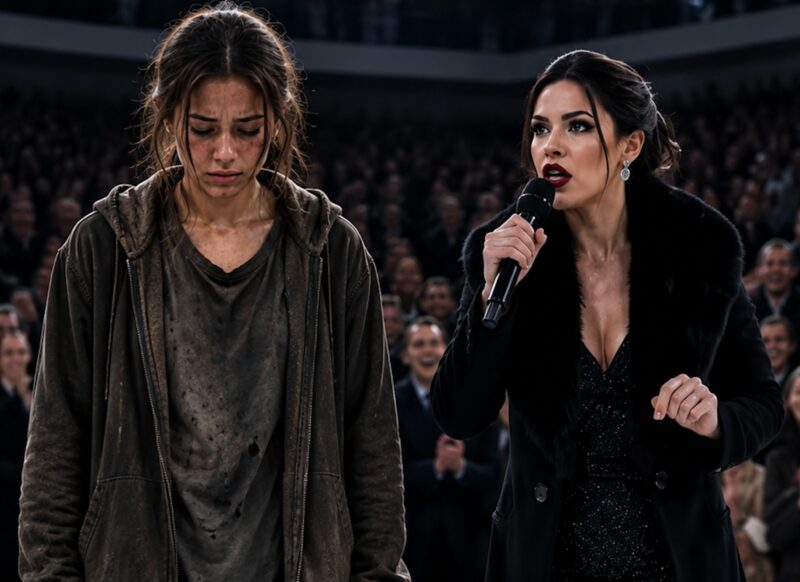
She was around twenty-eight years old, though life had clearly been harder on her than her age suggested. She wore an old jacket that had seen far better days, a pair of ripped jeans, and skating boots so worn and weathered that the laces looked like they might give out before she even reached center ice. There was nothing polished about her appearance. Nothing that fit the setting she had walked into.
The laughter started almost immediately.
Whispers rippled through the stands. Spectators nudged each other and pointed. A few of the other competitors exchanged amused glances, smiling behind their hands. Even the host couldn’t quite contain herself. She leaned toward the microphone with a barely concealed smirk and asked, “Is this some kind of joke? Who are you, exactly?”
The woman looked back at her without flinching.
“I just want to try my luck,” she said quietly. “Like everyone else.”
More laughter. More whispers.
“Look at those skates.”
“She must have gotten lost.”
“Who even let her in here?”
She heard every word. And she did not react to a single one.
She skated slowly to the center of the rink, positioned herself, and waited for the music to begin. The crowd was still murmuring, still entertained by what most of them assumed was some kind of mistake or misunderstanding. A few people had already pulled out their phones, ready to capture what they expected would be an embarrassing moment.
Then the music started.
And within seconds, everything changed.
She pushed off the ice with a power and precision that silenced the arena instantly. The movement was not that of someone stumbling through a routine. It was the movement of someone who had spent thousands of hours on the ice — someone whose body remembered every detail of this art form even when life had stripped everything else away.
She landed a difficult jump. Then another. She moved into a spin that was so clean, so controlled, so breathtakingly smooth that it looked as though she had been training in that very arena every single day. The laughter died. The whispers stopped. The phones stayed in pockets, forgotten.
The judges put down their pens.
The crowd leaned forward.
Every single element she performed was more beautiful than the last. The worn skates disappeared from everyone’s awareness. The torn jacket became invisible. All that existed in that arena was the woman on the ice and the extraordinary gift she was sharing with every person watching. And then, one by one, the spectators rose to their feet.
The applause began before she even finished.
When the music ended, she stopped at center ice, breathing steadily, and let the silence settle around her. The host, the same woman who had mocked her just minutes before, approached with wide eyes and a voice stripped of its earlier smugness.
“Who are you?” she asked.
The woman was quiet for a moment.
Then she spoke, and the arena listened.
She explained that she had once been a professional figure skater. She had trained seriously, competed at high levels, and dreamed of reaching international championships. But life, as it sometimes does, took everything from her in a very short period of time. She lost her parents. Then she lost her job. And eventually, she lost her housing. By the time she found herself standing in that arena, she had been living in a shelter for quite some time, raising two young children on her own. Every dollar she managed to earn went directly toward keeping them fed, clothed, and healthy.
She had not come for applause. She had not come for recognition.
She had come because one hundred thousand dollars could give her children a future she could not currently offer them on her own.
The arena was so still after she finished speaking that you could hear the faint sound of the ice beneath her blades.
When the judges announced the results, there was not a single person in that building who questioned the outcome.
She took first place.
The applause that followed was not the polite, appreciative kind that greets a strong performance. It was the kind that comes from somewhere deeper — from people who have just witnessed something that reminds them what the human spirit is genuinely capable of. People who had laughed at her were now wiping their eyes. People who had never planned to care about this competition were suddenly on their feet, clapping until their hands hurt, because what they had seen was not just a skating performance.
It was a woman who had refused to let the world’s cruelty define her limits.
It was a mother who had held on to her gift through circumstances that would have broken most people.
And it was a reminder — one that nobody in that arena would forget anytime soon — that you should never, ever judge someone by what they are wearing when they walk through the door.