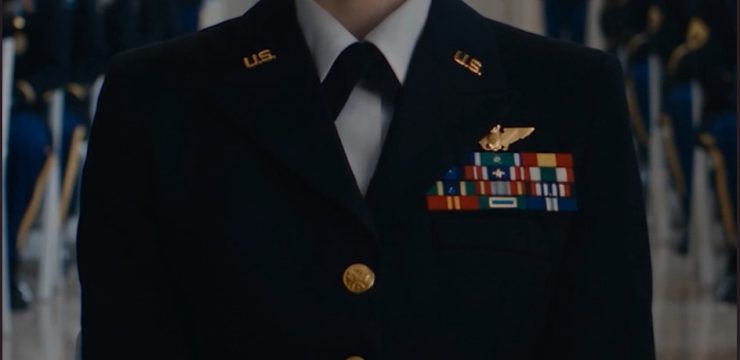
The farewell ceremony for Officer Alexander Morozov was supposed to be a solemn and orderly goodbye — the kind of dignified send-off that a man with twenty-five years of dedicated military service truly deserved. Military personnel had pressed their uniforms. Relatives had dried their eyes as best they could. Friends stood quietly near the walls of the spacious memorial hall, heads bowed, hearts heavy. In the center of the room, a closed coffin rested on a draped platform, holding the man whom many considered the finest dog handler in the country.
Alexander had given everything to his work. Over the course of his long career, he had trained dozens of service dogs — animals that went on to find missing children in the dark, track down dangerous criminals, and pull survivors from rubble during search-and-rescue operations. He was not just a trainer. To the dogs he worked alongside, Alexander was something far deeper than that. And on this particular afternoon, those animals were about to make sure the entire world understood exactly what he had meant to them.
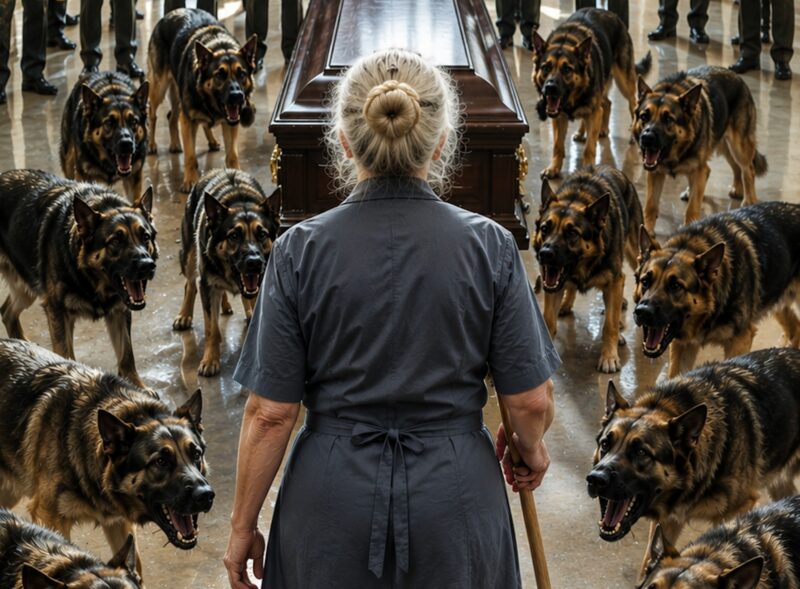
Twelve military working dogs had formed a tight, unbreakable circle around the coffin. And they were not letting a single soul come near it.
At first, the officers assumed the dogs were simply overwhelmed with grief. Animals that bond closely with their handlers often struggle when that person is gone — everyone in the room understood that much. But as the minutes ticked by without any sign of the situation calming, the mood in the hall shifted from sadness to something closer to fear. Every time someone took even a small step in the direction of the coffin, the entire pack rose to attention. Teeth bared. Deep, low growls rumbled through the hall like distant thunder.
One officer — experienced, confident, not easily rattled — carefully attempted to approach. A large German Shepherd lunged forward with such speed and force that the man barely stumbled backward in time. After that, no one tried again. They simply stood and watched, unsure of what to do, while relatives wept and whispered prayers and the ceremony fell further and further behind.
The unit commander rubbed the back of his neck and said quietly to the man standing beside him, “I don’t know how we’re going to handle this.” Nobody answered, because nobody had an answer.
Then the doors at the far end of the hall swung open.
An elderly woman walked in. She was carrying an old mop and a plastic bucket. Her clothing was plain, the kind worn by someone whose job is to keep floors clean and hallways tidy — not the kind of person who typically commands attention when she enters a room. She moved with the unhurried pace of someone who had walked these corridors a thousand times and had no particular reason to rush.
Several officers immediately moved toward her, arms raised, voices urgent. “Ma’am, please stop — the dogs aren’t safe right now, you need to stay back—”
She didn’t stop. She didn’t even slow down.
The entire hall went completely silent. Every head turned. All twelve dogs turned their heads toward her at exactly the same moment, and for a few breathless seconds, the tension in that room was almost unbearable. People braced themselves. Some closed their eyes.
Then the largest German Shepherd — the one that had lunged at the officer moments before — slowly lowered its massive head. Its tail began to wag. One by one, like dominoes falling in reverse, each dog in the circle did the same. And then, without any command being given, the pack quietly parted. They stepped aside and opened a path straight to the coffin.
The sound that moved through the crowd was barely a sound at all — just a collective exhale of pure disbelief.
The woman walked forward, reached out, and placed her hand gently on the lid of the coffin. Several dogs pressed themselves softly against her legs and stayed there, leaning into her with the kind of trust that takes years to earn.
“They know her,” someone whispered.
The woman turned to face the crowd. Her eyes were full of tears she was no longer trying to hold back. She spoke in a quiet, steady voice that somehow carried to every corner of the room.
She explained that after her husband passed away, she had found herself completely alone. She had taken a job here as a janitor — cleaning the floors, maintaining the building, staying out of everyone’s way. But Alexander had noticed her. And somewhere along the line, she had begun helping him with the dogs after training sessions, bringing them food and water when he was held up on duty, sitting with them during the long stretches when he was away on assignment for weeks at a time. She had been there through puppyhood, through training, through all of it. To those twelve dogs, she was family.
Then she reached into her pocket and placed something on top of the coffin. It was a photograph — old and worn at the edges, the kind that has been handled many times over many years. In the picture, a younger Alexander stood smiling beside the woman and twelve small puppies. The very same animals that now sat quietly around the coffin, calm at last.
It came out then — the full story. Years earlier, Alexander had rescued an entire litter of newborn puppies from a kennel fire. While he managed the demands of his duties, this woman had helped him raise every single one. She had bottle-fed them, kept them warm, watched over them through their most vulnerable weeks of life. She wasn’t just someone who had worked in the same building as their handler. She was one of the people who had given them life.
The dogs had not been blocking the coffin out of aggression or confusion. They had been waiting. Waiting for the one person left on earth who belonged to their circle — the last member of the only family their owner had truly claimed as his own.
When the woman leaned close to the coffin and whispered softly, “It’s okay, Sasha. You can rest now,” all twelve dogs lay down on the floor at once. Quietly. Completely still. As though they had spent the entire day holding their breath for exactly those words, and could finally, peacefully, let go.
The ceremony continued. And every officer who witnessed what happened in that hall later said the same thing — in all their years of service, they had never seen anything like it. The photograph was buried alongside Alexander, because it told the only story that mattered: that a good man’s legacy is measured not in medals or commendations, but in the hearts that keep loving him long after he is gone.