Nobody in the palace could have predicted what happened that morning. And nobody — not a single guard, not a single servant — could have imagined that a shattered piece of porcelain would end up unlocking something far more valuable than anyone had ever realized.
The day had started like any other. The maid climbed a tall ladder to clean the enormous crystal chandelier hanging from the grand hall’s ceiling. She worked slowly and carefully, wiping down each delicate pendant with the kind of patience that only comes from years of quiet, unnoticed service. The job was nearly done. She was almost finished. And then, without warning, one of the ladder’s steps shifted beneath her foot.
She reached out to steady herself. Her body tilted. Her foot swung to the side — and caught the edge of a tall porcelain vase resting on a carved wooden table just beside the ladder. The vase wobbled. It leaned. And then it fell — crashing onto the marble floor with a sound that echoed through every corridor of the palace like a thunderclap.
Shards of porcelain scattered across the polished floor. Silence followed.
The maid went pale. She stood frozen on the ladder, staring down at what she had done. In any other home, a broken vase might have meant a stern warning or a docked paycheck. But this was not just any vase. And this was not just any home.
That vase had belonged to the Sheikh’s late mother.
He had never allowed anyone to touch it unless absolutely necessary. It sat in its place like a sacred object — admired from a distance, protected at all costs. Everyone in the palace knew its significance. Everyone understood that it was the one possession their master held above all others. It was not about its beauty or its price. It was about who it had belonged to and what it represented — a connection to a woman he had lost and still deeply mourned.
Slowly, the maid climbed down from the ladder. Her legs trembled as she stepped onto the floor. She could not take her eyes off the broken pieces.
“No… not this one,” she whispered, her voice barely audible.
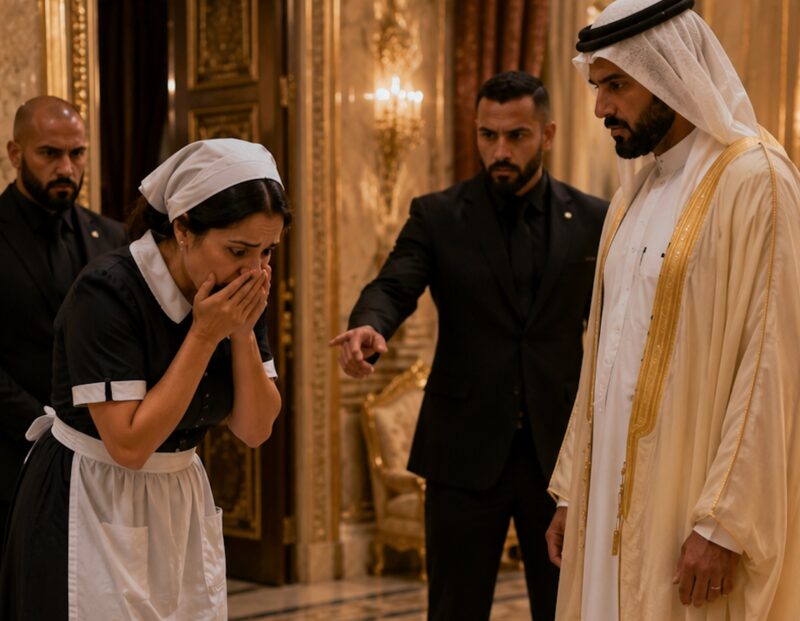
Within seconds, the guards came rushing in. They had heard the crash and they already knew. One look at the shattered remains on the floor told them everything.
“Do you have any idea what you’ve done?” one of them demanded, his voice sharp with anger.
“That was the most precious thing in this palace,” the other added. “You’re done here.”
They moved toward her, ready to escort her out immediately. The maid broke into tears.
“Please — I swear it was an accident. I lost my balance. I didn’t mean to. Please don’t send me away. I’ll work every single day to make it right. Whatever it costs — I’ll repay it.”
The guards looked at each other. One of them shook his head slowly.
“You can’t put a price on something like that.”
Before another word could be spoken, the doors to the hall swung open.
The Sheikh walked in.
He took one look at the scene — the trembling maid, the rigid guards, the porcelain scattered across the floor — and his face went still. A heavy silence descended over the room. No one moved. Some of the servants quietly looked away, bracing themselves for what they assumed was coming.
But the Sheikh did not shout. He did not point toward the door. He did not give the order that everyone expected.
Instead, he walked slowly toward the broken vase and knelt down beside the shattered pieces.
The guards looked at each other, confused.
The Sheikh carefully examined the fragments, turning them over gently with his hands. And then — a faint metallic sound rang out from within the pile of broken porcelain.
He paused.
He moved a few pieces aside and found something that had been hidden inside the base of the vase — a small, sealed metal cylinder, the kind used long ago to preserve important documents.
His hands began to tremble.
He lifted the cylinder carefully, removed the wax seal, and pulled out a tightly rolled piece of yellowed paper. The moment he unfolded it, he recognized the handwriting instantly.
It was a letter from his mother.
She had written it herself, years before her passing. She had hidden it deliberately inside the vase — knowing that one day, somehow, it would be found. In the letter, she explained everything. She told him why that vase had always meant so much to her. She revealed a family truth she had never found the courage to speak aloud while she was alive. She shared her heart in the way that only a letter can carry — quietly, tenderly, across the years.
The Sheikh read every word in silence.
When he finally stood up, the entire hall held its breath.
He walked to the maid, who had her eyes cast downward, waiting for the moment she would be told to leave.
He spoke calmly, without anger, without blame.
“If this vase had never broken today,” he said quietly, “I would never have known what my mother needed me to hear.”
The maid looked up at him, completely stunned.
And for the first time in a very long while, the Sheikh smiled — a real smile, the kind that comes from somewhere deep inside a person who has just been given an unexpected gift.
“You didn’t ruin anything,” he told her. “You helped carry out her final wish.”
He turned to his guards.
“Release her. From this day forward, no one in this palace is to speak a word against her.”
Silence settled over the room once more. But this time, it was a different kind of silence — the kind that follows something that changes a person forever.
Sometimes the things that seem like our worst mistakes turn out to be exactly what someone needed most. A broken vase. A hidden letter. And a man who finally heard his mother’s voice one last time.