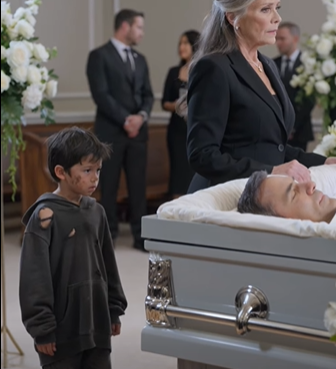
He was standing at the edge of the room like he wasn’t sure he was allowed to be there.
Small. Quiet. Wearing a coat that was just a little too thin for the weather outside. His shoes were clean, but barely. His hands were folded in front of him the way children fold their hands when they’ve been taught to be invisible in adult spaces.
No one had brought him. No one was standing with him. He had simply appeared — the way the truth always does, eventually — at the edge of a funeral for a man most people in that room had called respectable.
The woman in black noticed him first.
She was the deceased’s older sister. Poised, composed, the kind of woman who had spent decades learning how to feel things privately and present nothing publicly. She had managed the flowers, the guest list, the obituary. She had managed everything her family ever needed her to manage.
But she could not manage the way her breath caught when she saw the little boy’s face.
Because she knew that face.
She had seen it in old photographs. In the mirror. In the features of a brother she had loved even when she didn’t understand him.
She moved across the room slowly, careful not to draw attention. When she reached him, she crouched slightly, the way you do when you’re trying not to frighten something fragile.
“Who are you here with?” she asked gently.
The boy reached into his coat pocket and pulled out a small card. On the front was the name of the deceased — her brother. On the back, in handwriting she recognized immediately, were just a few words.
He is my son. Please be kind to him.
For one long second, the whole funeral room disappeared. Not the flowers. Not the mourners. Not the casket. Only the little boy. And the words on the back of that card.
Her hand trembled.
Because yes — she knew. She had always known, even when she pretended not to.
Years ago, long before family reputation hardened into something that felt more like a prison than a home, her brother had fallen in love with a woman no one approved of. She was young, and poor, and invisible to the world they moved in. When it became clear a child was coming, the family did what families like theirs have always done when the truth threatens the name on the door — they buried it.
Money changed hands. Records vanished. The woman was quietly, firmly, permanently removed from their story.
And the older sister — this same elegant woman now standing in black — had been the one trusted to make it disappear.
She had obeyed. Mostly.
But she could not bring herself to destroy one thing. A gold watch. Their father’s watch, the one passed down to her brother, engraved on the back with a date and a promise. She had hidden it instead of surrendering it, because some small and stubborn part of her believed that if a child ever returned, that watch would be proof enough to open a door that should never have been closed.
Now the child had returned.
Not grown. Not powerful. Not arriving with lawyers or demands.
Just small. Cold. And standing beside his father’s coffin with nowhere else to go.
She looked at him again — really looked — and saw everything she had spent years not seeing. Her brother’s eyes. The family’s jaw line. The same stillness her brother had carried as a boy when he was trying very hard not to cry in front of people.
“How long were you with him?” she whispered.
The boy looked at the floor.
“Three weeks.”
That landed harder than she expected. Because it meant her brother had found this child at the very end of his life. Not with enough time to raise him. Not with enough time to undo the years of silence or repair what the family had broken. Only enough time to say — go to my funeral, give them this card, and let the truth finally exist in the open.
She steadied herself.
“Where is your mother?”
His voice was very quiet.
“She died last winter.”
The room felt smaller.
Then he said the words that cracked something open inside her that she didn’t think could still break.
“He said I’m all that’s left.”
She closed her eyes for one moment. Just one.
Because suddenly this was no longer simply a funeral for her brother. It was a reckoning for herself. For all the years she had chosen obedience over honesty. For all the years she had told herself that silence was a form of survival, that going along with things was how you kept a family together, that what you didn’t say couldn’t hurt the people you loved.
A child had lived outside this family while the family kept its silver polished and its name clean.
She reached slowly into her handbag.
She had carried the velvet pouch with her throughout the entire funeral, though she couldn’t have explained why that morning when she picked it up. Perhaps some quiet part of her had known, even then, that today was the day the truth would finally need a witness.
She placed the gold watch into the boy’s small hands.
He turned it over. On the back, engraved in letters worn soft with age, was the family name. And beneath it, in her father’s careful script:
For my son.
The little boy stared at the watch. Then he looked up at her with eyes that asked a question his voice was too careful to say out loud.
And standing in that quiet room full of flowers and decades of carefully managed silence, the elegant woman in black finally understood something she should have known all along.
This child had not come looking for charity. He had not come to cause trouble or make demands or disrupt a funeral.
He had come to be acknowledged — before the last person who knew the truth was buried too.
She took his hand.
And this time, she did not let go.