She came in like clockwork. Every single day, rain or shine, the small hunched woman in the old wool coat appeared at the butcher’s counter, her worn shopping trolley squeaking against the tile floor like a tiny alarm announcing her arrival.
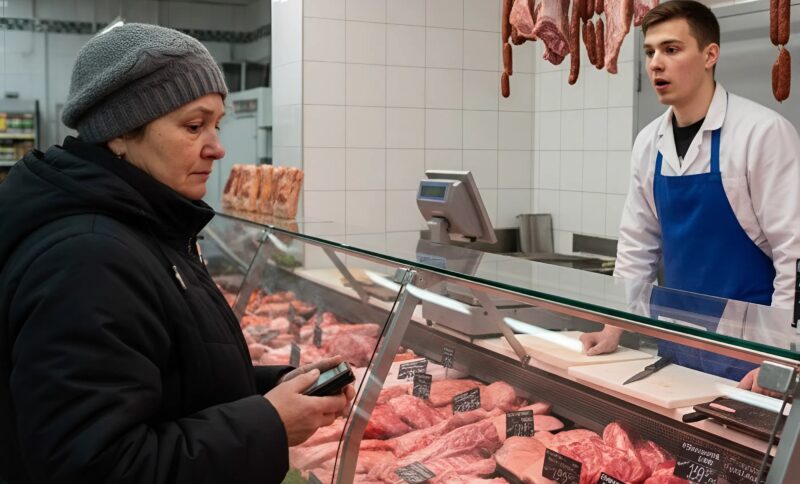
“Forty kilograms of beef,” she would say softly, sliding a neat stack of folded bills across the glass case. “As usual.”
The young butcher would nod, wrap the order, and watch her go — and every single time, he was quietly amazed. Forty kilos. Day after day. Week after week. That’s nearly half a carcass. Most families don’t go through that in a month.
At first, he assumed she was feeding a large extended family — maybe a daughter with lots of kids, or a son who ran a food business on the side. It happened. But something about this woman didn’t quite add up. She never made small talk. She never smiled. She barely made eye contact, just tucked her bags into that creaky trolley and shuffled out the door without a word.
And then there was the smell. It followed her in and lingered even after she left — a strange, heavy mix of iron, raw meat, and something else entirely. Something he couldn’t quite name, but that made the hair on the back of his neck stand up.
The market vendors noticed too. Whispers spread between the stalls like wildfire.
“I heard she’s cooking for her son’s whole family.”
“My money’s on dogs. A lot of dogs.”
“Or maybe she’s running some kind of underground restaurant.”
The butcher laughed it off at first. But curiosity has a way of growing, quietly and steadily, until it becomes impossible to ignore. One evening, after she disappeared around the corner, he made a decision. He grabbed his coat and followed her.
He kept his distance, staying half a block behind as she pulled that heavy trolley through the snow. She moved slowly but with surprising purpose — past the edge of town, past a row of abandoned garages, and toward an old factory building that had been sitting empty for years. The windows were dark. The doors were rusted. Nobody went there.
But she did.
She disappeared inside with her bags. The butcher stood in the cold, watching. Twenty minutes passed before she emerged again — hands completely empty, trolley empty too. She walked back the way she came as if nothing had happened.
The next day, the same thing. And the day after that.
On the third day, he couldn’t hold back any longer. He waited until she went inside, then crept up to the building and slipped in behind her, stepping as quietly as he could across the cracked concrete floor.
The smell hit him immediately — thick, raw, and wild in a way that made his stomach drop. And then came the sounds. Low, rumbling, guttural sounds that bounced off the empty walls and seemed to come from everywhere at once.
He moved toward a crack in the wall and looked through.
His breath caught in his throat.
Four enormous lions sat behind heavy iron cages, their amber eyes catching the weak light of a single hanging lamp. Bones and fresh chunks of beef were scattered across the floor. The animals were massive — clearly well-fed, clearly not tame.
And there, sitting in a worn armchair in the corner of that cold, abandoned room, was the old woman. Her voice had completely changed. The timid, quiet woman from the butcher shop was gone. In her place was someone speaking in a low, firm whisper — almost tender, almost reverent.
“Easy now, my darlings. Soon. People will come to watch you. It won’t be long.”
The butcher staggered back in shock. His foot scraped against the floor. One of the lions threw its head up and released a roar so powerful it shook the air in his chest. The woman spun around instantly, her eyes sharp and cold.
“What are you doing in here?!” she hissed, rising from the chair.
He didn’t wait to find out what came next. He ran.
The moment he hit open air, he pulled out his phone and called the police.
When officers arrived and pushed through those rusted doors, they found exactly what the butcher had described — and then some. The woman didn’t run. She stood in the center of the room, arms crossed, silent.
What investigators uncovered over the following hours was deeply disturbing. The old woman was a former zoologist who had worked at the local zoo until it shut down. When the animals were set to be transferred or put down, she had secretly taken several of the lions, telling herself she was saving them.
But somewhere along the way, saving them became exploiting them.
Behind the cages, officers discovered a crude arena — wooden barriers arranged in a rough circle, with claw marks gouged deep into the surrounding walls. Evidence pointed to illegal animal fighting events that had been staged in secret, attended by wealthy spectators who paid for the thrill of watching trained lions compete in brutal conditions.
The old woman, the quiet widow with the squeaky trolley and the forty kilos of daily meat, had been running the whole operation herself — buying the beef, maintaining the animals, organizing the events, collecting the payments.
She was taken into custody without a struggle.
The four lions were transferred to a wildlife rehabilitation facility, where experts began the long process of evaluating their health and preparing them for a safer life.
As for the butcher — he still thinks about her sometimes. The way she looked at those animals. The way her voice softened when she spoke to them. Whatever twisted road she had walked down, something in her had genuinely loved those lions.
That’s the part he can’t quite shake.