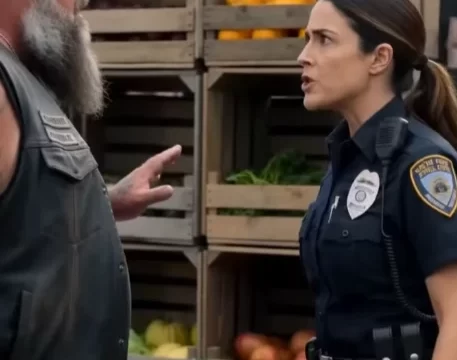
Clara was eighty-four years old, sitting in a corner booth of a small-town diner, trying desperately to hold a coffee cup steady with a hand that refused to obey her. Across the table, her nephew Evan slid a document toward her — smooth, patient, almost kind. But Clara had lived long enough to know the difference between someone who loves you and someone who needs something from you.
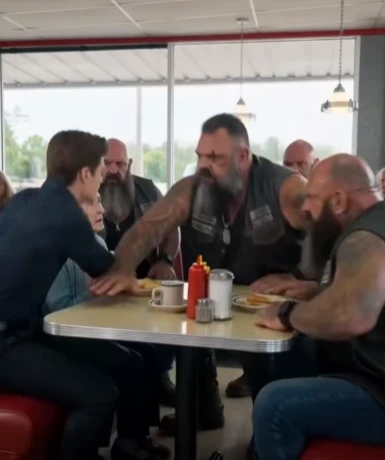
The paper asked her to sign over her house.
She called it a transfer. He called it protection. But Clara knew what it really was — the last piece of Harold she had left in this world. The little yellow house on Harrow Street, with the porch Harold rebuilt three times because he could never measure straight, with the pencil marks inside the pantry door recording every grandchild’s height, with the rosebush she had nearly torn out with her bare hands the spring after Harold died because seeing it bloom without him felt unbearable. That house was not an asset. That house was a memory made of wood and brick and love.
When her hand shook so badly the cup rattled against the saucer, Evan leaned forward and whispered the word that always silenced her. “Your memory,” he said. “Your condition.” As if her trembling fingers were evidence that she no longer had the right to say no.
Then six motorcycles rolled into the parking lot.
The men who walked through the diner door were large, weathered, and wore leather vests with the words IRON SCRIBES stitched in silver. The room shifted the way rooms do when people make snap judgments. Mothers pulled children closer. College kids stopped laughing. But Clara watched them differently. She watched because the biggest one — a man with a graying beard and a scar through his left eyebrow — looked at her. Only for a second. But he saw her. Not the confused old woman Evan described. Not the patient on Dr. Vale’s forms. Her.
When Evan’s hand closed around her wrist hard enough to leave marks, Clara made a decision that took every ounce of courage she had. She stood up, walked past her nephew, crossed thirty feet of diner floor, and stopped beside the biggest biker at the corner table.
“Could you hold my hand?” she whispered.
His name was John Mercer. The club called him Bear. He did not laugh. He did not look away. He extended his scarred, engine-roughened hand and wrapped it gently around hers. The trembling softened. Not completely. But enough for Clara to remember she was still a person with rights, with a home, with a story that was not finished.
What Bear did not know — what none of them knew yet — was that this moment was not random. It was the final chapter of something that had started before Clara and Bear were even in the same room.
The men of the Iron Scribes did not simply stand between Clara and Evan in that diner. They took her in. They found her a safe place to sleep, changed her locks, brought in an attorney named Lena Ortiz who had the quiet intensity of someone who had spent her career angry on behalf of people who couldn’t afford to be angry themselves. And Sarah, a nurse married to one of the bikers, started asking questions about Clara’s medications that nobody had ever thought to ask before.
The answers were devastating.
Clara had been told she had Parkinson’s disease. She had believed it. She had mourned her own mind, apologized for her trembling, allowed her fear of her own body to make her compliant, controllable, easy to manage. But Sarah laid out every prescription bottle on the kitchen table and made a phone call to a pharmacist she trusted. One of Clara’s medications — prescribed by Dr. Marcus Vale, chosen by Evan — was known to cause severe tremor, stiffness, and cognitive fog in elderly patients. Symptoms indistinguishable from Parkinson’s disease. Symptoms that could make a sharp, stubborn, fully capable woman appear confused, dependent, and in need of someone to manage her affairs.
Someone like Evan.
As Lena dug deeper, the picture that emerged was not just a nephew’s greed. It was a system. Vale identified elderly property owners who were isolated and vulnerable. Evan handled the paperwork and the relationships. A lawyer named Paul Renshaw handled the transfers. Dozens of families across years. Millions of dollars in properties. And at the center of it all, the quiet, devastating weapon of making someone doubt their own mind until they stop fighting back.
Clara’s younger sister Ruth had come before her. Ruth had also fallen under Vale’s care. Ruth had also ended up in an assisted-living facility, her home sold, her savings drained. Ruth had died there, in a facility she hated, after a do-not-resuscitate form was signed in her name — a form she never agreed to, a signature she never gave. And on a small recorder hidden beneath her mattress, Ruth had left behind one final act of courage: a recording of the conversation that proved what Vale had done.
She had been trying to protect Clara from the very beginning.
When Evan finally broke — exhausted, afraid, cornered — he walked into Lena’s office carrying six years of recorded evidence against Vale. Not out of goodness. Out of desperation. But the recordings were real, and the truth they contained sent Vale, Renshaw, and two facility administrators to prison. Thirty-one suspected victims. Twelve years of coordinated elder exploitation. And a verdict that made national news.
But the moment that mattered most happened quietly, on a balcony, when Bear opened a letter Harold had written years before anyone knew any of this would happen. A letter addressed to John Mercer. A letter that revealed Harold had once been a frightened twelve-year-old boy sitting outside a hospital alone — and a stranger named Elias Mercer, Bear’s own father, had simply sat beside him and refused to leave.
Harold had spent his whole life paying that kindness forward. He had taken in a troubled teenage boy named John and given him work, dignity, and a second chance. Decades later, that boy — now called Bear — had been sitting in exactly the right diner on exactly the right morning when an eighty-four-year-old woman needed someone to hold her hand.
Clara’s tremor never returned after the medications were changed.
She lived to ninety-two, surrounded by people she had gathered simply by refusing to disappear quietly. She started a foundation. She wore a silver pin — a hand inside a motorcycle wheel — because she said the leather vest made her look like an upholstered raisin. She knitted slightly crooked scarves for every man in the Iron Scribes and never apologized for the uneven stitches.
At her funeral, Bear stood before hundreds of motorcycles and hundreds of people and said the thing Clara would have wanted said most.
“We think courage means fear disappears. Clara taught me courage is what you do while fear is still sitting right beside you.”
She walked across that diner terrified. She asked for help terrified. She told the truth terrified. And every person whose life changed because of her did the same. A hand offered in fear became a promise. A hand held in kindness became a legacy. And the smallest act of courage — crossing thirty feet of diner floor with a shaking hand outstretched — turned out to be the beginning of everything.