I’ve been a park ranger for eight years. I’ve handled lost children, medical emergencies, and wildlife disputes. Nothing — and I mean nothing — could have prepared me for that Tuesday afternoon at Southside Playground.
It started with a scream.
A high-pitched, terrified scream that cut straight through the lazy summer noise of the park. Parents froze mid-conversation. Children stopped mid-swing. I was already moving before my radio even crackled.
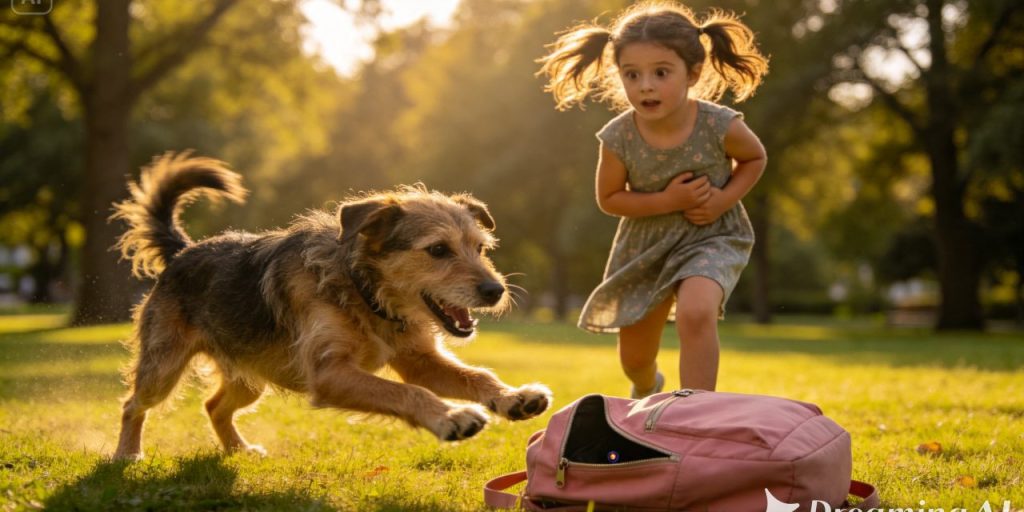
When I pushed through the crowd, I found a little girl — no older than seven — flat on the ground, face streaked with dirt and tears. Standing over her, teeth bared, was the largest stray dog I had ever seen. A heavily muscled brindle mix, covered in old, faded scars, with clipped ears that told the story of a rough and unloved life.
But something immediately felt wrong about this scene.
The dog wasn’t looking at the child. It was standing directly over her backpack — a bright pink canvas bag covered in cartoon princesses — and it was refusing to let anyone near it. Not the little girl. Not the gathering crowd. Not me.
Then I heard it.
Click… click… click.
A slow, heavy, metallic rhythm rising from inside that pink backpack. It didn’t sound like a toy accidentally switched on. It wasn’t a vibrating phone. It was deliberate. It was mechanical. And every instinct in my body ignited at once.
“Everyone, back away!” I roared, and the crowd shattered instantly.
I scooped the trembling girl into my arms and moved her back, scanning the fleeing crowd until a woman burst through the treeline, screaming her daughter’s name. I handed little Mia over to her mother and ordered them both to run toward the concrete restroom building and not stop.
Then I grabbed my radio.
Within minutes, the park was a controlled explosion of flashing lights and yellow crime scene tape. Local police, then the county bomb squad, then a hazmat unit — all converging on one pink children’s backpack while a scarred stray dog refused to abandon his post over it.
The bomb squad deployed their rover — a small, heavily equipped robot — but the dog charged it with everything he had, barking ferociously, refusing to let the machine anywhere near the bag. He didn’t trust it. Somehow, this animal understood something none of us could yet articulate.
Captain Reynolds, the bomb squad commander, made a quiet observation that sent a chill down my spine.
“Dogs can smell nitrates, chemical compounds, unstable materials,” he murmured, watching the dog pace protectively. “But trained dogs sit when they find explosives. They don’t attack. Unless what’s inside is something they’ve never been trained for.”
I volunteered to catch the dog. Nobody else was going in, and animal control was twenty minutes away — time we clearly didn’t have.
I walked out into that empty, silent playground with an aluminum catch pole and shaking hands, got within feet of a dark, spreading stain that smelled of copper and burnt machinery, and somehow slipped the wire loop over the dog’s thick, scarred neck.
He didn’t fight me. The moment the loop tightened, he leaned his weight against the pole as if he understood. As if he was finally trusting me to take it from here.
The rover moved in. The camera feed went live on the monitors inside the bomb squad truck, and what we saw on that screen made grown men go completely silent.
It wasn’t a bomb.
Inside the ruined backpack, behind a zipper that was already splitting apart under immense internal pressure, was a smooth metallic surface — deeply gouged with savage scratch marks from the inside — and in the center of it, one glowing, red, mechanical eye.
The zipper blew.
What emerged was a fully autonomous combat drone — roughly the size of a large dog, six articulated limbs ending in blade-like points, a scorched titanium chassis leaking dark hydraulic fluid from a massive gash in its side. It destroyed the rover in seconds, and every weapon trained on it froze because one scarred, unloved stray dog ripped free of my grip and charged it head-on.
What followed was the bravest thing I have ever witnessed in my life.
That dog slammed into the machine with everything he had, ignoring the slashing blades cutting into his shoulders and flanks, clamping his powerful jaws onto the drone’s central housing and shaking it with everything he was worth. The titanium casing buckled. Sparks rained into the woodchips. The drone screeched in failing circuitry.
It drove a limb into the dog’s hind leg. He yelped — just once — and his grip slipped.
The machine tried to drag itself toward the treeline.
I didn’t think. I grabbed my steel baton, sprinted past every frozen officer, and drove it down into that glowing red eye with everything I had left in my body.
The machine went dark.
The dog was lying in the sand, breathing in shallow, ragged gasps, his brindle coat soaked through. I dropped to my knees beside him, pressing my hands against his wounds, talking to him softly while tears I wasn’t ashamed of ran down my face.
He looked up at me, and his tail thumped weakly against the ground.
Federal agents swept in hours later and buried the story — the drone was a stolen military prototype hidden in the nearest available bag by a panicked operative about to be captured. If that dog hadn’t smelled the leaking hydraulic fluid and torn it free from that little girl’s back, the drone’s self-repair system would have activated on a playground full of children.
The dog survived surgery. A hundred stitches, a permanent limp, and the stubbornness of something that simply refused to quit.
I adopted him the same day he was discharged. I named him Titan.
He sleeps at the foot of my sofa now, snoring on an orthopedic bed that cost more than my first paycheck. Mia and her mother visit every weekend with toys and fresh steaks. People still cross the street when they see us walking because he looks intimidating, scarred, and rough around the edges.
But I know what beats inside that chest.
Titan taught me something I carry every single day: the most overlooked, the most dismissed, the most written-off among us are often the ones who will stand between you and the darkness without a second’s hesitation.
Never judge a soul by its scars.