The grip on my collar tightened before anyone in first class understood what was happening.
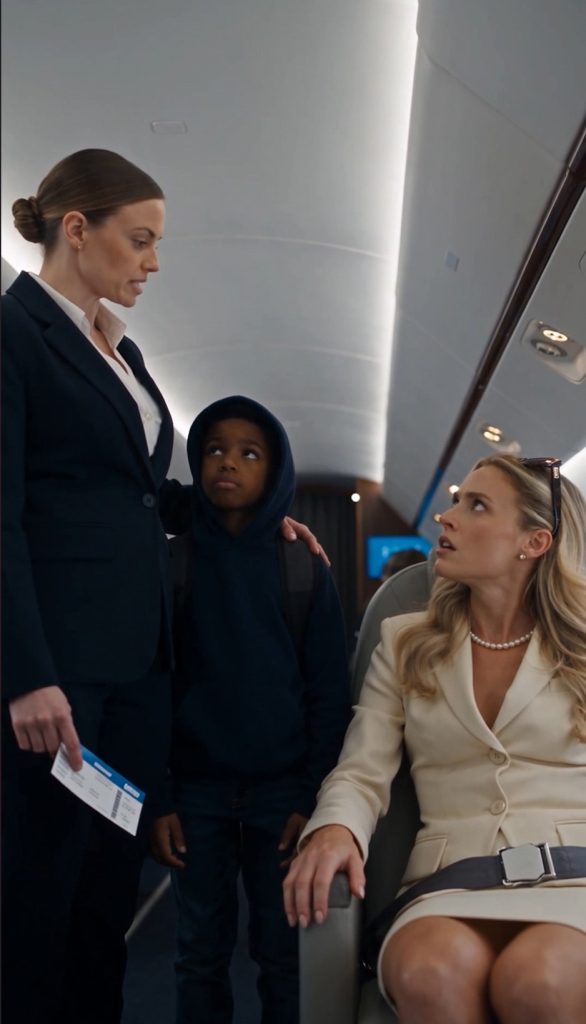
“Get this child out of here,” the woman snapped, dragging me away from seat 2A. “He’s harassing me.”
I was ten years old.
I held my boarding pass with both hands because if I loosened my fingers, everyone would see them shaking.
The cabin went silent.
Victoria Whitmore released me, smoothed her cream blazer, and settled into my window seat as though it had always belonged to her. Expensive perfume hung in the air.
“I don’t think so, honey,” she said from behind dark sunglasses.
Marcus, the flight attendant, hurried over.
“Ma’am, his ticket does say 2A.”
Victoria gave a short laugh.
“Do you know who my husband is? Richard Whitmore. Whitmore Group.”
Then she looked down at my worn sneakers, oversized navy hoodie, and cheap backpack.
“Children like you belong in the back.”
Across the aisle, a woman quietly raised her phone.
The red recording light came on.
My throat burned.
I wanted Grandma Loretta.
She had died eight months earlier, but I could still hear the last lesson she gave me.
Be the calm, Malik. Rich people panic when poor people don’t beg.
So I didn’t.
Marcus stared at my boarding pass, then at Victoria’s diamond bracelet.
“Buddy,” he murmured, “why don’t we find you a nice seat in economy? I’ll bring you some snacks.”
Victoria smiled.
“See? Even the crew understands.”
Then someone stepped into the aisle.
“His name is Malik. And he is assigned to 2A.”
Diane Mercer—my legal guardian—stood perfectly still in her black suit, silver watch catching the cabin light.
She looked at Marcus’s name tag.
“You verified his boarding pass. Explain why you’re asking him to move.”
Marcus swallowed.
“Mrs. Whitmore is a premium member, and her husband’s company—”
“Her husband’s company is irrelevant unless it purchased this airline in the last ten minutes.”
Victoria shot to her feet.
“He assaulted me!”
Gasps moved through the cabin.
An older man in row four immediately spoke.
“That’s a lie. She dragged that boy out herself.”
Now phones were appearing everywhere.
Victoria saw it too.
She was losing control.
“Security!” she screamed. “Remove him. I feel unsafe.”
A broad-shouldered airport security officer boarded moments later.
Victoria pointed at me.
“That boy attacked me.”
The officer looked at her diamonds.
Then at my hoodie.
“Son, you and your mother need to step off.”
Diane moved between us.
“I am his guardian. And you will not touch him.”
He grabbed my arm anyway.
Hard.
Diane’s expression changed.
“Release him in three seconds.”
Victoria laughed.
“Who do you think you are? My husband can buy everyone on this plane.”
Grandma’s words came back again.
The moment matters more than the words.
I pulled free, opened my backpack, and took out the iPad Diane had given me.
My hands were still trembling.
My voice wasn’t.
“I need to call Mr. Alvarez.”
Victoria frowned.
“Who?”
Diane never looked away from her.
“The chairman of Whitmore Group’s emergency governance committee.”
For the first time, Victoria stopped smiling.
I tapped one contact.
The encrypted video call connected.
A silver-haired man appeared on the screen, seated in a boardroom with five silent executives behind him.
“Malik,” he said carefully. “Are you safe?”
Nobody moved.
I looked directly at Victoria, still standing beside the seat she had taken from me.
“No.”
I swallowed.
“And Richard Whitmore’s wife just called the majority shareholder trash.”
Victoria’s phone buzzed.
Then buzzed again.
Marcus’s airline tablet suddenly lit up with an urgent alert.
Diane leaned toward me.
“Don’t say another word until they ask the right question.”
On the screen, Mr. Alvarez slowly removed his glasses.
“Mrs. Whitmore,” he said, “where exactly is your husband right now?”
Victoria looked at her phone.
Whatever she saw erased the last trace of anger from her face.
Because the message waiting on that screen wasn’t from Richard.
It was from the board.
And nobody in first class was prepared for what that message was about to set in motion. 👇
Victoria read the message twice.
Her lips parted, but nothing came out.
The confidence that had filled the cabin only seconds earlier seemed to drain from her body so quickly that she reached for the seatback beside her.
“What did you do?” she whispered.
Mr. Alvarez remained perfectly still on my screen.
“No one has done anything yet, Mrs. Whitmore.”
The word yet landed harder than shouting could have.
Marcus’s tablet chimed again. He looked down, and whatever appeared there made him straighten so abruptly that the device nearly slipped from his hands.
The security officer finally released my arm.
A red mark had already begun forming beneath the cuff of my hoodie.
Diane saw it.
Her eyes moved from the mark to the officer’s face.
“Name,” she said.
He hesitated.
“Officer Daniel Reeves.”
“Thank you.”
There was something about the way she said it that frightened him more than a threat would have.
Victoria looked from Diane to me and then back to the screen.
“This is ridiculous. Richard will straighten this out.”
Mr. Alvarez folded his hands on the boardroom table.
“That is precisely why I asked where your husband is.”
“I don’t know. At a meeting.”
“With whom?”
She stared at him.
“I don’t report my husband’s schedule to you.”
One of the executives behind Mr. Alvarez leaned forward and placed a folder on the table. Even through the small screen, I saw Richard Whitmore’s name printed across the top.
Victoria saw it too.
Her fingers tightened around her phone.
Mr. Alvarez’s voice remained quiet.
“Mrs. Whitmore, Richard was instructed forty-three minutes ago to appear before the emergency governance committee.”
The cabin seemed to shrink around us.
“He failed to appear.”
Victoria shook her head.
“That doesn’t mean anything.”
“No,” Mr. Alvarez said. “By itself, it does not.”
He looked toward someone outside the frame.
“But his attorney’s letter does.”
Diane’s hand settled gently against my shoulder.
Not pulling me back.
Just letting me know she was there.
Victoria’s phone began ringing.
RICHARD flashed across the screen.
Everyone close enough could see it.
She answered immediately.
“Richard?”
For the first time since she had dragged me from my seat, her voice sounded small.
Whatever he said made her turn away.
“What do you mean, don’t say anything?”
Silence.
Her face changed again.
“No. Richard, listen to me. There’s some boy here and—”
She stopped.
Her eyes found mine.
The person on the other end was talking fast now.
Victoria lowered the phone from her ear.
“You knew,” she said.
I didn’t answer.
She took one step toward me.
Diane stepped between us before her second foot touched the carpet.
“Don’t.”
Victoria stared over Diane’s shoulder.
“You knew who you were.”
I looked at the boarding pass still crushed in my hand.
“I knew my seat number.”
A sound came from somewhere behind us.
Not laughter exactly.
Something quieter.
The release of a room that had been holding its breath.
Victoria heard it.
Her cheeks burned.
“You set me up.”
“No,” Diane said. “You encountered a ten-year-old child with a valid ticket.”
Victoria pointed at me.
“He deliberately dressed like that.”
I looked down at Grandma’s old navy hoodie.
The sleeves were too long because it had never belonged to me.
It had belonged to her.
For months after she died, I had slept with it folded beside my pillow because the fabric still smelled faintly like the lavender detergent she used.
Diane knew that.
Her jaw tightened.
“He dressed like a child traveling with the belongings he loves.”
Victoria opened her mouth.
Diane didn’t let her speak.
“You decided the rest.”
That finally silenced her.
Mr. Alvarez cleared his throat.
“Malik.”
I looked at the screen.
“We need a decision from you.”
Diane turned sharply.
“He is ten.”
“I know.”
“Then whatever corporate matter you think needs resolving can wait until he is no longer standing in an aircraft aisle with a bruise forming on his arm.”
Mr. Alvarez’s expression softened.
“You’re right.”
He looked directly at me.
“Malik, I’m sorry.”
No adult had apologized to me since this began.
Not Marcus.
Not Officer Reeves.
Certainly not Victoria.
Those two words almost broke something open inside me.
I looked away.
The woman across the aisle slowly lowered her phone.
Mr. Alvarez continued.
“The flight will not depart until airport authorities finish documenting what happened. You and Ms. Mercer may leave the aircraft if you wish. Your seat will remain yours.”
My seat.
Such a small thing.
Two words and one number.
2A.
But standing there, I understood that the fight had never really been about leather upholstery or extra legroom.
It was about how quickly everyone had decided that something belonging to me must actually belong to someone like Victoria.
I looked at Marcus.
He couldn’t meet my eyes.
“Do I have to leave?”
“No,” Diane said.
I turned to her.
“Then I want my seat.”
Victoria stared at me.
Diane studied my face for a long moment.
Then she nodded.
“Okay.”
Victoria gave a disbelieving laugh.
“You cannot seriously expect me to sit beside him after this.”
Marcus finally found his voice.
“Mrs. Whitmore, 2A is his assigned seat.”
The words sounded different now.
Victoria looked at him as though he had betrayed her.
“You were going to move him five minutes ago.”
Marcus flinched.
“Yes.”
“And now?”
His eyes moved to me.
“Now I’m correcting that.”
It wasn’t enough.
We both knew it.
But it was the first honest thing he had said.
Victoria snatched her handbag from the seat.
“I want another first-class seat.”
Marcus checked the cabin.
“There aren’t any.”
“Then move someone.”
No one spoke.
Not one passenger looked away.
For the first time, Victoria seemed to understand what it felt like to stand in a room where everyone had already seen exactly who you were.
She grabbed her carry-on.
“I’m getting off this plane.”
Officer Reeves stepped into the aisle.
“Mrs. Whitmore, airport investigators need you to remain available.”
She stared at him.
“You were just removing them for me.”
His face tightened.
“I was wrong.”
The admission seemed to cost him something.
Victoria laughed once, bitter and breathless.
“You’re all cowards.”
“No,” the older man from row four said.
He folded his newspaper and placed it on his lap.
“They just stopped being useful to you.”
Victoria turned toward him, but there was nowhere left for her anger to go.
Every phone was watching.
Every face was awake.
Every version of the story she might have told later had already been contradicted by dozens of witnesses.
Her power had not vanished.
Something worse had happened.
It had become useless.
Two airport supervisors boarded with another security officer. They spoke quietly with Diane, then with the passengers who had recorded the incident.
The woman across the aisle handed over her video.
“So you have the whole thing,” she said.
Her voice shook.
“I started recording when she grabbed him.”
Diane thanked her.
Marcus stood near the galley, pale and motionless.
I sat down in 2A.
The window was cold against my forehead.
Outside, ground crews moved beneath white floodlights as though nothing inside our aircraft had changed.
Diane took the seat beside me.
For several minutes, neither of us spoke.
Then she noticed my hands.
They were still shaking.
I shoved them beneath my thighs.
She pretended not to see me do it.
That kindness hurt more than being noticed.
“Grandma would’ve been mad,” I whispered.
“At you?”
I shook my head.
“At everybody.”
Diane almost smiled.
“Yes.”
“She would’ve yelled.”
“She absolutely would have.”
I stared out the window.
“But she told me to stay calm.”
Diane’s face softened.
“Loretta taught you how to survive rooms that should never have asked you to prove you belonged in them.”
My eyes burned.
I blinked hard.
“She didn’t teach me what to do after.”
Diane was quiet for a moment.
Then she held out her hand between our seats.
“Neither did anyone else.”
I looked at it.
“So we learn that part together.”
I put my hand in hers.
Behind us, Victoria was escorted off the aircraft.
She did not look at me as she passed.
Her sunglasses were gone.
Without them, she seemed less untouchable.
Mostly she looked frightened.
I thought seeing that would make me happy.
It didn’t.
It just made me tired.
The flight was delayed for nearly two hours.
During that time, airport investigators photographed my arm, collected passenger statements, copied recordings, and interviewed Diane.
Officer Reeves gave his account separately.
Marcus asked to speak with me before boarding resumed.
Diane let me decide.
I said yes.
He approached without the professional smile he had worn earlier.
“I’m sorry, Malik.”
I waited.
He rubbed his thumb against the edge of his identification badge.
“I knew the seat was yours.”
“Yes.”
“I should have stopped it there.”
“Yes.”
His eyes reddened.
“I was afraid of what she could do to my job.”
I thought about Grandma.
Rich people panic when poor people don’t beg.
Maybe everybody panicked when power entered a room.
Some people just made somebody weaker pay for their fear.
“You were afraid of her,” I said.
Marcus nodded.
“So you made me afraid instead.”
His face crumpled slightly.
“Yes.”
I didn’t tell him it was okay.
It wasn’t.
But when he thanked me for listening, I nodded.
That was all I had to give him.
By the time the aircraft finally pushed away from the gate, Victoria’s seat beside the aisle remained empty.
Diane and I watched the runway lights slide past the window.
As the engines rose, I pressed my fingers against Grandma’s hoodie.
For the first time all night, I let myself cry.
Quietly.
Diane didn’t tell me to be brave.
She simply held my hand until the city disappeared beneath the clouds.
The real confrontation happened the next morning.
Whitmore Group’s boardroom occupied the forty-second floor of a glass tower overlooking the river.
I had been there only twice before.
Grandma hated bringing me.
“Children should know playgrounds before boardrooms,” she used to say.
But this time Diane asked whether I wanted to attend.
I did.
Richard Whitmore was already seated when we entered.
He looked older than he did in photographs.
His tie was loose. His face was gray with exhaustion.
Victoria sat several chairs away from him.
They did not look at each other.
Mr. Alvarez stood when I entered.
So did the other directors.
Richard did not.
His eyes stayed fixed on me.
“You’re Loretta’s grandson.”
I stopped.
Grandma’s name sounded wrong in his mouth.
“Yes.”
Richard leaned back.
“She always enjoyed dramatic gestures.”
Diane placed her briefcase on the table.
“Careful.”
He glanced at her.
“Is that legal advice?”
“It’s mercy.”
Mr. Alvarez interrupted before Richard could answer.
“This meeting concerns more than the incident aboard Flight 417.”
A folder slid across the table.
Then another.
And another.
Richard’s expression changed.
Victoria looked confused.
“What is all this?”
Mr. Alvarez opened the first file.
“Three months before Loretta Bennett died, she requested an independent review of several Whitmore Group aviation-contract subsidiaries.”
Richard went still.
Diane looked at me.
This part was new to me too.
Mr. Alvarez continued.
“The review identified undisclosed related-party payments, unauthorized guarantees, and transactions benefiting entities controlled indirectly by Richard Whitmore.”
Victoria turned toward her husband.
“What?”
Richard’s voice hardened.
“Those were legitimate restructuring expenses.”
“They were concealed from the board.”
“They were disclosed to finance.”
“The finance officer who approved them reported directly to you.”
Richard stood.
“I’m not sitting through an ambush engineered by a dead woman.”
The room froze.
My chest tightened.
Diane’s fingers touched the back of my chair.
Not restraining me.
Reminding me that I didn’t have to respond.
Mr. Alvarez did it for me.
“Sit down, Richard.”
Something in his voice made Richard obey.
Mr. Alvarez opened another folder.
“Loretta anticipated that the investigation might become difficult after her death. She therefore transferred her voting shares into a trust.”
Richard’s eyes moved to me.
Now I understood the look he had given me when I entered.
Not curiosity.
Fear.
“The trust’s majority beneficiary,” Mr. Alvarez said, “is Malik Bennett.”
Victoria slowly turned toward me.
Her mouth opened.
“You’re the majority shareholder.”
I looked at her.
“That’s what I told you.”
Her face tightened as if the memory physically hurt.
Richard pushed away from the table.
“This is absurd. He’s a child. He cannot control a corporation.”
“He doesn’t,” Diane said. “The trust exercises his voting rights under Loretta’s governance instructions until he reaches the specified age.”
Richard looked at her.
“And you control the trust.”
“No.”
For the first time, Diane smiled.
“Loretta was smarter than that.”
Mr. Alvarez placed a sealed envelope in front of me.
“The trustees are independent. Diane protects Malik’s personal interests. Neither can act alone.”
Richard stared at the envelope.
“What is that?”
Mr. Alvarez looked at me.
“Something Loretta instructed us to open only if Richard attempted to use his position or corporate relationships to intimidate Malik.”
The room became absolutely silent.
Victoria whispered, “On the plane.”
Mr. Alvarez nodded.
“Your statement that your husband could ‘buy everyone on the plane’ triggered the final condition.”
Richard turned toward her.
The look on his face was terrible.
“What exactly did you say?”
Victoria’s eyes filled.
“Don’t.”
“What did you say?”
“You weren’t there.”
“No. I was busy trying to stop this company from removing me while you were threatening people with my name.”
She stood.
“You told me your name mattered.”
Richard went silent.
Victoria’s voice shook.
“For fifteen years, you told me doors opened because of you. Restaurants. Schools. Airlines. Clubs. You told me people should know who we were.”
“I never told you to assault a child.”
“No. You just taught me that people without power moved when people like us entered the room.”
No one spoke.
Even Diane seemed caught by the honesty of it.
Victoria wiped beneath one eye.
“I became exactly what you rewarded.”
Richard looked away.
Mr. Alvarez broke the silence.
“That does not excuse what happened to Malik.”
“No,” Victoria said.
Her voice was barely audible.
“It doesn’t.”
She looked at me.
I expected another excuse.
Instead she removed the diamond bracelet from her wrist and placed it on the table.
Maybe she needed her hands free.
Maybe she suddenly hated what it represented.
“I saw your clothes,” she said.
Diane stiffened.
Victoria continued anyway.
“And I decided you couldn’t belong there.”
My stomach twisted.
“I know.”
“I told myself you had pushed me because I needed everyone else to believe I was the victim.”
Her voice cracked.
“I knew you hadn’t.”
Richard closed his eyes.
Victoria looked at the table.
“I lied.”
The confession did not repair anything.
But it changed the air.
Officer Reeves had admitted he was wrong.
Marcus had admitted he was afraid.
Now Victoria had admitted the worst part.
Not confusion.
Not misunderstanding.
Choice.
Mr. Alvarez opened Loretta’s envelope.
Inside was a handwritten letter.
I recognized the blue ink immediately.
My breath stopped.
Grandma.
Mr. Alvarez handed it to me.
I couldn’t read it at first.
The letters blurred.
Diane crouched beside my chair.
“You don’t have to.”
“Yes, I do.”
I wiped my eyes.
The letter began with my name.
Malik,
If they are reading this to you, then someone with power has probably forgotten that power is borrowed.
I stopped.
The room disappeared.
For one second I was eight again, sitting at Grandma’s kitchen table while she cut apples too thin and complained about people who used words like synergy.
I kept reading.
I have spent my life watching adults confuse wealth with worth. I could not keep that confusion away from you forever. I could only make sure that when it reached you, you would not face it alone.
My hands trembled.
There was more.
The shares were never meant to make you powerful enough to frighten people.
They were meant to make you safe enough that nobody could frighten you into becoming someone else.
I covered my mouth.
Diane looked away.
Around the table, no one moved.
Then I reached the final paragraph.
If the day comes when you must choose between protecting the company and protecting a person who has less power than the company, protect the person.
Every time.
That is the only inheritance I care whether you keep.
Love,
Grandma Loretta.
I lowered the letter.
Richard was staring at me.
Mr. Alvarez spoke carefully.
“The governance provision attached to that letter gives the trust authority to demand Richard’s immediate removal for cause if the independent investigation confirms the violations already identified.”
Richard stood again.
“You cannot let a child decide this.”
I folded Grandma’s letter along its original crease.
“I’m not.”
He frowned.
“The evidence decides it.”
Diane’s eyes moved to me.
I continued.
“And Grandma already decided what mattered.”
Richard looked around the room.
No one came to his defense.
Not one director.
Not Victoria.
The vote took eleven minutes.
Richard Whitmore was removed as chief executive, stripped of his board authority, and referred for further investigation concerning the undisclosed transactions.
The company issued preservation orders on the relevant records before we left the room.
Nothing about it felt triumphant.
There was no applause.
No dramatic shouting.
Just the soft sound of papers moving across polished wood while a man who had built his identity around being obeyed discovered that his name no longer controlled the room.
Richard gathered his phone and keys.
At the door, he stopped beside me.
For a moment, I thought he might apologize.
Instead he said, “Your grandmother destroyed everything I built.”
I looked at the letter in my hands.
“No.”
He waited.
“You did.”
Richard left.
The door closed quietly behind him.
That was the sound of his power ending.
Victoria remained seated.
She looked smaller without Richard beside her.
Mr. Alvarez explained that the airline incident and her false accusation would be handled separately by the appropriate authorities and investigators. Whitmore Group would not intervene for her.
For once, the family name would not become a shield.
Victoria nodded.
Then she looked at me.
“I don’t expect forgiveness.”
I said nothing.
“I’m sorry.”
My fingers tightened around Grandma’s letter.
“You scared me.”
Her eyes filled again.
“I know.”
“You grabbed me.”
“I know.”
“You tried to make everyone think I did something to you.”
She lowered her head.
“I know.”
I had imagined apologies before.
In those imaginary versions, hearing one always made the hurt disappear.
The real thing didn’t work like that.
My arm still hurt.
Grandma was still dead.
I still remembered the officer deciding what kind of person I was before asking a single question.
“I don’t forgive you today,” I said.
Victoria nodded slowly.
“You don’t have to.”
Diane looked at me with an expression I couldn’t quite understand until much later.
Pride, maybe.
Not because I had punished Victoria.
Because I had told the truth without pretending it healed faster than it did.
We left the boardroom just before noon.
Outside, rain streaked the tower windows.
I expected reporters.
Instead Diane had arranged a private exit.
In the elevator, I leaned against the mirrored wall.
“Is it over?”
She considered the question.
“The board part is.”
“That’s not what I meant.”
“I know.”
She crouched so we were eye level.
“No, Malik. Things like this don’t become over just because the bad part stops happening.”
I looked down.
“Then when?”
“When you can remember it without feeling like you’re still trapped inside it.”
“How long does that take?”
She smiled sadly.
“I’ll tell you when I figure it out.”
The airline investigation moved quickly because there were too many recordings to argue with.
Marcus was removed from flight duty while the incident was reviewed. Weeks later, Diane told me he had completed retraining and requested reassignment to a passenger-advocacy program rather than returning immediately to first-class service.
He sent me a letter.
Not an excuse.
A letter.
He wrote that he had spent years thinking good customer service meant keeping powerful passengers happy.
Now he understood that sometimes service meant being the first person willing to say no.
I kept the letter.
Officer Reeves faced a formal review over his handling of the incident and the unnecessary force used against me.
He sent an apology too.
His was shorter.
He wrote one sentence that stayed with me.
I looked at the situation and decided who was dangerous before I listened to anyone.
Diane asked whether I wanted to respond.
I said no.
She nodded.
Healing, I learned, did not require giving everyone access to you.
Three months passed.
Richard’s removal became permanent after the independent review confirmed enough of Loretta’s concerns for the board to sever his remaining executive ties.
The investigation into the financial transactions continued without me.
Diane made sure of that.
“You are a beneficiary,” she told me one afternoon. “Not a detective.”
I liked that.
For the first time since Grandma died, adults were solving adult problems without asking me to become older just because they had failed.
Victoria accepted responsibility for the false accusation during the airport investigation.
I never saw her again.
But one envelope arrived near the beginning of winter.
Inside was no letter.
Only a check made payable to a youth travel-rights nonprofit Diane had recently helped establish.
The amount was large.
There was one handwritten sentence on the memo line.
For the children I once believed should move.
I stared at it for a long time.
“Does this mean she changed?” I asked.
Diane sat across from me at Grandma’s old kitchen table.
“It means she did one better thing.”
“That’s not the same.”
“No.”
She pushed the check back toward me.
“People don’t become good because they perform one good act. And they don’t erase harm by paying for something afterward.”
“Then why take it?”
“Because children can still be helped by money that cannot repair what happened to you.”
I thought about that.
Grandma would have liked the answer.
Probably after arguing with it for twenty minutes.
Winter softened into spring.
I went back to school.
I played basketball badly.
I forgot homework twice.
I got into an argument with a boy named Caleb because he said the Knicks were going to win everything.
Diane grounded me for lying about a broken lamp.
Normal things.
Beautifully ordinary things.
Whitmore Group existed somewhere beyond my world of spelling tests, sneakers, and cereal bowls.
Mr. Alvarez sent quarterly reports to the trust.
I never opened them.
Diane did.
Then, on the first warm Saturday in April, she woke me early.
“Get dressed.”
“Why?”
“We’re going somewhere.”
“Where?”
She smiled.
“Seat 2A.”
I froze.
“No.”
“You haven’t heard the rest.”
“I don’t want the rest.”
She sat on the edge of my bed.
“We don’t have to go.”
I looked at her.
“Then why did you buy tickets?”
“I didn’t.”
She handed me an envelope.
Inside were two boarding passes.
Neither said first class.
They were economy seats.
18A and 18B.
I frowned.
“There’s another envelope.”
Inside that one was a note in Grandma’s handwriting.
I stopped breathing.
“Where did you get this?”
“Mr. Alvarez found it with the trust documents. Loretta left instructions about when I could give it to you.”
“When?”
Diane’s eyes softened.
“When you were ready to fly again.”
I unfolded it.
Malik,
If you are reading this, somebody finally convinced you to get back on an airplane.
I laughed before I could stop myself.
Of course she knew.
The next line made my eyes sting.
I hope they did not put you in first class.
I looked up.
Diane was smiling.
I kept reading.
I bought you nice seats sometimes because I could, not because the front of an airplane is where important people belong.
Never let luxury become another cage.
Sit in the back.
Sit by a window.
Eat terrible airport snacks.
Talk to somebody you would never meet in a boardroom.
See the clouds.
Go somewhere because you want to go, not because someone important expects you there.
And if anybody ever tells you that you do not belong, remember this:
You belonged before they noticed you.
I stopped reading.
For months, I had believed Grandma’s final lesson to me was about staying calm around cruel people.
It wasn’t.
That had only been the lesson I needed to survive the moment.
This was the one she had wanted me to live with afterward.
You belonged before they noticed you.
I pressed the paper against my chest.
“Where are we going?”
Diane stood.
“Chicago.”
“Why?”
“No board meeting.”
“Then why Chicago?”
“Because your grandmother prepaid for two tickets to a Cubs game before she got sick.”
I stared at her.
“She hated baseball.”
“She hated watching baseball on television.”
“That’s the same thing.”
“Apparently she disagreed.”
I laughed.
It came out strange at first.
Then harder.
Soon Diane was laughing too.
We flew that afternoon.
I hesitated when we reached the aircraft door.
The smell hit me first.
Coffee.
Carpet.
Cold conditioned air.
For half a second, my arm remembered Officer Reeves’s hand.
My collar remembered Victoria’s fingers.
My chest tightened.
Diane didn’t touch me.
She simply waited.
Passengers moved around us.
A baby cried somewhere behind the wings.
A flight attendant smiled.
“Take your time.”
Not buddy.
Not hurry.
Just take your time.
I breathed.
Then I stepped aboard.
We passed first class.
Seat 2A was empty.
I looked at it.
The leather seat seemed impossibly ordinary.
For months, it had existed in my memory like a courtroom, a battlefield, a symbol of everything people had tried to take from me.
Now it was just a chair.
I kept walking.
Row eighteen was crowded.
A college student had fallen asleep against the aisle before departure. Someone behind us was arguing cheerfully about overhead-bin space. A little girl across the aisle was pressing stickers onto her father’s sleeve while he pretended not to notice.
I slid into 18A.
Diane sat beside me.
“You okay?”
I looked through the window.
Ground crews moved beneath the afternoon sun.
Same machines.
Same fluorescent vests.
Same strange choreography I had watched the night Victoria took my seat.
But I was different.
“I think so.”
When the plane began moving, I pulled Grandma’s letter from my backpack.
The navy hoodie was folded beneath it.
I no longer wore it every day.
That had felt like betrayal at first.
Then Diane told me loving someone did not require turning grief into a uniform.
I kept both things close anyway.
The plane lifted.
The city fell away beneath us.
Clouds filled the window until there was nothing else.
I understood then why Grandma had written about them.
From thirty thousand feet, nobody could tell which houses belonged to millionaires.
Nobody could see diamond bracelets.
Nobody could tell who sat in row two and who sat in row eighteen.
The world below became roads, rivers, roofs, fields.
Small enough to remind you that most of the borders people defended so fiercely existed only because everyone agreed to keep seeing them.
Diane fell asleep halfway through the flight.
Her head tilted toward me.
I pulled the thin airline blanket over her shoulder.
Then I looked at Grandma’s letter one more time.
There was writing on the back.
I had missed it.
One final sentence.
And Malik—if Diane is asleep beside you, let her sleep. She has spent enough years watching over everyone else.
I stared at the words.
Then at Diane.
A laugh escaped me so suddenly that the passenger in front glanced back.
I covered my mouth.
Grandma had known.
Not about Victoria.
Not about the plane.
Not about Richard’s downfall.
Something better.
She had known that after she was gone, Diane would stay.
That was the final inheritance.
Not the shares.
Not the company.
Not the seat.
A person.
Someone who would stand between me and an officer when I was frightened.
Someone who would let me cry without calling me brave.
Someone who would tell me when I was wrong.
Someone who would sit beside me in row eighteen even when first class was available.
I carefully folded the letter.
Diane stirred.
“What?”
“Nothing.”
She opened one eye.
“You’re laughing at me.”
“Grandma is.”
That woke her.
“What?”
I handed her the letter.
She read the sentence on the back.
Her face crumpled.
For several seconds she tried not to cry.
Then she gave up.
“Oh, Loretta.”
I leaned against her.
She wrapped an arm around me.
Neither of us said anything else.
There was nothing left that needed explaining.
Months later, on the anniversary of Grandma’s death, Diane and I went to her house.
We had kept it.
Not as a museum.
Grandma would have hated that.
The kitchen still had the small burn mark near the stove where she once forgot a towel beside a hot pan.
Her gardening shoes remained muddy in the garage.
The refrigerator now held my juice boxes beside Diane’s terrible sparkling water.
On the kitchen wall, we framed Grandma’s letter.
Not the corporate one.
The airplane one.
You belonged before they noticed you.
Mr. Alvarez came for dinner.
So did the older man from row four, whose name turned out to be Harold Bennett, no relation, though Grandma would have considered that hilarious.
The woman who recorded the incident came too.
Her name was Sofia.
She brought her daughter.
Marcus sent cookies from the airport bakery where his sister worked.
We ate them after dinner.
Nobody talked about Richard.
Nobody needed to.
His power had once filled every room before he entered it.
Now his absence required no explanation.
The company had survived him.
So had we.
Near sunset, everyone moved into the backyard.
Diane brought out Grandma’s old folding chairs.
One of them squeaked horribly.
Mr. Alvarez offered to replace it.
I almost shouted.
“No.”
Everyone looked at me.
I ran my hand over the chipped metal arm.
“Grandma liked this one.”
Diane smiled.
“She complained about that chair for twelve years.”
“She still liked it.”
“That sounds like Loretta,” Mr. Alvarez said.
We left it exactly where it was.
As evening settled over the yard, I sat in Grandma’s chair and watched fireflies appear near the fence.
Diane came outside carrying two glasses of lemonade.
She handed me one.
“You know,” she said, “you’re getting too big for that hoodie.”
I looked down.
Grandma’s sleeves no longer covered my hands.
“I know.”
“What are you going to do with it?”
I thought about the question.
A year earlier, I would have panicked.
The idea of putting it away would have felt like losing her again.
Now I understood something I hadn’t before.
Objects could carry memories.
They did not have to carry all of them.
“I think I’ll fold it up.”
Diane nodded.
“And put it somewhere safe.”
“Sounds good.”
I looked toward the kitchen window.
Grandma’s handwriting was visible through the glass, framed beneath the warm light.
You belonged before they noticed you.
“I don’t need it to remember anymore.”
Diane’s eyes glistened.
She sat beside me.
The old chair squeaked beneath my weight.
Somewhere beyond the fence, children were laughing.
A lawn mower started two houses away.
Mr. Alvarez was inside arguing with Harold about coffee.
Sofia’s daughter chased a firefly across the grass.
Nothing dramatic happened.
No phone rang.
No board convened.
No one demanded proof that I belonged there.
The sky slowly turned gold above Grandma’s house.
I rested my head against Diane’s shoulder.
She rested hers against mine.
For once, nobody was asking me to be calm.
Nobody was asking me to be brave.
Nobody was asking me to prove anything.
I was ten years old.
I was safe.
And in the warm light spilling from Grandma’s kitchen, surrounded by people who had stayed when they could have walked away, I finally understood the inheritance she had spent her whole life preparing for me.
It was never the power to own the room.
It was knowing, without anyone’s permission, that I already belonged in it.