“On your knees. Wipe my boots.”
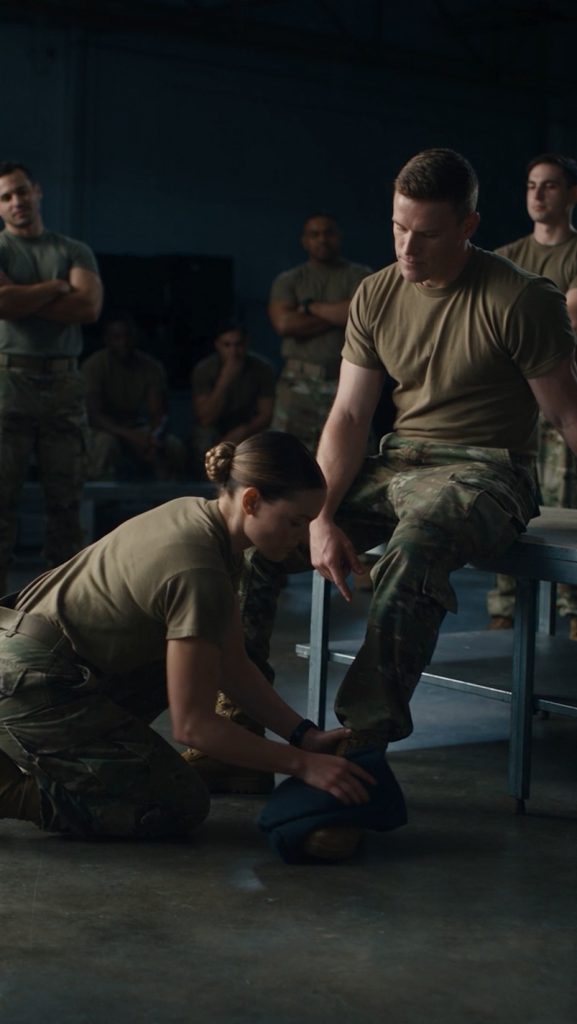
The order cut through the cafeteria, followed by laughter from men already holding up their phones. The young woman looked at the filthy rag near her knees, then at the lieutenant smiling above her—and for the first time all day, something in her expression changed.
Only hours earlier, she had arrived at the Marine base beneath a cold gray morning sky.
Fog clung to the training grounds and curled around the enormous metal hangars. Machinery rumbled somewhere beyond the yard, boots struck wet concrete, and the air carried the sharp smell of motor oil mixed with bitter cafeteria coffee.
With a heavy bag over one shoulder, the young recruit walked through the base without hesitation.
Heads turned almost immediately.
Some Marines exchanged amused looks. Others made no effort to lower their voices.
“Women don’t last long here.”
“Maybe she took a wrong turn.”
She heard them. Her face gave nothing away.
Lieutenant Daniel Harper noticed that.
Tall, broad-shouldered, and hardened by years of command, Harper understood something else too—the platoon was watching him. Waiting to see how he would handle the newcomer.
And Harper had no intention of appearing soft.
From the first training exercise, he stayed on her.
“Move faster.”
“You’re slowing everyone down.”
“Still sure you belong here?”
Each remark was loud enough for the others to hear. Each one carried the same message beneath the words.
You are not one of us.
But she never gave him the reaction he wanted.
She followed instructions. Finished every drill. Spoke only when necessary.
No complaints.
No anger.
No visible humiliation.
Her silence seemed to irritate Harper more than defiance would have.
By lunchtime, the tension surrounding them had become impossible to ignore.
The cafeteria roared with conversation, laughter, scraping chairs, and metal trays striking tables. Marines crowded together beneath harsh overhead lights while the new recruit sat alone near the edge of the room.
She ate quietly.
Then Harper appeared beside her.
His shadow fell across the table.
“Get up,” he said. “Lunch is over. That’s my seat.”
Nearby conversations faded.
The young woman slowly looked up at him.
“I’ll leave when I finish eating,” she replied evenly. “The seats are shared.”
Silence spread across the room.
Harper’s jaw tightened.
For one long second, neither of them moved.
Then he seized her tray.
He slammed it onto the floor.
The crash was violent enough to make several people flinch. Plates shattered against the concrete. Food scattered beneath the tables, and a drink splashed across the polished boots of two nearby Marines.
Then came the laughter.
Someone clapped.
Another Marine whistled.
The young woman stared at the mess.
Her face remained calm, but her fingers tightened once against the edge of the table before she stood.
Without saying a word, she lowered herself to the floor and began gathering the broken pieces with her hands.
Harper watched her.
Satisfied.
He dropped into the seat she had just left and leaned back as though he had won something.
Then he lifted one heavy boot and planted it directly on the table.
A dirty cleaning rag was lying nearby.
Harper picked it up.
For a moment, he turned it slowly in his hand while several Marines began reaching for their phones.
Then he threw it.
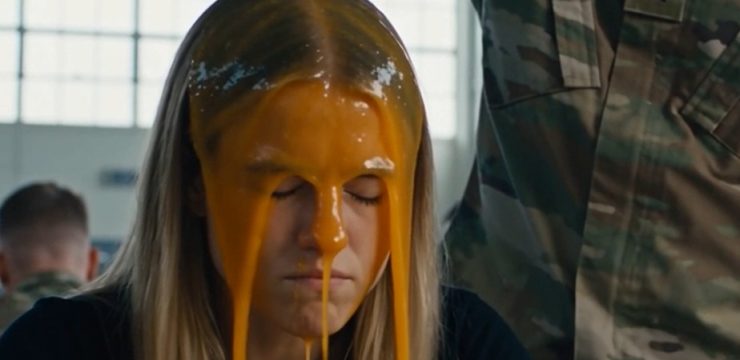
The cloth struck the young woman across the face before falling beside her.
“Wipe my boots,” Harper said.
His voice was low now.
“Know your place.”
The cafeteria erupted again.
Phones rose higher.
Harper smiled as she reached down and picked up the rag.
Slowly, she turned toward him.
For several seconds, she simply stared at the boot resting above her.
No fear.
No embarrassment.
Not anymore.
Her hand moved toward his leg.
Harper’s grin widened.
Then, just before the cloth touched his boot, the young woman stopped—and the entire room seemed to hold its breath.
Nobody in that cafeteria was prepared for what happened next. 👇
The rag never touched the leather.
Her hand stopped an inch from Harper’s boot. Then she lifted her eyes to his face, rose slowly from the floor, and placed the filthy cloth on the table between them.
“No, sir.”
The laughter died so completely that the hum of the ventilation system suddenly sounded enormous.
Harper’s smile vanished. “What did you say?”
“I said no.”
A phone near the back lowered slightly. Another kept recording.
Harper stood so fast that his chair scraped across the concrete. “You think you get to decide which orders you follow?”
The recruit’s breathing remained measured, but the hand at her side had begun to tremble. She closed it into a fist.
“An order to train is an order,” she said. “An order to humiliate me for your entertainment is something else.”
A few faces changed.
Harper stepped closer. “Careful.”
She did not move.
“Or what?”
A voice from behind the crowd cut through the room.
“Lieutenant, step away from her.”
Master Sergeant Cole stood in the cafeteria entrance, rain darkening the shoulders of his uniform. Beside him was Captain Elena Ramirez, the company commander, her eyes moving from the shattered plate to the phones still raised around the room.
Harper’s face lost color.
“Ma’am, this recruit refused a direct—”
“I heard enough from the hallway,” Ramirez said. “Everyone who recorded this, do not delete anything. Everyone who witnessed it remains available for statements.”
Harper gave a dry laugh. “You’re seriously going to make an issue out of a rag?”
The recruit looked at him.
“It was never about the rag.”
Something in her voice made Cole stare.
Harper heard it too.
“What is that supposed to mean?”
The young woman’s gaze shifted toward her heavy bag beneath the far end of the table. Then she looked at Ramirez.
“I need to show you something.”
Harper moved first.
“Enough.”
He reached for her arm.
Cole caught his wrist before he touched her.
“Don’t.”
The recruit knelt beside her bag and pulled a worn brown envelope from an inner pocket. Its edges were soft from being handled too many times.
Harper stared at it.
For the first time, he looked afraid.
“What’s in there?” Ramirez asked.
“Letters my sister wrote three years ago when she was stationed here.”
Nobody moved.
“She was under Lieutenant Harper.”
Harper’s mouth opened.
“She wrote about being singled out. Mocked in front of the unit. Ordered to clean his gear while people watched. Food knocked from her hands. Punishments that weren’t part of training.”
“That’s a lie,” Harper snapped.
Her fingers tightened around the envelope.
“She reported it. Two weeks later, she withdrew the complaint and requested a transfer. My family thought she simply wanted out.” Her voice caught. “She didn’t tell us why until last year.”
Ramirez took the envelope carefully.
Inside were copies of dated letters, a complaint form, and a handwritten statement.
Cole’s jaw tightened as he read over her shoulder.
Harper looked around the cafeteria as if searching for someone who might still laugh with him.
No one did.
Then a Marine at the nearest table stood.
Private Mason—the same man who had clapped when the tray hit the floor—held his phone in both hands.
“He did it to Torres too,” Mason said.
Harper stared at him.
Mason swallowed. “Last month. Made him scrub mud off his truck after midnight because Torres questioned a drill assignment. We all acted like it was funny.”
Across the room, another Marine rose.
Then another.
A corporal near the wall murmured, “There was Reeves.”
Someone else said, “And Carter.”
Names began filling the silence.
Harper’s authority did not collapse with a shout. It disappeared in those names, in the eyes that stopped avoiding him, in the phones no longer aimed at the recruit as though she were the spectacle.
Now they were pointed at him.
Captain Ramirez relieved Harper of duty on the spot pending formal investigation.
He tried to argue.
Then he blamed the recruit.
Then he called the entire thing a misunderstanding.
Each explanation made the room colder.
When military police arrived, Harper’s voice was still loud, but nobody obeyed when he told them to put their phones away.
As he was escorted out, he looked back at the recruit.
“You planned this.”
She held his gaze.
“No,” she said. “You did.”
The doors closed.
For several seconds, nobody spoke.
Then the recruit crouched beside the shattered plate again.
Mason stepped forward.
“I’ve got it.”
She looked up.
His eyes dropped.
“I laughed,” he said. “I shouldn’t have.”
He knelt and began picking up the larger pieces.
One by one, others joined him.
No speeches. No applause.
Just hands reaching for broken things.
The investigation lasted months.
The cafeteria videos led investigators to earlier complaints, messages, witness statements, and incidents that had been dismissed separately but became impossible to ignore together. Harper’s pattern stretched further back than anyone wanted to admit.
He was removed from command and ultimately separated from service after disciplinary proceedings. Several leaders who had ignored earlier warnings were formally disciplined as well.
The recruit’s sister received something she had stopped expecting: an official letter acknowledging that her complaint had been mishandled.
When the recruit brought it home, her sister sat at the kitchen table without opening it for nearly ten minutes.
Finally, she slid one finger beneath the envelope.
Halfway through reading, her hand covered her mouth.
The recruit sat across from her.
Neither spoke.
Then her sister reached across the table and took her hand.
“You shouldn’t have had to carry this back there for me,” she whispered.
“I didn’t.”
Her sister looked up.
“I carried it there for me too.”
Weeks later, Mason found the recruit outside the training yard after morning drills. He held two paper cups of coffee.
“I didn’t know how you take it.”
She accepted one.
“Badly.”
He blinked.
Then she smiled.
It was the first time he had seen her do it.
“I sent the video before Captain Ramirez walked in,” he said.
Her smile faded.
“To who?”
“Cole.”
She stared at him.
Mason rubbed the back of his neck. “When Harper threw your tray, I knew where it was going. I’d seen it before. I laughed because I was scared he’d notice I wasn’t laughing.”
She said nothing.
“I’m not asking you to tell me that was okay,” he added.
“Why send it?”
Mason looked toward the wet training field.
“Because you were the first person I saw tell him no without becoming like him.”
That was the truth she had not expected.
She had believed she came to the base carrying her sister’s courage inside a brown envelope.
She had not realized that, before she ever opened it, her own quiet refusal had already given someone else enough courage to act.
The cafeteria changed in small ways after that.
The seat Harper had claimed as “his” belonged to whoever reached it first. The crude jokes grew rarer, not because everyone suddenly became better, but because someone finally challenged them.
Torres stopped keeping his eyes on the floor.
Mason stopped laughing when he was uncomfortable.
Captain Ramirez created private reporting hours every Friday and made certain complaints no longer disappeared inside closed offices.
And the recruit stayed.
She became stronger, faster, louder when she needed to be.
She did not become hard.
On the morning she completed the final stage of training, fog covered the base exactly as it had on her first day.
Her sister waited beyond the gate.
For a moment, the recruit simply stood there with her bag over one shoulder, looking at her.
Then her sister lifted the old brown envelope.
“I think we’re done carrying this.”
Together, they walked to a metal bin beside the administration building.
They did not burn the letters. They did not destroy them.
The recruit folded them carefully, placed them inside a new envelope marked CLOSED, and handed it to her sister.
Her sister pressed it against her chest.
Evidence once meant proving what had happened.
Now it meant something else too.
They had been believed.
Behind them, the cafeteria doors opened and Mason called her name, holding up a cup of terrible coffee.
She laughed.
Her sister laughed with her.
And beneath a pale morning sun breaking through the last of the fog, they walked toward him together—not as people still waiting for justice, not as women carrying someone else’s shame, but as two sisters finally light enough to go home.