The morgue worker had already seen the boy’s death certificate when he noticed something beneath his hair that made his hand freeze.
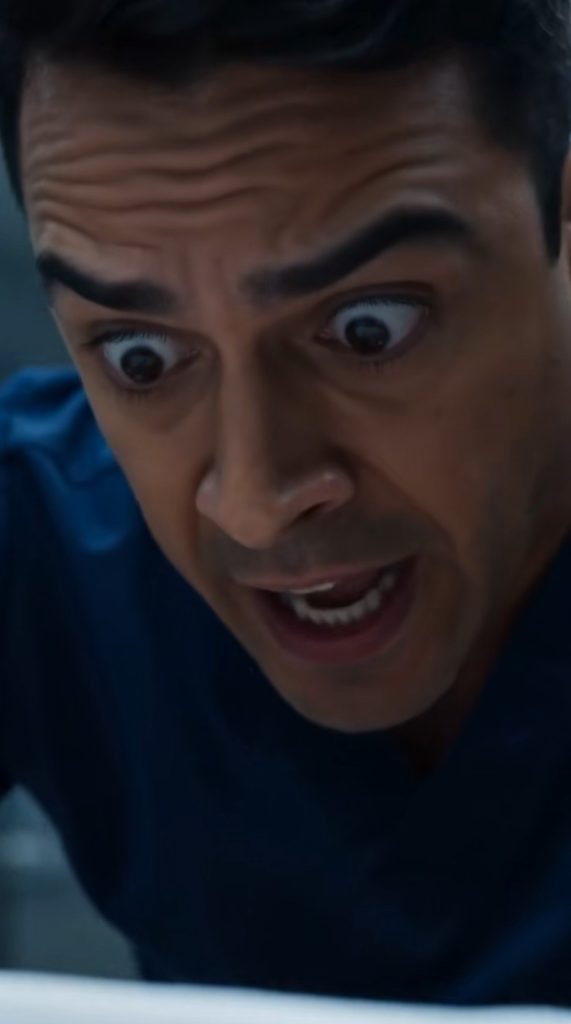
Seconds later, metal trays were crashing to the floor, and he was running through the hospital corridor shouting for a doctor.
Hours earlier, the eight-year-old had been laughing.
Lucas Bennett sat beside his grandmother at a crowded family celebration, eating cake while his cousins argued over who would get the last piece. The room was noisy, warm, ordinary.
Then Lucas suddenly collapsed.
At first, nobody understood what they were seeing. His grandmother screamed his name. Chairs scraped backward. Someone dropped a plate as adults rushed toward the small body lying motionless on the floor.
An ambulance arrived within minutes.
At the hospital, doctors worked desperately to understand why Lucas had deteriorated so quickly. Nearly an hour passed wCreate a short, intriguing title that will pique viewers’ curiosity and encourage them to watch the next scene after seeing it.ith no clear explanation.
Just after midnight, his family received the words no parent is prepared to hear.
Lucas was gone.
Shortly before 2:00 a.m., his body was taken downstairs to the hospital morgue.
Michael Reed, the 48-year-old night worker on duty, received the paperwork in near silence. He had spent years around death. He knew how grief sounded in hallways, how families sometimes lingered because walking away felt too much like accepting what had happened.
Lucas arrived fully clothed beneath a clean white sheet.
His mother had refused to leave the hospital until a nurse gently persuaded her to go upstairs with relatives.
But Lucas’s uncle remained.
He stood beside the stretcher longer than anyone else, staring at the shape beneath the sheet.
Then he turned to Michael.
“Please,” he said quietly. “Be careful around his head.”
Michael frowned.
“Was he injured there?”
The uncle hesitated.
For a moment, something unreadable passed across his face.
“No.”
He swallowed.
“Just… please.”
Then he walked away.
The words stayed with Michael.
For nearly twenty minutes, he tried to ignore them while completing paperwork. Eventually, he approached the examination table.
Under the fluorescent lights, Lucas looked almost peaceful.
Too peaceful.
Michael lowered the sheet enough to see his face. The boy’s skin was pale, but something about it bothered him. There was no obvious wound. Nothing in the medical notes explained the uncle’s strange warning.
He picked up a small penlight.
Carefully, he checked one of Lucas’s eyes.
Nothing unusual.
Michael switched the light off.
Then stopped.
His hand remained suspended in the air.
Something he had just seen didn’t make sense.
He leaned closer.
Slowly, he moved several strands of hair away from the side of Lucas’s head.
Nothing.
At least, nothing obvious.
Michael let the hair fall back and took one step away.
Then his expression changed.
He turned around instantly.
This time, he lifted the same section of hair faster.
And stared.
His breathing grew louder.
“No…”
He blinked hard and looked again.
Whatever was there was tiny. Easy to overlook. But Michael had spent enough years examining bodies to know when something didn’t belong.
His eyes shifted toward Lucas’s torso.
For several seconds, he didn’t move.
Then he pulled the sheet aside and lifted the bottom of the boy’s shirt just enough to see his abdomen.
Michael went completely still.
The color drained from his face.
“I… I don’t believe this.”
His eyes moved from Lucas’s stomach back to the hidden spot beneath his hair.
Once.
Twice.
As though he were desperately searching for another explanation.
There wasn’t one.
Michael staggered backward into a metal trolley.
Trays slammed onto the floor with a violent crash.
He barely noticed.
He tore open the morgue door.
“DOCTOR!”
A nurse at the far end of the corridor spun around.
“GET A DOCTOR DOWN HERE! NOW!”
Footsteps thundered toward him.
Michael stood at the doorway when the doctor entered, pointing toward Lucas without approaching the table again.
The doctor examined what Michael had found.
His expression changed immediately.
“Close the door.”
The nurse obeyed.
Then the doctor looked directly at her, his voice suddenly cold.
“Call security. Don’t let the family leave the hospital.”
Michael stared at him.
“What did somebody do to this child?”
The doctor said nothing.
And in that silence, Michael realized the story written in Lucas Bennett’s medical file was beginning to fall apart.
Nobody outside that morgue was prepared for what came next. 👇
The doctor’s fingers moved to Lucas’s neck.
For three long seconds, nobody breathed.
Then his eyes snapped toward the nurse. “Get the crash team. Now.”
Michael stared at him. “What?”
“I felt something.”
The nurse was already reaching for the wall phone while the doctor pressed two fingers harder beneath Lucas’s jaw, then bent close to the boy’s mouth.
“Very faint pulse,” the doctor said. “He’s alive.”
The words seemed too large for the room.
Michael grabbed the stretcher as the doors burst open and a resuscitation team rushed in. Lucas was wheeled out beneath lights so bright they made his small face look almost transparent. The sheet that had covered him as a body was thrown aside and left crumpled on the morgue floor.
But before leaving, the doctor pointed to the tiny mark hidden beneath Lucas’s hair, then to the faded punctures across his abdomen.
“Photograph those. Don’t touch anything else.”
Upstairs, Lucas’s mother was halfway toward the elevators when two security officers stopped her.
“What are you doing?” she demanded. “My son is dead.”
Lucas’s uncle stood several feet away.
He looked at her, and for the first time that night, he did not look frightened.
“No,” he said. “He isn’t.”
Her face emptied.
The elevator doors opened behind the guards, and Lucas’s stretcher shot past them toward intensive care.
His mother stepped forward, but the uncle caught her expression before she could hide it.
It was not relief.
It was fear.
The doctor returned minutes later carrying the first emergency lab results. Lucas’s breathing was being supported, his heart rhythm was weak but present, and the team had found traces of a powerful sedating medication in his bloodstream—something that had never appeared anywhere in his chart.
The puncture beneath his hair was fresh.
The marks on his abdomen were not.
Some were days old. Some were older.
Michael stood against the corridor wall while the doctor spoke quietly to security. Nobody said the word out loud yet, but it hung between them anyway.
Someone had been dosing Lucas repeatedly.
Then a nurse came from the family waiting room carrying a handbag sealed inside a clear hospital evidence bag.
“She tried to leave this in the restroom,” the nurse said.
Lucas’s mother closed her eyes.
Inside were two capped syringes, a small vial with the label partly peeled away, and alcohol wipes folded into the side pocket.
Lucas’s grandmother covered her mouth.
Security moved toward Lucas’s mother.
She backed away. “Those aren’t his.”
Nobody answered.
“They’re mine.”
The doctor held her gaze. “Then you can explain that to the police.”
Her eyes flashed toward her brother.
That was when something inside him finally broke.
“I saw you,” he said.
She went still.
“At the party. Right before he collapsed.”
His voice trembled, but he kept going.
“You had your arm around him. I thought you were fixing his hair. Then he flinched.” He swallowed. “When I came closer, there was a tiny spot of blood behind his ear.”
Their mother stared at him. “Why didn’t you say something?”
“I didn’t know what I saw.”
His face folded with shame.
“When he died, I thought I had imagined it. So I told the morgue worker to be careful around his head. I wanted somebody else to see it before I accused my own sister of something I couldn’t take back.”
Lucas’s mother lunged toward him.
“You always hated me.”
A security officer caught her arm.
“No,” the uncle whispered. “I trusted you.”
That hurt her more.
She stopped fighting.
The police arrived before dawn.
Under questioning, the story she had protected for months began to collapse. Hospital records showed earlier unexplained episodes—dizziness, vomiting, sudden sleepiness—that had always resolved before anyone found a cause. Pharmacy records and the medication in her bag connected her to the same sedative found in Lucas’s blood.
Then came the truth she had fought hardest to keep buried.
Lucas had started asking questions.
He had told his uncle weeks earlier that his mother sometimes gave him “medicine” when he was not sick. He said it made him too tired to argue and too foggy to remember things clearly. His uncle had assumed the boy was confused about ordinary medication.
He would carry that mistake for a long time.
At the celebration, Lucas had refused her.
He had threatened to tell his grandmother.
So his mother had hidden the injection beneath his hair, believing no one would notice.
She had expected him to sleep.
Instead, his heart had slowed until even trained people believed there was nothing left to save.
When detectives led her away, Lucas’s grandmother did not shout.
She simply sat down in a plastic chair and stared at her own hands.
“I raised her,” she whispered.
Her son knelt in front of her.
“You also helped raise him.”
She looked toward the ICU doors.
That was where she chose to place what remained of her strength.
Lucas stayed unconscious for thirty-six hours.
Michael came to work the next night and avoided the elevators leading to intensive care. Near midnight, the doctor found him beside the morgue desk.
“He opened his eyes.”
Michael’s chair scraped backward.
The doctor smiled for the first time.
“He asked for his grandmother.”
Lucas recovered slowly.
His voice returned before his strength did. For several days, he spoke in whispers. He hated needles. He cried when anyone touched his hair without warning. His uncle learned to ask before sitting on the edge of his bed.
One afternoon, Lucas looked at him and said, “You knew something was wrong.”
His uncle’s eyes filled.
“Not soon enough.”
Lucas studied him, then reached from beneath the blanket and hooked one finger around his uncle’s.
“You told somebody.”
His uncle bowed his head and cried silently beside the bed.
Months later, the evidence left little room for denial. Lucas’s mother was convicted on charges tied to the repeated drugging and the final attempt that nearly killed him. The hospital conducted its own investigation into how a living child had been declared dead, and new procedures were put in place before Lucas returned home.
Michael testified only once.
When he stepped out of the courthouse afterward, Lucas and his grandmother were waiting near the stairs.
Lucas was thinner than Michael remembered.
But he was standing.
For a second, neither of them knew what to say.
Then Lucas walked forward and wrapped both arms around Michael’s waist.
Michael froze.
Slowly, he rested one hand on the back of the boy’s head.
Carefully.
Exactly where he had been asked to be careful.
“I remember your voice,” Lucas murmured.
Michael looked down. “What?”
“In the cold room.”
His grandmother’s eyes widened.
Lucas tightened his arms around him.
“I couldn’t move. I couldn’t open my eyes. But I heard somebody say, ‘No.’ Then I heard things fall. Then you shouted for a doctor.”
Michael’s mouth opened, but nothing came out.
All those months, he had believed he had found Lucas by accident.
Lucas shook his head as if answering the thought.
“I kept trying to wake up when you were there.”
Michael crouched until they were eye level.
“You did.”
Lucas smiled.
It was small and uneven, but alive.
A year after the celebration, the family gathered again in the same house.
Not for an anniversary. Not to replace what had happened.
Just dinner.
Lucas sat beside his grandmother while his cousins argued over the last piece of cake, and for one brief second the room went quiet because everyone remembered another table, another cake, another night.
Lucas noticed.
He rolled his eyes.
“I’m fine.”
His grandmother laughed through tears and pulled him closer anyway.
His uncle stood in the kitchen doorway, watching the boy complain about getting the smaller slice. The guilt had not disappeared, but it no longer owned every room he entered.
There were things the family would never get back.
There were also things they had learned not to postpone.
Apologies. Questions. Believing a child the first time. Saying I love you while the person was still there to hear it.
Outside, evening settled softly against the windows.
Lucas carried his plate to the sink, then turned back and saw his grandmother holding out her hand.
He took it without asking why.
She drew him close, kissed the top of his hair, and this time nobody flinched.
Across the room, his uncle smiled.
And somewhere else in the city, Michael Reed began another quiet night shift knowing that one empty table in his morgue had once held a boy everyone thought was gone.
But Lucas Bennett was home.
Warm light filled the kitchen. His grandmother’s hand rested on his shoulder. His cousins were laughing again.
And for the first time since that terrible night, no one in the house was waiting for something bad to happen.