The laughter followed her all the way to the glass doors.
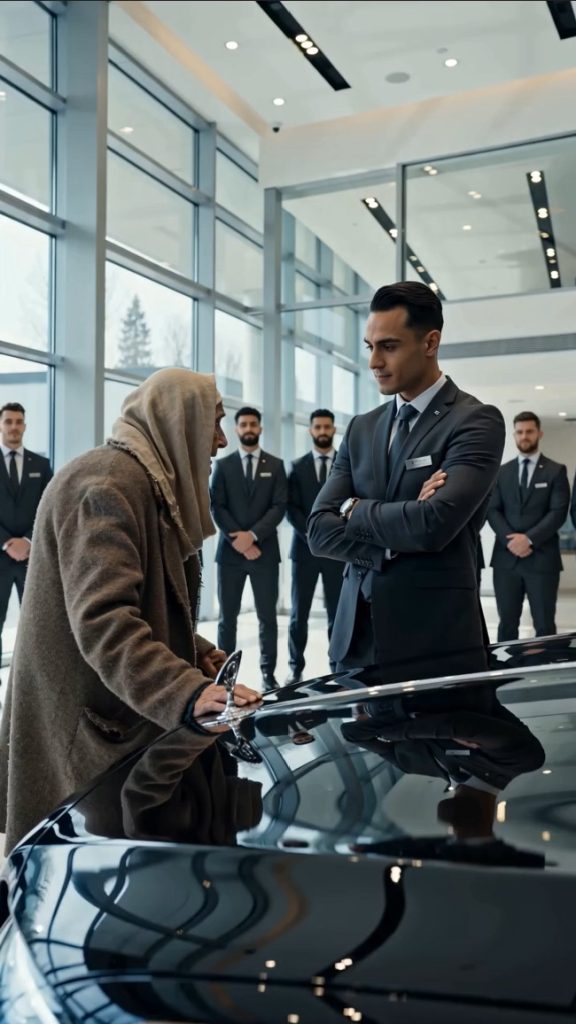
She didn’t argue. She didn’t defend herself. She simply lowered her head and walked out of the luxury dealership while the words “you smell like poverty” hung in the air behind her.
Only minutes later, the people who had laughed would realize the moment wasn’t over.
Earlier, the elderly woman had stepped quietly inside wearing an old, faded coat that looked painfully out of place beneath the showroom’s bright lights.
The air smelled of polished leather, new upholstery, and expensive perfume. Perfectly detailed cars stood beneath the lights like museum pieces, their paint gleaming so brightly she could see fragments of her reflection as she passed.
She hesitated near the entrance.
For a moment, she seemed unsure whether she belonged there.
Then she began walking slowly between the cars, studying each one carefully. Her fingers occasionally brushed the smooth bodywork with almost delicate caution, as though touching something she had only ever seen from a distance.
Across the showroom, the manager noticed her immediately.
He pretended to remain occupied, glancing at paperwork and checking something behind the counter, but his eyes kept returning to her.
The worn coat.
The trembling hands.
The uncertain steps.
Everything about her appearance seemed to irritate him.
Customers who usually entered that dealership arrived dressed sharply, carrying expensive bags or speaking confidently about financing and specifications.
This woman looked nothing like them.
Then she stopped.
In front of her stood an expensive SUV, large and immaculate beneath the showroom lights.
She looked at it for several long seconds.
There was something almost private in the way she studied it. Her hand rested lightly against the vehicle, and for the first time since entering, the uncertainty in her face seemed to disappear.
She turned toward the manager.
“I want to buy this car.”
The words were quiet.
But they were clear.
The manager stared at her for a second before a smirk slowly appeared across his face.
He walked over, folded his arms across his chest, and looked her up and down as though she had just told him a joke.
“And how do you plan to pay?”
The woman lifted her eyes to meet his.
She didn’t answer immediately.
That silence seemed to encourage him.
He stepped closer, lowering his voice just enough to make the cruelty feel personal.
“Ma’am, we don’t do business with retirees. Not even on installments.”
His expression barely changed.
“You simply won’t live long enough.”
The elderly woman’s face stiffened.
Still, she said nothing.
Then the manager leaned slightly toward her.
“And besides…”
He paused, looking at her worn clothes with open disgust.
“You should go home and take a bath first.”
Another pause.
“You smell like poverty.”
A quiet laugh escaped from somewhere behind them.
Then another.
Within seconds, several people in the showroom were laughing.
The woman seemed to become smaller beneath the sound.
Her fingers slipped away from the SUV.
She looked down at the polished floor, her hands trembling faintly at her sides.
No anger.
No shouting.
No desperate attempt to prove herself.
She simply turned toward the exit.
Each step toward the glass doors seemed heavier than the last, but she never looked back.
Behind her, the manager remained standing beside the expensive SUV, still wearing the satisfied expression of someone convinced he had put an unwanted visitor back in her place.
The doors opened.
The elderly woman stepped outside.
Then they closed behind her.
For a few moments, the dealership returned to normal.
Conversations resumed.
Someone laughed one final time.
The manager straightened his jacket and walked back toward his desk as though nothing important had happened.
As though the humiliation he had just delivered would disappear the moment that woman vanished from sight.
But it didn’t.
Because only a short time later, something happened inside that showroom that wiped the smile from his face.
And nobody there was prepared for what came next. 👇
A phone began ringing before the manager reached his desk.
He almost ignored it. Then he saw the private number flashing on the screen and answered with the polished voice he used for wealthy customers. “Good afternoon.”
The voice on the other end said only one thing at first.
“Is Mrs. Bennett still there?”
The manager’s smile faded.
He glanced toward the glass doors. Outside, the elderly woman stood beneath the gray afternoon sky, one hand gripping the lapel of her old coat.
“I’m sorry,” he said carefully. “Who?”
A pause.
Then the caller’s tone hardened. “Eleanor Bennett. She had an appointment at three. She was coming to purchase the black SUV and sign the ownership documents.”
The manager stopped breathing for a beat.
“Ownership documents?”
The front doors opened again before the caller could answer.
The elderly woman stepped back inside.
This time, she wasn’t alone.
A silver-haired man in a dark suit walked beside her. Two executives followed several steps behind, their expressions so controlled that the silence around them felt heavier than shouting.
The manager lowered the phone.
The silver-haired man looked at him, then at Eleanor.
“Mrs. Bennett,” he said softly, “I’m deeply sorry.”
The manager’s eyes darted from face to face. “Sir, I think there’s been some misunderstanding.”
Eleanor looked at him for the first time since leaving.
There was no triumph in her face. That frightened him more.
The silver-haired man set a leather folder on the nearest desk. “There’s no misunderstanding. Mrs. Bennett is the majority owner of this dealership group.”
A chair scraped somewhere behind them.
The manager’s lips parted.
Eleanor tightened her fingers around the cuff of her coat. “I didn’t come here to inspect anyone,” she said. “I came to buy a car.”
Her voice trembled slightly.
“I haven’t driven much since my husband died. Today was the first day I thought I could.”
The room changed.
The cruelty that had seemed funny minutes earlier now sat exposed beneath the showroom lights.
The manager swallowed. “Mrs. Bennett, if I had known—”
“That is the problem.”
He stopped.
“If you had known who I was,” she continued, “you would have treated me differently.”
She took one slow step closer. “So I need to know something before anyone decides what happens to you. Was I the first person?”
No one answered.
Then a young receptionist near the service corridor raised her hand halfway.
“No,” she whispered.
The manager turned sharply. “Maya.”
She flinched.
Eleanor saw it.
Maya unlocked her phone with shaking hands. “There were complaints. People said they were ignored because of their clothes, their age, their accents. Some were told there were no appointments even when there were.”
“Enough,” the manager snapped.
The silver-haired man stepped between them. “Let her finish.”
Maya swallowed. “He told us those customers wasted time. He said we should focus on people who looked like they could afford the cars. When I complained, he said there were ten people waiting for my job.”
Another salesman walked forward and placed a printed email beside the leather folder.
“We kept copies,” he said.
The manager stared at the papers.
The evidence was simple. Complaints. Messages. Instructions in his own words. Months of small humiliations, now gathered in one place where they could no longer be dismissed.
The silver-haired executive opened the folder.
“Your employment is terminated effective immediately.”
The manager looked at Eleanor.
“Please. I made a mistake.”
“No.” Her voice remained gentle. “A mistake is forgetting a name. You made a choice. Then you made it again with people whose names I’ll never know.”
His mouth trembled.
“I have a family.”
Something in Eleanor’s face softened, but she did not look away.
“So did the people you humiliated.”
Security appeared at the edge of the showroom.
The manager looked around, searching for one friendly face.
Nobody moved.
Even the customers who had laughed lowered their eyes.
He removed his badge with unsteady fingers and placed it on the desk.
The plastic clicked softly against the glass.
As security escorted him toward the doors, Eleanor spoke once more.
“Don’t mock him.”
Everyone looked at her.
“No one learns dignity by being denied it.”
The doors closed behind him.
For several seconds, the dealership was silent.
Then Maya covered her mouth and began to cry.
Eleanor crossed the room.
“I should have said something,” Maya whispered. “I wanted to. I just…”
“You were afraid.”
Maya nodded.
“Next time,” Eleanor said, touching her wrist, “be afraid and speak anyway.”
It wasn’t absolution.
It was a chance.
The investigation did not end with one dismissal. Complaints were reopened. Customers who had been turned away received apologies. Employees were interviewed without managers present, and new rules made it impossible for one person to bury a complaint because someone did not look profitable.
Three weeks later, Eleanor returned to the showroom on a bright morning washed clean by overnight rain.
The black SUV was still there.
Maya met her beside it with the paperwork.
“Would you still like to buy this car?”
Eleanor ran her fingertips across the door exactly as she had the first time.
For a moment, she couldn’t answer.
Then she smiled.
“Yes.”
Maya noticed Eleanor looking down at the sleeve of her old coat.
“I hope you don’t mind me asking,” she said carefully. “Why that coat?”
Eleanor opened it slightly and showed her the faded stitching inside.
A name was sewn there.
Thomas Bennett.
“My husband wore this when we had nothing,” Eleanor said.
She looked across the gleaming showroom.
“Before there were polished floors. Before there was a dealership, Thomas repaired cars in a two-bay garage that leaked whenever it rained.”
Her thumb moved over the worn fabric.
“He came home every night smelling like engine oil and metal. We saved for years. He sold his tools once to make payroll and never told me.”
Maya’s eyes filled.
Eleanor gave a small, fragile laugh.
“Yesterday would have been our fifty-second anniversary.”
The truth settled quietly between them.
The coat the manager had looked at with disgust was not evidence of poverty.
It was where everything had begun.
Eleanor had worn it because she had been terrified to walk into the business without the man who built it beside her.
Her trembling hands had not been weakness.
They had been grief.
And the SUV was not a status symbol.
Thomas had wanted them to take one last long road trip together. He died before they could.
“So I thought,” Eleanor said, brushing away a tear, “maybe I could take the trip anyway.”
Maya looked down at the keys in her palm, then held them out.
Eleanor stared at them before closing her hand around them.
Months later, a photograph appeared in the employee lounge.
It showed Eleanor beside the black SUV on a quiet coastal road, wind lifting her silver hair, Thomas’s old coat around her shoulders.
Underneath it was a handwritten note.
Treat every person who walks through these doors as if their story matters, because it does.
Years passed, and Maya eventually became the dealership’s general manager.
On her first day, Eleanor came to see her.
There were no executives this time. No legal folders. No frightened silence.
Just two women standing near the same display where everything had once broken open.
Maya smiled nervously. “I still think about that day.”
“So do I.”
“I wish I had been braver.”
Eleanor reached for her hand.
“You became braver. That matters more.”
Before leaving, Eleanor handed her a small box.
Inside was the old dealership badge Thomas had worn when he opened his first garage.
Maya looked up, stunned. “I can’t take this.”
“Yes, you can.”
“But it belongs to your family.”
Eleanor smiled.
“It belongs wherever people remember what the place was built for.”
Outside, the late sun turned the showroom windows gold.
Eleanor walked toward her SUV, slower now, but steady. She opened the driver’s door and paused.
The old coat was folded carefully across the passenger seat.
For fifty-two years, that seat had belonged to Thomas.
Now it held the thing that still carried the warmth of his memory.
Eleanor rested her hand on the coat for a moment.
Then she smiled, started the engine, and drove toward the open road as the evening light filled the empty seat beside her—not with absence anymore, but with home.